
What makes a reliable hydrogen dispenser unit exporter for your project?




What Makes a Reliable Hydrogen Dispenser Unit Exporter for Your Project?
Selecting a hydrogen dispenser unit exporter is not the same as buying a conventional fuel dispenser from an overseas catalogue. A hydrogen dispenser sits at the final, highly visible point of a much larger high-pressure system, but it is also where several project risks converge: vehicle compatibility, fueling protocol control, leak prevention, emergency shutdown logic, metering integrity, user safety, and station availability.
For a project manager, the central question is rarely “Who can ship a dispenser?” The more useful question is: who can deliver equipment that will integrate correctly with the compressor, cascade storage, cooling package, control system, civil works, local approval process, and future maintenance plan? A reliable hydrogen dispenser unit exporter should be able to answer that question with drawings, engineering assumptions, traceable documentation, and realistic limits—not broad assurances.
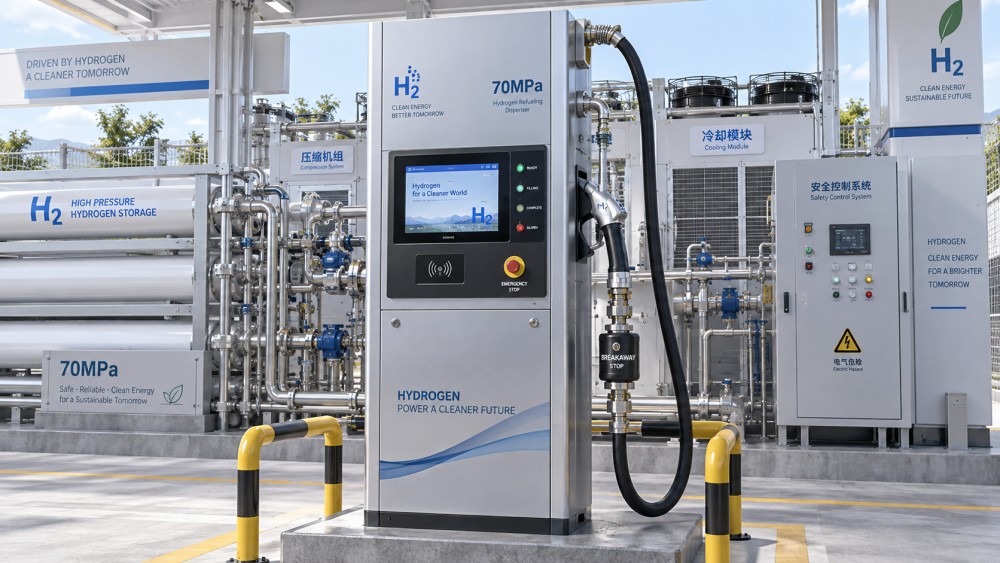
This matters especially for 70 MPa-class passenger-vehicle stations, where small deviations in temperature control, communication logic, hose selection, or breakaway configuration can create commissioning delays. The same discipline applies to 35 MPa fleet applications, though the operational profile, duty cycle, and vehicle interface may differ. In both cases, the dispenser must be assessed as part of a station architecture rather than as an isolated cabinet.
Start with system responsibility, not the equipment brochure
A credible exporter will define exactly where its scope begins and ends. That sounds basic, yet unclear boundaries are a common source of disputes during installation. The dispenser supplier may provide the cabinet, nozzle, hose, local control hardware, display, and safety devices, while another contractor is responsible for upstream piping, cooling, compression, station PLC integration, foundations, electrical works, or hazardous-area installation. If these interfaces are not documented early, the project team can be left resolving incompatible signals, fittings, cable routes, or pressure-control expectations on site.
Ask for an interface matrix before placing an order. It should identify upstream design pressure, inlet conditions, hydrogen quality assumptions, communication protocols, electrical supply, earthing requirements, emergency-stop interfaces, vent routing responsibilities, and the party responsible for final integrated testing. A supplier that treats these questions as “site details to be decided later” may be underestimating the work required for a safe startup.
In complex hydrogen infrastructure programs, the dispenser is connected to decisions made much earlier in the value chain. Hydrogen produced by PEM or alkaline electrolysis, delivered as compressed gas or prepared through cryogenic liquid-hydrogen logistics, still has to reach the vehicle under tightly controlled conditions. Technical benchmarking platforms such as the Global Hydrogen-Economy & Zero-Carbon Infrastructure (G-HEI) are useful in this context because they keep the focus on material integrity, pressure management, and cross-system compliance rather than treating refueling hardware as a standalone purchase.
Standards alignment must be specific and project-relevant
Standards are often listed prominently in proposals, but a list of standard names is not proof that the supplied configuration fits the project. The buyer should ask how each relevant standard is applied to the actual dispenser package, its interfaces, and its test documentation.
For hydrogen refueling stations, ISO 19880 is commonly referenced for gaseous hydrogen fueling station safety and performance considerations. SAE J2601 is widely associated with hydrogen fueling protocols for light-duty vehicles and becomes particularly important where vehicle fueling performance and communication are part of the design basis. ASME B31.12 may be relevant to hydrogen piping and pipeline systems, although its applicability must be reviewed against the project’s piping scope, jurisdiction, and engineering design. Local building codes, pressure-equipment rules, electrical regulations, hazardous-area requirements, and authority having jurisdiction requirements can be equally decisive.
A reliable exporter does not casually promise universal compliance. Instead, it should state which requirements are included in the base design, which must be verified by the local engineering contractor, and which documents can be supplied for review. Useful evidence may include component data sheets, pressure-test records, material traceability where applicable, hazardous-area documentation for supplied equipment, functional test procedures, calibration information, and as-built wiring diagrams. The exact package varies by station design and local regulation, but the discipline should be visible.
Look beyond pressure rating: fueling control is where reliability becomes visible
It is easy to compare units by their headline pressure rating and nozzle count. Those details matter, but they do not tell the whole operational story. A dispenser may be designed for high-pressure service while still depending on upstream cooling capacity, storage sequencing, and control logic that have not been properly matched to the expected vehicle throughput.
The practical questions are more revealing. How does the dispenser communicate with the station control system? What happens if communication is interrupted during a fill? How are abnormal temperature, pressure, gas detection, nozzle connection, hose breakaway, or emergency-stop events handled? Can diagnostic information be exported in a form that the project’s operating team can use? Does the supplier distinguish between a demonstration station with modest daily demand and a fleet station expected to refuel vehicles repeatedly within narrow operating windows?
For 70 MPa fueling, protocol execution, pre-cooling availability, and accurate pressure-temperature compensation are not optional niceties. They affect whether a vehicle receives an appropriate fill without unnecessary interruption. The exporter should be prepared to explain the assumptions behind dispenser flow capacity, fueling sequence, communication hardware, and compatibility with the intended vehicle population. If the answer remains limited to “70 MPa supported,” the engineering review is incomplete.
Material choices and component traceability deserve a closer review
Hydrogen service is unforgiving of vague material specifications. The concern is not simply whether a component looks industrial-grade; it is whether wetted materials, seals, valves, tubing, fittings, and connections are suitable for their pressure range, temperature exposure, cycling conditions, and hydrogen-service environment. The final assessment belongs with qualified engineering and applicable codes, but the exporter should make the underlying component selection transparent.
Project teams should request a bill of materials or at least a component schedule for critical items. It should identify the manufacturer and model of key valves, breakaways, nozzles, hoses, meters, transmitters, safety relief devices, and control components. This is not procurement bureaucracy. When a station is down because a specific component needs replacement, vague descriptions such as “equivalent imported valve” are of little help.
Traceability also supports future modification. Hydrogen projects evolve: a single dispenser may later be connected to additional storage, a larger compressor, a fleet-management platform, or a different vehicle mix. If the original design records are incomplete, even a modest upgrade can trigger avoidable re-engineering.
Factory testing should resemble the real project, not a showroom demonstration
A factory acceptance test is one of the best opportunities to expose problems before equipment crosses a border. The exporter should provide a proposed FAT procedure early enough for the buyer and engineering team to comment on it. A meaningful procedure covers more than powering up a screen and opening a valve. It should address control sequences, alarm behavior, emergency shutdown actions, signal exchange, leak-test approach, instrument checks, display operation, and documentation review.
Not every function can be fully replicated at the factory, particularly when integrated fueling depends on upstream packages supplied by others. That limitation should be acknowledged, not hidden. Where full simulation is impractical, define what will be checked at FAT and what must be verified later during site acceptance testing and integrated commissioning. This separation protects both sides from the unrealistic expectation that a dispenser can prove whole-station performance on its own.
It is also worth agreeing on document handover before shipment. A rushed project often discovers too late that operating manuals, wiring drawings, spare-parts lists, test records, software backup files, and recommended maintenance schedules are scattered across emails. A professional exporter treats the document package as a deliverable, not an afterthought.
Export capability is tested by packaging, customs support, and site response
An exporter may build sound equipment but still create project risk through poor logistics planning. Hydrogen dispensers contain sensitive instrumentation, control panels, display components, precision fittings, and sometimes long-lead spare parts. Packaging must protect these items against vibration, moisture, handling damage, and prolonged storage at port or site. The buyer should confirm shipment dimensions, lifting points, package weights, preservation requirements, and any limits on outdoor storage.
Customs documentation needs the same attention. The exporter should be able to provide a clear packing list, commercial invoice, country-of-origin information where required, and technical descriptions consistent with the contract. The project’s logistics partner will still manage local import formalities, but unclear product descriptions or incomplete shipping records can delay equipment that is already on a critical path.
After delivery, responsiveness becomes more important than presentation quality. Ask who will support installation questions, whether remote commissioning is available, what time-zone coverage is realistic, and how software access is controlled. If onsite assistance is required, clarify whether it is included, optional, or subject to travel and local work-permit constraints. There is no universal service model; the issue is whether the model matches the project’s risk profile.
Evaluate lifecycle support before negotiating the final price
The lowest equipment price can become expensive if the project has no plan for consumables, calibration, component replacement, or control-system support. A dispenser is not maintenance-free simply because it has few moving parts visible to the user. Hoses, seals, nozzle components, sensors, filters where used, displays, and electronic control elements all require an operating strategy.
A useful proposal identifies recommended commissioning spares, two-year operational spares where appropriate, critical long-lead items, and parts that can be sourced locally only with prior approval. Project managers should also ask whether replacement parts are proprietary, whether firmware changes require supplier intervention, and whether the operator can access fault histories without compromising safety settings or warranty conditions.
Be cautious with generic uptime promises. Station availability depends on hydrogen supply, compression, storage, cooling, site utilities, network connectivity, vehicle behavior, and operator response—not only the dispenser. A better sign of maturity is an exporter that explains its own support obligations clearly while recognizing the dependencies outside its control.
Questions that expose whether an exporter is ready for a serious project
- What station configuration, inlet pressure range, cooling arrangement, and vehicle application has the quoted dispenser been designed around?
- Which requirements of ISO 19880, SAE J2601, ASME B31.12, and local rules are within the supplier’s scope, and which remain with the EPC contractor or owner?
- Can the supplier provide a detailed interface list, GA drawing, P&ID contribution, wiring diagram, and control-signal definition before manufacture?
- What critical components are used, and what traceability or manufacturer documentation can be supplied?
- What will be witnessed during FAT, what remains for SAT, and who signs off each stage?
- What spare parts, remote support, training, and escalation route are available after handover?
The quality of the answers matters as much as the answers themselves. A dependable hydrogen dispenser unit exporter will usually ask for information in return: vehicle type, target fills per day, station layout, ambient conditions, grid supply, local regulations, communications architecture, and commissioning responsibilities. That is not sales friction. It is evidence that the supplier understands the dispenser’s place in a high-pressure hydrogen system.
Choose the partner that reduces uncertainty
For hydrogen infrastructure, procurement discipline is part of technical risk management. The strongest exporter is not necessarily the one with the longest feature list or the fastest informal delivery promise. It is the one that can convert your project assumptions into a controlled equipment scope, identify unresolved interfaces early, support standards-based review, and remain available when the station moves from shipment to commissioning.
Before issuing a purchase order, hold a technical clarification meeting with the exporter, EPC team, safety lead, and future operator. Review the process conditions line by line, agree the acceptance boundaries, and record open items with owners and deadlines. In a hydrogen refueling project, that meeting often prevents more delay than another round of price negotiation.
Related News
- UK Hydrogen Refuelling Developer Element 2 Enters Administration, Business Put Up for SaleNov 09, 2026Element 2 enters administration, putting its UK hydrogen refuelling business up for sale. Explore potential risks for suppliers, buyers and infrastructure projects.
- What does ISO 19880-2 require for hydrogen refueling dispensers?Oct 22, 2026Hydrogen refueling stations ISO 19880: explore ISO 19880-2 dispenser safety, pressure integrity, and verification evidence to assess supplier claims and make confident buying decisions.
- Hydrogen Dispenser Certifications: Which Standards Apply to 70 MPa Retail Stations?Oct 09, 2026Hydrogen dispenser certifications for 70 MPa retail stations: explore ISO 19880, SAE J2601, pressure equipment, hazardous-area and metering requirements.
- What certification is required before an H2 dispenser enters service?Oct 18, 2026H2 dispenser certification: discover the approvals, safety tests, commissioning evidence, and metrology checks needed before a hydrogen dispenser enters service.
Related News
- 00
0000-00
Hydrogen Energy Storage for Data Centers Gets Costly Fast - 00
0000-00
When 99.999% Hydrogen Purity Still Is Not Good Enough - 00
0000-00
When Does a Hydrogen-Ready Gas Turbine Pay Off? - 00
0000-00
Electricity Price Volatility Is Rewriting Hydrogen Cost Models - 00
0000-00
PSA Recovery Rate Drops for Reasons Operators Miss
Dr. Victor Gear
Weekly Insights
Stay ahead with our curated technology reports delivered every Monday.