When does a hydrogen steelmaking retrofit make operational sense?




A hydrogen steelmaking retrofit makes operational sense when the existing plant can absorb a change in reductant, fuel, gas handling, and maintenance practice without creating an unmanageable constraint elsewhere in the production route. Hydrogen availability alone is insufficient. The practical question is whether the site can receive, condition, distribute, and safely consume hydrogen while preserving a stable feed to downstream melting, casting, and finishing operations.
The strongest retrofit candidates usually have identifiable equipment bottlenecks, a defined decarbonization boundary, and enough outage flexibility to install new systems in stages. A direct-reduction shaft furnace, a natural-gas reformer-based reducing-gas circuit, an electric arc furnace feed system, or selected reheating furnaces may provide a more realistic conversion point than an integrated replacement of every ironmaking asset. The scope must be tied to the metallurgy of the product mix. Flat products, long products, high-strength grades, and specialty steels can impose different tolerance limits on residual elements, gangue carryover, metallization, and thermal history.
Start with the existing process route
A retrofit should begin with a mass and energy balance for the actual operating envelope, rather than a nameplate design basis. Iron ore quality, pellet chemistry, lump ore fraction, moisture, gangue content, flux demand, reductant composition, furnace pressure, and recycle-gas behavior all affect whether hydrogen can replace part or all of the current reducing gas. In a direct-reduction route, hydrogen reduction produces water vapor rather than carbon dioxide. That changes the top-gas composition, dew-point control requirements, recycle-gas treatment duty, and the available sensible heat in the gas loop.
Where a shaft furnace currently operates on reformed natural gas, an early-stage conversion may retain a mixed reducing-gas strategy. This can reduce the size of the first hydrogen supply buildout and allow operating teams to establish stable heat and mass-transfer behavior before moving toward higher hydrogen fractions. The relevant constraint is not simply hydrogen volume. It is the relationship between gas temperature, hydrogen-to-water-vapor ratio, residence time, burden permeability, and the degree of metallization required by the downstream melt shop.
Hydrogen reduction can require a different thermal approach because the reaction absorbs heat. If preheating, gas reforming, electrical heating, or hot-gas recycle cannot maintain the necessary temperature profile through the reduction zone, productivity may fall or material quality may become inconsistent. A retrofit is operationally credible only when this heat deficit has a defined engineering response and the response can be operated through expected variations in ore feed and hydrogen supply.
For blast-furnace assets, hydrogen injection may be technically considered as one component of burden and tuyere practice, but it should not be treated as equivalent to converting a gas-based direct-reduction plant. Coke still performs structural, thermal, and chemical functions in the furnace. The required changes may extend to raceway conditions, blast temperature, moisture control, burden distribution, pulverized-coal practice, top-gas treatment, and hot-metal chemistry. A limited injection project and a full hydrogen-based ironmaking transition therefore have materially different risk profiles.
Hydrogen supply must match the operating rhythm
Steelmaking consumes energy continuously while electricity supply, electrolyzer output, and hydrogen deliveries may vary. The retrofit becomes difficult when hydrogen production follows a variable power profile but the reduction furnace has no practical buffer. Reducing gas composition, pressure, and temperature cannot swing freely without consequences for furnace stability. The supply concept should identify the firm hydrogen quantity available during normal production, during maintenance, and during periods of constrained electrical input.
On-site electrolysis can reduce transport exposure, but it introduces a close coupling between power quality, water treatment, electrolyzer availability, compression, purification, storage, and the steel plant’s gas demand. Grid-connected supply may need a firm power arrangement, curtailment logic, and clear limits on when the plant may switch to stored hydrogen or an alternative reductant. Delivered hydrogen can simplify some site utilities while placing greater emphasis on delivery pressure, unloading capacity, trailer circulation, pipeline nominations, and receiving-station reliability.
Storage is often where a concept moves from attractive to operationally workable. A small buffer may smooth compressor cycling but cannot protect a furnace through a prolonged supply interruption. Larger compressed-gas storage requires substantial plot area, pressure-control equipment, separation distances, emergency isolation, inspection access, and a defined depressurization philosophy. Liquid hydrogen can change the logistics model, yet it adds cryogenic handling, boil-off management, vaporization capacity, and specific material and operating requirements. The appropriate storage duration should follow from the restart behavior of the ironmaking unit and the credible duration of supply interruptions, not from a generic autonomy target.
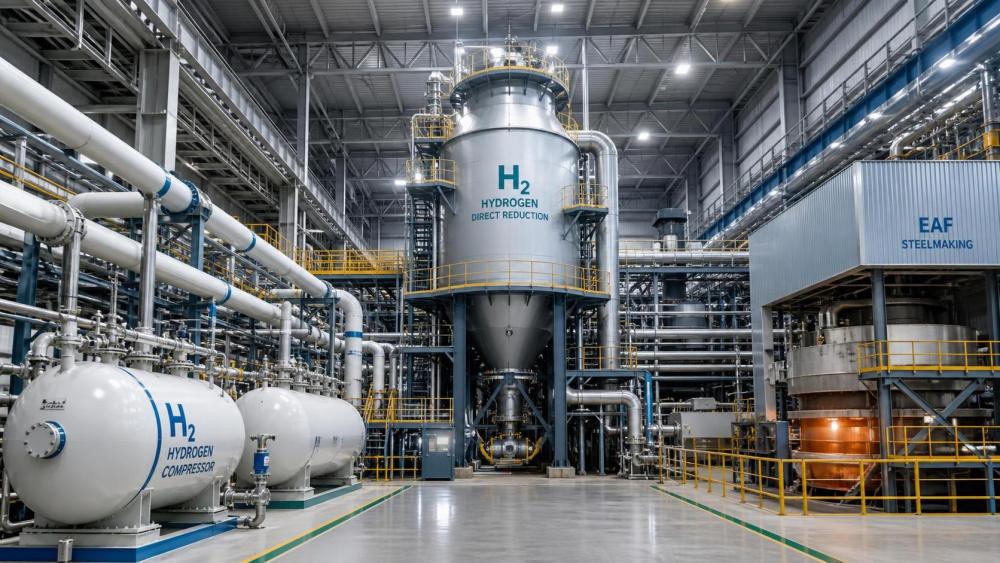
The hydrogen quality specification should also be written around the consuming equipment. Moisture, oxygen, nitrogen, sulfur compounds, compressor lubricants, particulates, and carryover from purification equipment can affect process control, catalyst life, instrumentation, and corrosion behavior. Sampling points need to represent the gas actually entering the furnace or burner train, rather than only the outlet of a production unit. A specification that is technically clean at one battery limit may become unreliable after blending, compression, storage, or long distribution piping.
Convert the gas network, not just the furnace
Existing natural-gas infrastructure cannot automatically be declared hydrogen-ready. The assessment should cover pipe material, weld records, fitting types, valves, gaskets, regulators, flexible connections, meters, analyzers, vents, drain points, and isolation arrangements. Hydrogen’s small molecule increases the importance of leak tightness, while high-pressure service can raise concerns about material compatibility and hydrogen-assisted cracking in some steels and welded areas. The correct response depends on pressure, temperature, cycling, material condition, fabrication history, and applicable design requirements.
Many retrofit studies underestimate interfaces around the gas network. A hydrogen distribution header may require new pressure-reduction stages, redundant control valves, flame arresting or purge arrangements where applicable, relief routing, vent-stack location, and emergency shutdown logic. Pipe supports, expansion allowances, access routes, electrical classification boundaries, and firewater coverage can become construction-critical even when the process line diagram appears straightforward.
Instrumentation should be designed for hydrogen service rather than transferred unchanged from natural gas duty. Gas analyzers must respond accurately to the expected composition range. Flow metering needs sufficient turndown for ramp-up, recirculation, and low-load conditions. Pressure transmitters, valve position feedback, gas detection, and furnace control loops should be reviewed together because a delayed signal or unsuitable range can create unstable transitions. Functional safety studies should define loss-of-power, loss-of-instrument-air, compressor trip, analyzer failure, gas-detection alarm, and emergency depressurization responses before detailed controls are frozen.
Plan construction around production continuity
A hydrogen steelmaking retrofit often fails commercially when the physical installation sequence is separated from the production schedule. Tie-ins to headers, electrical substations, cooling-water circuits, process-control networks, and furnace ducts may require shutdown windows that are scarce or tightly controlled. Long-lead items such as compressors, electrolyzer packages, high-pressure valves, specialized heat exchangers, electrical transformers, and analyzers should be linked to the outage plan at the earliest procurement stage.
Modularization can reduce site work, but only where transportation dimensions, lifting capacity, foundations, access roads, and final tie-in tolerances have been confirmed. Skid-mounted compression or purification equipment still requires pipe stress review, drainage, earthing, ventilation, maintainable clearances, and suitable interfaces with permanent plant utilities. Factory testing is valuable, yet it does not replace site commissioning of the complete gas, electrical, control, and safeguarding sequence.
Commissioning should progress through defined operating states. Initial inerting and leak testing establish mechanical integrity. Controlled introduction of hydrogen verifies purging, detection, isolation, and venting arrangements. Cold circulation can validate pressure control and analyzer response before the furnace sees a changed gas composition. Hot trials should begin with bounded operating conditions and clear stop criteria. The team needs a written method for returning to the established fuel or reductant arrangement if process stability is not achieved during the planned window.
Maintenance and safety changes are part of the operating model
Hydrogen service changes routine work as well as major process equipment. Isolation procedures, permit boundaries, gas testing, ventilation verification, purging, line breaking, confined-space entry, and emergency response need to reflect the new hazard profile. A valve that was routinely serviced in natural-gas duty may require different isolation, venting, or confirmation steps when connected to a hydrogen header. Maintenance planning should identify components exposed to pressure cycling, seals with expected wear, detector calibration intervals, compressor maintenance requirements, and the access needed to inspect critical joints.
Detection coverage should be based on credible accumulation locations, including roof spaces, enclosed pipe racks, compressor enclosures, trenches where other gases may collect, and poorly ventilated process buildings. Detector location must account for airflow, obstructions, maintenance access, and alarm response time. A detector network without a defined response matrix can produce nuisance alarms or delayed isolation. The same applies to emergency shutdown: stopping hydrogen flow, tripping compressors, isolating electrical equipment, opening vents, and protecting the furnace must occur in a sequence that avoids creating a separate process upset.
Measure economics at the production boundary
Lifecycle economics should compare complete operating cases, not only the cost of hydrogen against the cost of natural gas or coal. Relevant items include power demand, water treatment, hydrogen compression, storage losses, replacement of burners or process gas equipment, electrical reinforcement, maintenance labor, consumables, planned downtime, reduced throughput during ramp-up, and changes in downstream melting energy. If carbon-management obligations, product requirements, or contractual emissions boundaries apply, they should be stated explicitly in the model rather than assumed to favor the retrofit.
A useful decision gate is whether the plant can maintain an acceptable production plan under conservative assumptions for hydrogen availability, electricity cost exposure, equipment availability, and commissioning duration. Sensitivity analysis should test the variables that materially affect the route: ore quality, metallization target, gas recycle performance, storage capacity, compressor availability, and the timing of outages. A favorable base case with no response to supply interruption is not an operational case.
The retrofit is ready to proceed when the process route has a defendable heat and mass balance, hydrogen supply has a firm operating basis, the gas system has been assessed down to materials and controls, and installation can be sequenced without relying on undefined shutdown time. At that point, decarbonization intent has been translated into equipment duties, operating limits, and recoverable project risks.
Related News
- When does a hydrogen steelmaking retrofit make operational sense?Sep 06, 2026Hydrogen steelmaking retrofit: discover the operational conditions, gas-network upgrades, supply strategy, safety controls, and economics needed for a practical, production-ready transition.
- How Hydrogen Ignition Control Reduces Flashback Risk in Direct BurnersAug 13, 2026Hydrogen ignition control helps reduce flashback risk in direct burners by improving timing, mixing, and flame stability—keeping hydrogen combustion safer, cleaner, and more reliable.
- Industrial Hydrogen Solutions for Refineries: Cost Priorities and Retrofit OptionsJul 13, 2026Industrial hydrogen solutions for refineries: compare cost priorities, retrofit paths, and low-carbon options to improve resilience, compliance, and long-term refinery value.
- When to Hire Refinery Decarbonization Consultants for Scope, Cost, and ComplianceJul 12, 2026Refinery decarbonization consultants help buyers define scope, control retrofit costs, and improve compliance readiness. Learn the best time to hire for stronger refinery project decisions.
Related News
- 00
0000-00
Hydrogen Energy Storage for Data Centers Gets Costly Fast - 00
0000-00
When 99.999% Hydrogen Purity Still Is Not Good Enough - 00
0000-00
When Does a Hydrogen-Ready Gas Turbine Pay Off? - 00
0000-00
Electricity Price Volatility Is Rewriting Hydrogen Cost Models - 00
0000-00
PSA Recovery Rate Drops for Reasons Operators Miss
Dr. Hideo Torque
Weekly Insights
Stay ahead with our curated technology reports delivered every Monday.