



Hydrogen blending pressure is a decisive operating variable for gas turbine combustion stability, influencing flame speed, flashback risk, emissions, and load-following performance in hydrogen-ready power assets.
For technical evaluators, pressure must be assessed alongside hydrogen fraction, combustor geometry, fuel conditioning, ambient conditions, and the turbine control architecture rather than as an isolated specification.
Search intent: Readers usually need to determine whether a proposed fuel-pressure range supports stable operation at a stated hydrogen blend, load profile, and safety case.
Evaluation priority: The practical question is not whether higher hydrogen blending pressure is universally better, but whether the entire fuel-to-flame system remains inside validated operating limits.
Why Hydrogen Blending Pressure Changes the Stability Envelope
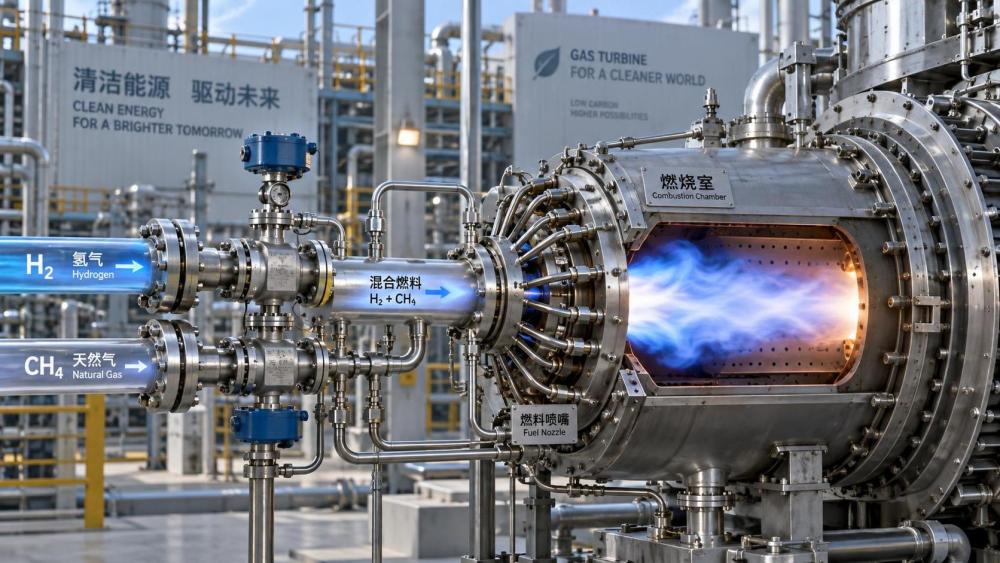
Hydrogen blending pressure affects combustion stability because it changes fuel density, injector pressure drop, jet momentum, mixing behavior, and the relationship between fuel flow and combustor air flow.
At a given thermal input, hydrogen requires a substantially greater volumetric flow than natural gas because its lower heating value per unit volume is much lower.
Increasing supply pressure can provide the flow capacity needed for higher hydrogen blends, particularly where existing piping, valves, meters, and injector passages constrain volumetric throughput.
However, pressure is not simply a delivery solution. It can alter local fuel-air mixing patterns and create conditions that increase flashback, autoignition, or combustion dynamics.
Hydrogen has a high laminar flame speed, broad flammability range, low ignition energy, and strong diffusivity, making it more sensitive than methane to local flow disturbances.
These properties mean that fuel-system pressure changes can move the flame position rapidly, especially in premixed dry low-emissions combustors designed originally for natural gas.
Technical evaluations should therefore distinguish between upstream hydrogen blending pressure, skid outlet pressure, combustor manifold pressure, and the effective pressure drop across each fuel injector.
Only the final pressure relationships near the injector determine the local velocity and mixing conditions that resist flame propagation upstream into fuel passages.
A reported supply pressure without a pressure-loss map is incomplete. Filters, control valves, blending skids, piping runs, manifolds, and injector circuits can materially reduce available pressure.
Evaluators should request pressure data at minimum load, rated load, transient ramps, cold starts, hot restarts, and the anticipated ambient-temperature extremes for each fuel composition.
Pressure Drop Across Injectors Is More Important Than Absolute Header Pressure
The key combustion-stability parameter is usually injector differential pressure, rather than absolute hydrogen blending pressure at the battery limit or pipeline connection point.
Injector differential pressure determines discharge velocity. Adequate velocity helps prevent a hydrogen-containing flame from propagating upstream through premixer passages, nozzles, or swirler regions.
When differential pressure falls, fuel jet momentum declines. Local residence time may increase, and low-velocity boundary regions can become more vulnerable to flame anchoring or flashback.
When differential pressure rises excessively, mixing can become nonuniform, pressure losses increase, and control-valve authority may deteriorate at part load or during rapid load changes.
Higher pressure can also strengthen fuel jets enough to alter swirl interaction, recirculation-zone structure, and equivalence-ratio distribution within the primary combustion zone.
For premixed systems, a stable design balances flame speed against local flow velocity while maintaining sufficiently uniform mixing to avoid rich pockets, lean blowout, and excessive NOx.
For diffusion-flame systems, pressure effects are different but still significant. Fuel momentum affects flame length, local stoichiometry, liner heat flux, and the likelihood of dynamic pressure oscillations.
OEM documentation should define permitted injector pressure-drop ranges by hydrogen concentration, turbine load, inlet-air condition, and emissions mode rather than listing one nominal value.
Where documentation provides only a maximum blend percentage, evaluators should treat that figure as preliminary unless it is linked to validated pressure, temperature, and operating-envelope conditions.
A credible package will include a fuel-flow versus pressure curve, control-valve sizing basis, injector-pressure targets, and restrictions on rate of change during fuel-composition transitions.
How Hydrogen Concentration Amplifies Pressure-Related Risks
The influence of hydrogen blending pressure becomes stronger as hydrogen concentration rises because hydrogen increasingly determines mixture reactivity, transport behavior, and required volumetric fuel flow.
At low blend levels, a turbine may retain much of its natural-gas operating behavior, although gas-quality controls and calibration checks remain necessary for reliable emissions performance.
At medium blend levels, changed Wobbe index, flame speed, and volumetric flow can require revised fuel schedules, modified combustor hardware, or tighter pressure-control tolerances.
At high blend levels, especially above manufacturer-qualified thresholds, legacy premixers may face major flashback limitations even when total fuel supply pressure appears adequate.
Hydrogen concentration should be measured or reliably calculated upstream of the turbine. Assuming a fixed blend from nominated supply contracts is insufficient for operational safety.
Composition variation affects calorific value and density. A pressure controller alone cannot ensure constant heat input when the hydrogen fraction changes during delivery or storage turnover.
Modern systems therefore combine gas chromatography, thermal conductivity analysis, calorific-value estimation, or validated composition sensors with fuel-flow and turbine-load control logic.
Technical assessors should ask whether the control system uses direct hydrogen measurement, inferred composition, conservative blend limits, or manual operating restrictions during uncertain gas-quality conditions.
The response time matters. A slow composition measurement may be acceptable for steady pipeline supply but inadequate where local blending skids operate dynamically with variable electrolyzer output.
Pressure-control performance must be tested across anticipated composition changes because a controller tuned for methane-rich fuel can respond differently as hydrogen volumetric demand increases.
Flashback, Lean Blowout, and Combustion Dynamics Must Be Evaluated Together
Flashback often receives the most attention in hydrogen combustion, but stable deployment also requires protection against lean blowout, thermoacoustic instability, overheating, and emissions excursions.
Flashback occurs when flame propagation exceeds local flow velocity or when ignition develops in low-velocity regions such as boundary layers, recirculation zones, or injector wakes.
Insufficient injector pressure drop can increase this risk, particularly during low-load operation when fuel flow falls while hydrogen flame speed remains comparatively high.
Lean blowout presents the opposite failure mode. Excessively lean mixtures may extinguish when pressure fluctuations, ambient changes, or rapid load reductions disrupt the flame’s heat-release balance.
Hydrogen can extend lean operating capability, but this does not eliminate blowout risk because combustor aerodynamics, dilution flow, and transient control behavior remain decisive.
Combustion dynamics arise when heat-release oscillations couple with acoustic modes in the combustor. Pressure changes can shift fuel-response characteristics and worsen unstable operating regions.
Dynamic pressure monitoring should be included in factory acceptance, commissioning, and periodic validation plans, with alert thresholds tied to fuel composition and operating load.
Evaluators should seek evidence from full-pressure, full-temperature testing. Atmospheric rig tests are useful, but they may not reproduce commercial turbine acoustic behavior or autoignition conditions.
Part-load operation deserves special scrutiny because grid-support turbines increasingly cycle, ramp, and operate below base load while accommodating variable renewable generation and hydrogen availability.
A combustion system that remains stable at rated load but becomes unstable during ramps cannot be considered fully hydrogen-ready for flexible power-system applications.
Fuel Temperature and Compression Can Change the Result
Hydrogen blending pressure cannot be assessed independently from fuel temperature. Compression, throttling, heat tracing, ambient exposure, and blending equipment can all affect final fuel conditions.
Higher fuel temperature can shorten ignition delay and increase autoignition sensitivity, particularly where residence times are elevated in premixing passages or near hot metal surfaces.
Pressure and temperature together influence density, viscosity, sonic velocity, and valve-flow behavior, affecting whether fuel metering remains accurate throughout the required operating range.
For compressed hydrogen supplied from storage, pressure decay during discharge may create changing control conditions unless regulation stages and buffer capacity are designed for stable turbine demand.
For electrolyzer-linked systems, production pressure, compressor cycling, purification trains, and blending-skid response should be considered as an integrated dynamic fuel-supply system.
Transient pressure dips can be more important than steady-state values. Even brief reductions may reduce injector velocity during a load increase or cause a protection trip.
Conversely, abrupt pressure increases can upset equivalence-ratio control, create momentary rich zones, and trigger dynamic excursions before the turbine governor corrects fuel flow.
Acceptance criteria should specify permissible pressure ripple, ramp rate, temperature range, and response time at the turbine fuel interface, not merely average operating pressure.
What Technical Evaluators Should Request From OEMs and Integrators
A robust technical assessment starts with an operating map showing approved hydrogen concentration, fuel pressure, fuel temperature, load, ambient condition, and emissions-mode combinations.
The map should identify prohibited zones, transient restrictions, start-up limitations, shutdown requirements, and the boundary conditions used to establish combustion stability margins.
Request combustor configuration details, including premixed or diffusion operation, injector design, purge arrangements, active damping systems, material changes, and hydrogen-specific hardware upgrades.
Ask for the basis of qualification. Useful evidence includes engine tests, high-pressure combustor rigs, fleet operating hours, independent validation, and documented extrapolation limits.
Pressure-control documentation should include process-and-instrumentation diagrams, regulator sizing, fail-safe positions, valve-stroke margins, filtration requirements, and pressure-transmitter accuracy specifications.
Control narratives should explain how the turbine responds to hydrogen concentration changes, pressure loss, sensor disagreement, abnormal combustion dynamics, and loss of blending-skid communication.
For each protection function, determine whether it is advisory, automated, safety-instrumented, or dependent on operator intervention. The distinction affects both risk allocation and availability.
Material compatibility must also be reviewed. High-pressure hydrogen service may introduce embrittlement concerns in selected steels, seals, valves, fittings, and welded connections.
Relevant assessment frameworks may include ASME B31.12 for hydrogen piping, ISO 19880 where applicable to hydrogen supply interfaces, and project-specific national gas-safety requirements.
Standards compliance does not prove combustion stability by itself. It establishes an essential safety and integrity baseline that must be paired with turbine-specific performance validation.
Commissioning Tests That Establish a Defensible Stability Case
Commissioning should validate the actual integrated system because installed pipe losses, gas quality, ambient conditions, and control tuning can differ materially from design assumptions.
Begin with calibrated pressure, temperature, flow, and composition instrumentation. Uncertain measurement quality can conceal a marginal stability condition until an operational upset occurs.
Testing should progressively cover approved hydrogen blend levels, including minimum and maximum fuel pressures, low-load operation, rated output, ramps, starts, stops, and load rejection scenarios.
Each test point should capture combustor dynamic pressure, exhaust temperature spread, NOx, carbon monoxide, unburned fuel where relevant, fuel-valve position, and injector differential pressure.
Trend analysis is more useful than isolated readings. Rising dynamic amplitudes, narrowing valve margins, or deteriorating temperature spread can indicate approaching instability before trips occur.
Commissioning plans should include repeatability checks after control tuning changes. A setting that improves emissions at one blend may reduce flashback margin at another operating point.
Emergency logic also requires proof testing. Evaluate reaction to low supply pressure, unexpectedly high hydrogen fraction, composition-sensor failure, pressure-transmitter disagreement, and abnormal dynamic pressure.
Where hydrogen availability is intermittent, test transitions between blended fuel and conventional fuel. Transition quality often determines operational confidence more than steady-state performance alone.
Documented test results should become the baseline for ongoing condition monitoring, alarm rationalization, maintenance planning, and future blend-ratio expansion decisions.
Making the Investment Decision: Use Pressure as a System-Level Criterion
For asset decisions, hydrogen blending pressure should be treated as a system-level criterion linking fuel production, compression, transport, storage, combustion, controls, and plant availability.
A turbine may be technically capable of higher hydrogen blends while the surrounding fuel infrastructure lacks sufficient pressure stability, response speed, measurement quality, or material qualification.
Conversely, oversized compression capacity does not create a hydrogen-ready plant if the combustor cannot safely accept the resulting fuel conditions across its intended load range.
The most defensible decision compares required pressure at the combustor against available pressure under worst-case supply conditions, including degradation, maintenance states, and concurrent plant demand.
Evaluators should quantify margin in practical terms: injector differential pressure, valve authority, compressor turndown, storage autonomy, dynamic-pressure limits, and approved hydrogen concentration at each load.
Commercial models should include the energy penalty of compression, controls upgrades, inspection requirements, combustor retrofits, emissions compliance, and potential derating during hydrogen operation.
Reliability assumptions should be explicit. Hydrogen blending systems introduce additional valves, sensors, analyzers, compressors, and interlocks that can affect plant availability without disciplined maintenance.
Clear operating limits are not a weakness. They are evidence that the supplier understands combustion behavior and can define a controlled, auditable path toward higher hydrogen utilization.
Conclusion
Hydrogen blending pressure affects gas turbine combustion stability primarily through injector differential pressure, fuel velocity, mixing quality, control response, and interaction with hydrogen’s high reactivity.
Higher pressure can enable necessary hydrogen flow, but it can also change combustor aerodynamics and dynamics. Stable operation depends on validated limits, not generic pressure targets.
Technical evaluators should require integrated evidence covering composition, pressure, temperature, load transients, combustor dynamics, hardware configuration, controls, and fuel-system material integrity.
The correct conclusion is therefore conditional: a hydrogen-ready turbine is credible only when its pressure-management system and combustor stability envelope are demonstrated together under representative conditions.