
How to compare hydrogen turbine suppliers by proven blend capability




A supplier’s maximum hydrogen blend percentage is not a sufficient basis for turbine selection. The useful comparison is the hydrogen concentration that a specific turbine configuration can sustain across your required operating envelope, with acceptable emissions, stable combustion, documented maintenance implications, and contractual performance coverage.
A higher advertised percentage can represent a narrower capability: one combustor tested briefly at a single load, rather than a complete turbine operating through starts, load changes, and fuel-quality variation. When comparing hydrogen turbine systems suppliers, separate what has been demonstrated, what is commercially supported, and what remains an upgrade commitment.
Put every blend claim on the same basis
Hydrogen concentration is commonly expressed as a percentage by volume. That is not the same as its share of fuel energy. Because hydrogen has substantially less energy per unit of gas volume than methane, a seemingly large volumetric blend can deliver a much smaller hydrogen energy contribution.
For an illustrative hydrogen–methane mixture, using approximate lower heating values of 10.8 MJ/Nm³ for hydrogen and 35.8 MJ/Nm³ for methane on a consistent reference basis, hydrogen’s energy share is:
Hydrogen energy share = (hydrogen volume fraction × hydrogen heating value) ÷ total mixture heating value.
These are calculated examples, not turbine performance results. Actual natural-gas composition changes the calculation. Require suppliers to state the gas composition, reference conditions, and whether performance figures use lower or higher heating value. A comparison mixing these bases can distort efficiency and fuel-consumption conclusions.
At unchanged efficiency and electrical output, hydrogen’s energy share provides an approximate indication of the reduction in direct combustion CO₂ when replacing methane. It does not establish lifecycle emissions savings, which also depend on hydrogen production and delivery. For turbine qualification, keep the immediate question narrower: how much fossil energy is displaced at the guaranteed operating point?
Trace the claim to the exact turbine configuration
“Hydrogen-ready” is not a sufficiently precise technical specification. It can describe an existing operating capability, a configuration requiring replacement hardware, or a platform intended for future development. Ask for the turbine model, combustor version, fuel-nozzle design, control-software revision, and auxiliary-system configuration associated with each blend claim.
Evidence from another machine in the same product family needs a documented transfer argument. Similar branding does not establish identical burner aerodynamics, fuel distribution, combustion dynamics, or thermal loading. A supplier should identify which components are shared and which differences require additional validation.
The evidence also needs to be classified by what it actually demonstrates:
- Burner or sector testing can establish combustion behavior under specified conditions, but does not prove complete-machine performance.
- Full-annular combustor testing can provide broader combustion evidence, depending on how closely pressure, temperature, and flow conditions reproduce the turbine.
- Complete-engine testing demonstrates integrated operation, but its value still depends on duration, load coverage, and the installed configuration.
- Field operation can show operational exposure and maintenance outcomes, provided the blend history and operating conditions are available.
No evidence category eliminates the need to examine scope. A well-instrumented engine test may answer a particular qualification question more clearly than a field reference with undocumented fuel composition. Conversely, a short engine demonstration cannot establish long-term component durability.
Compare operating envelopes, not isolated peak blends
A turbine does not operate only at its advertised reference point. The relevant capability is a map covering hydrogen concentration, load, ambient conditions, fuel properties, and operating mode. Define your required envelope before requesting supplier proposals; otherwise, each supplier can present its strongest but least comparable test point.
Request a load-versus-blend map showing the permitted operating region and the evidence supporting its boundaries. It should identify minimum stable load, any output derating, emissions restrictions, and conditions requiring a change in combustion mode. Where capability depends on fuel temperature or pressure, those limits belong on the map or in its accompanying specification.
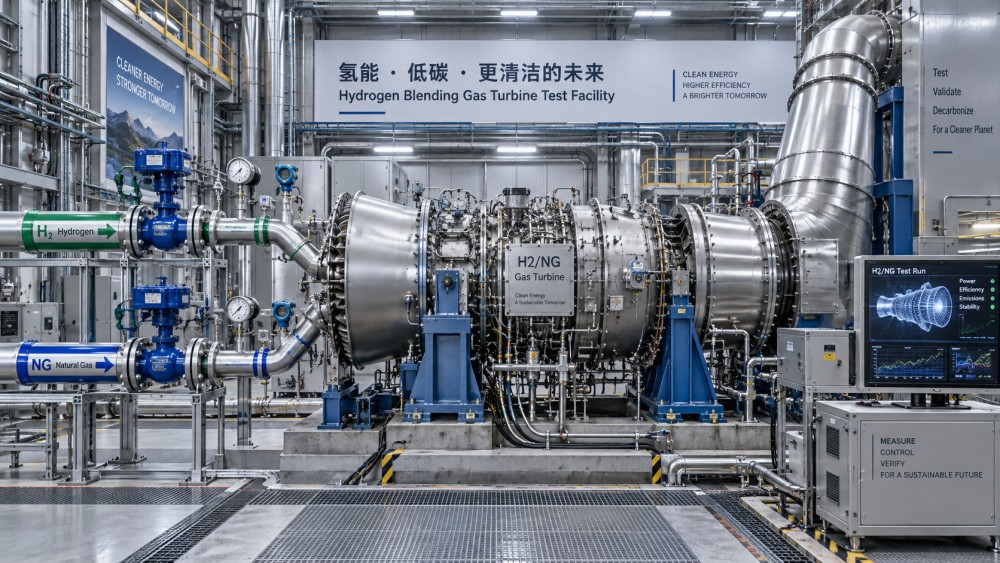
Distinguish steady operation from transitions. Starting on natural gas and introducing hydrogen after reaching a stable load is a different capability from starting on a hydrogen-containing mixture. Likewise, sustaining a fixed blend does not establish tolerance to rapid composition changes.
For a cycling plant, seek evidence covering load ramps, blend ramps, shutdown, trips, and restart conditions. For a plant supplied by variable hydrogen production, the acceptable rate of change in hydrogen concentration may matter more than the maximum concentration. The control system must manage the changing fuel properties without unacceptable combustion excursions or repeated protective shutdowns.
Ambient coverage matters as well. Evidence at one inlet temperature does not automatically validate operation across seasonal conditions. Suppliers should distinguish measured points from model-based extensions and explain the validation supporting those extensions.
Read test duration alongside exposure and inspection results
A statement of accumulated operating hours is incomplete unless it shows how those hours were distributed. Time spent on natural gas should not be presented as equivalent to time at the claimed hydrogen blend. Request hours grouped by blend range and load range, together with starts, shutdowns, trips, and significant fuel transitions.
There is no universal number of hours that makes every hydrogen capability “proven.” The necessary evidence depends on what is being claimed. Stable combustion can be demonstrated within a test campaign; preservation of inspection intervals or component life requires a stronger durability basis.
Evaluate whether the test duration allowed thermal conditions to stabilize and whether the instrumentation could detect relevant failure mechanisms. Combustion-pressure measurements, metal temperatures, emissions data, and protective-system records help establish what occurred during operation. Post-test inspection provides different evidence: nozzle condition, cracking, coating degradation, and other signs of abnormal thermal exposure.
Where long-term experience is limited, ask how the supplier establishes component-life expectations. Engineering analysis can support a qualification case, but it should not be relabeled as accumulated service experience. Any uncertainty should appear in maintenance assumptions and commercial obligations, not disappear behind a headline blend percentage.
Make emissions and combustion stability simultaneous acceptance conditions
A hydrogen blend capability is useful only if the turbine can meet the required emissions limits while operating stably. Hydrogen changes flame propagation and fuel-mixture behavior, which can affect flashback, autoignition, and combustion dynamics. Their significance depends on the combustor design and operating conditions; none can be resolved by blend percentage alone.
Require emissions measurements at the relevant blend and load points. NOₓ results should specify whether concentrations are reported on a dry or wet basis, the reference oxygen concentration, and whether values are measured before or after exhaust treatment. A bare ppm figure is not comparable across suppliers.
Also request CO performance where applicable, especially during part-load operation and combustion-mode transitions. A low-NOₓ point achieved under one operating condition does not prove compliant operation across the full dispatch range.
Identify what is needed to achieve the emissions claim. Dry low-emissions combustion, diluent injection, and downstream selective catalytic reduction impose different plant requirements. Water or steam demand, treatment-system capacity, reagent consumption, and exhaust-temperature compatibility can determine whether a nominally acceptable turbine fits the site.
For combustion stability, request the acceptance limits and measured results for pressure oscillations, together with evidence addressing flashback and damaging thermal excursions. “No trip occurred” is weaker than a record showing adequate margin to protective limits. Supplier comparisons should reward demonstrated margin, not merely successful completion of a selected test point.
Check the fuel-system boundary before accepting turbine capability
The combustor may tolerate a blend that the existing fuel train cannot deliver. At the same thermal input, adding hydrogen increases the required volumetric fuel flow relative to methane. Valve capacity, piping pressure drop, metering range, and available supply pressure can therefore constrain output before the combustor reaches its limit.
Request a fuel-system assessment covering the entire agreed supply boundary: blending equipment, filters, valves, pressure regulation, meters, manifolds, purge arrangements, and connections to the turbine. The assessment should use the proposed fuel composition and operating conditions, rather than a generic compatibility statement.
Material suitability depends on factors including alloy, stress, pressure, temperature, and exposure. Seals and joints also need a leakage assessment. A statement that piping is suitable for hydrogen does not by itself qualify every valve, instrument, or enclosure in the system.
Fuel specifications should define acceptable contaminants, moisture, temperature, pressure, and composition variability. The control strategy needs a stated method for determining or accounting for changing fuel properties. Measurement accuracy and response time matter when blend changes can outpace control adjustments.
Applicable codes and approvals should be tied to their actual scope. For example, ASME B31.12 addresses hydrogen piping and pipelines where applicable; conformity with a piping code does not certify turbine combustion performance. A defensible proposal separates piping design, hazardous-area requirements, ventilation, leak detection, functional protection, and turbine qualification, with responsibility assigned for each interface.
Turn demonstrated capability into enforceable selection criteria
The shortlist should reflect the capability a supplier will contractually support, not just the capability it has publicized. Ask for a guarantee schedule specifying permitted hydrogen concentration, fuel composition, output, heat rate, emissions, load range, ambient conditions, and any required auxiliary consumption. Each guarantee should identify its measurement basis and acceptance-test method.
Warranty and maintenance terms need the same specificity. Confirm whether hydrogen operation changes inspection intervals, component-life assumptions, spare-parts requirements, or exclusions. A proposal can appear technically attractive while transferring the cost of increased inspections or fuel-related damage to the owner.
For upgrade-based offers, identify the hardware, software, outages, and requalification required. Separate equipment available for delivery from a development milestone. A future high-blend commitment should not receive the same technical credit as a supported configuration with relevant operating evidence.
A practical comparison record links each requirement to four items: the supplier’s stated limit, the supporting evidence, the contractual commitment, and the remaining qualification gap. Use pass/fail gates for non-negotiable requirements such as emissions compliance, safe operating range, and fuel-system suitability. Scoring cannot compensate for failure to meet a mandatory plant condition.
If one supplier demonstrates a higher blend only at base load while another supports a lower blend across the required cycling range, the second may be the stronger selection. If sustained high-load operation is the intended duty, the comparison may reverse—but only after emissions, durability, and fuel-supply constraints are included.
The defensible choice is the supplier whose evidence and guarantees overlap most closely with the plant’s intended operation. Maximum hydrogen percentage remains a useful boundary value. Proven blend capability is the supported operating region inside that boundary, including the transitions, interfaces, and maintenance obligations needed to use it reliably.
Related News
- When Does a Hydrogen-Ready Gas Turbine Pay Off?Apr 27, 2026Hydrogen-ready gas turbine economics explained: evaluate industrial decarbonization, hydrogen blending, hydrogen infrastructure, and utility-scale power ROI to see when future-proof flexibility truly pays off.
- RWE Wins German Capacity Auction for 2.1 GW of Hydrogen-Ready Gas PlantsNov 04, 2026RWE wins German capacity auction for 2.1 GW of hydrogen-ready gas plants. Discover what the award could mean for suppliers and contractors.
- German Economy Ministry Announces €1.5 Billion Hydrogen Support PackageOct 20, 2026Germany’s €1.5 billion hydrogen support package could reshape industrial investment. Explore 2027 CCfD funding, blue hydrogen support and procurement opportunities, pending EU approval.
- How to compare hydrogen turbine suppliers by proven blend capabilityOct 14, 2026Compare hydrogen turbine systems suppliers by proven blend capability, emissions, operating range, and guarantees. Discover how to choose a supplier that fits your plant’s needs.
Related News
- 00
0000-00
Hydrogen Energy Storage for Data Centers Gets Costly Fast - 00
0000-00
When 99.999% Hydrogen Purity Still Is Not Good Enough - 00
0000-00
When Does a Hydrogen-Ready Gas Turbine Pay Off? - 00
0000-00
Electricity Price Volatility Is Rewriting Hydrogen Cost Models - 00
0000-00
PSA Recovery Rate Drops for Reasons Operators Miss
Dr. Hideo Torque
Weekly Insights
Stay ahead with our curated technology reports delivered every Monday.