
What Limits Hydrogen Blend Ratios in Existing Gas Turbine Fleets?




A hydrogen blend limit in an existing gas turbine fleet is set by the first constraint reached under the unit's actual operating envelope, not by the volume of hydrogen available at the fuel skid. The limiting condition may be flashback at part load, an emissions exceedance at a particular ambient temperature, insufficient fuel-valve authority during a fast load change, excessive combustor pressure pulsation, or a restriction in the approved operating and certification basis. A blend that appears stable during a short baseload trial can still be unsuitable for starts, turns, cold weather, hot-day derates, or grid-support duty.
Hydrogen changes the fuel behavior inside the entire combustion system. Its low volumetric heating value increases required fuel volume flow, while its high flame speed, wide flammability range, low ignition energy, and high diffusivity alter the margin between a stable flame and an uncontrolled one. Those effects interact with the combustor architecture, fuel composition, control logic, and downstream turbine hardware. Blend percentage is therefore an incomplete descriptor unless it states whether the figure is by volume or energy, identifies the accompanying natural-gas composition, and defines the permitted operating range.
Combustor geometry usually sets the early ceiling
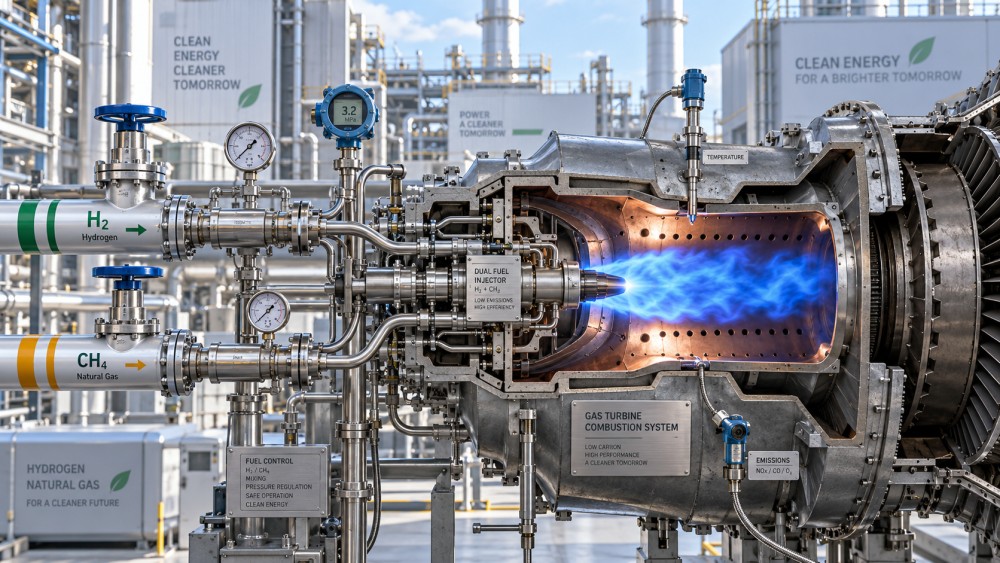
Most existing gas turbines were designed around a narrow range of gaseous-fuel properties. Premixed dry-low-emissions combustors are often the most sensitive because fuel and air are intentionally mixed before reaching the flame zone. Introducing hydrogen accelerates flame propagation through that mixture. If local flame speed exceeds the velocity carrying the mixture through the burner passages, the flame can travel upstream toward the injector. This is flashback.
Flashback is not a single event with a single cause. A flame may propagate through the central premixer, along a boundary layer near a burner wall, through a recirculation zone, or into small passages around an injector. Surface condition matters. Deposits, damaged coatings, worn seals, altered clearances, and local overheating can create low-velocity regions that did not exist in the design condition. A unit with nominally identical hardware to another unit can consequently show a different hydrogen tolerance after years of service.
Diffusion-flame combustors avoid some premixer flashback mechanisms because fuel and air meet closer to the flame zone. They are not automatically more tolerant. Their fuel nozzles, mixing quality, flame anchoring, temperature profile, and NOx-control method still determine whether higher hydrogen content is acceptable. Water or steam injection, where fitted, changes combustion temperature and mass flow, but it also changes control interactions and turbine cooling conditions.
The relevant limit is often local rather than average. A bulk fuel analysis may show a modest hydrogen fraction, yet fuel staging can create a much richer hydrogen concentration in a pilot circuit than in the total manifold. During ignition, transfer between combustor zones, or low-load operation, the pilot-to-main split can produce the most severe flashback or pulsation condition. Evaluating only full-load, fully premixed operation misses these transitions.
Fuel composition must be expressed in ways the turbine can use
A volumetric blend is intuitive for pipeline discussions, but turbine controls respond to energy flow, pressure, temperature, and valve position. Hydrogen contributes far less energy per unit volume than methane. At a fixed turbine firing requirement, increasing the hydrogen volume fraction raises total fuel volumetric flow. The result can be higher line velocity, greater pressure loss across filters and valves, and reduced reserve in control-valve travel.
Fuel quality calculations should include lower heating value, Wobbe index, relative density, compressibility, dew point, and likely composition variation at the turbine boundary. Hydrogen also lowers the molecular weight of the mixture. Flow meters and fuel-control algorithms calibrated around conventional natural gas can misstate mass or energy delivery if their compensation ranges do not cover the new gas properties.
Wobbe index alone is useful but insufficient. It relates fuel heating value and density, helping indicate interchangeability through a fixed orifice, yet it does not predict flame speed, flashback tendency, autoignition behavior, or combustion dynamics. Two fuels with a similar Wobbe index can produce materially different combustor behavior when one contains more hydrogen. Treating a familiar interchangeability metric as a combustion qualification is a common source of overconfidence.
Fuel temperature and pressure deserve equal attention. Compression, pressure regulation, and pipeline routing can raise or vary temperature. At the same nominal blend ratio, a warmer mixture has different density and flow characteristics; the resulting valve pressure ratio may shift. A hydrogen supply system also needs to prevent unintended air ingress during maintenance or tie-in work. Purging sequences, vent routing, leak detection coverage, and hazardous-area assumptions need to match the altered fuel properties rather than merely follow procedures written for natural gas.
Emissions limits may arrive before hardware damage
Hydrogen has no carbon, so blending reduces carbon dioxide emissions from the fuel stream on an energy basis. That benefit does not establish compliance with nitrogen-oxide limits. NOx formation is strongly influenced by peak flame temperature, residence time, equivalence ratio, and the distribution of those conditions across the combustor. Higher flame speed can shift where heat release occurs. A tuning setting that kept methane operation within emissions limits can produce higher NOx, elevated carbon monoxide at low load, or unstable behavior after the fuel composition changes.
Dry-low-NOx systems are particularly sensitive because they rely on tightly managed lean premixing. Moving leaner may reduce temperature-driven NOx, but a very lean mixture approaches lean blowout and can increase carbon monoxide and unburned hydrocarbons. Moving richer can restore stability but erode the NOx margin. The permitted blend ratio is frequently tied to whether acceptable emissions, stable operation, and required load response can coexist across ambient conditions.
Combustion dynamics complicate this balance. Pressure oscillations arise when fluctuating heat release reinforces acoustic modes in the combustor or fuel system. Hydrogen changes the timing of heat release and may move a previously benign operating point into a resonant regime. High dynamic pressure can damage liners, transition pieces, fuel injectors, seals, and instrumentation even when average exhaust temperatures look normal. A satisfactory stack-emissions reading does not rule out a damaging dynamic condition.
Measurement strategy matters during qualification. Continuous emissions monitoring describes exhaust results, while high-frequency dynamic pressure instrumentation identifies combustion instability. Exhaust temperature spread, combustor metal-temperature indicators where available, fuel-manifold pressure, valve position, and pilot/main fuel splits should be time-aligned with hydrogen composition. Without synchronized data, a composition-driven event can be mistaken for an ambient change, a control oscillation, or ordinary unit scatter.
Temperature distribution reaches beyond the combustor
The turbine section does not respond only to the average turbine inlet temperature inferred by the control system. It responds to the spatial temperature pattern entering the first-stage nozzles and blades. Changes in fuel reactivity and mixing can alter hot streaks, radial profile, and circumferential temperature non-uniformity. A fleet may retain the same nominal firing-temperature limit while experiencing a less favorable pattern factor.
This distinction is important for components already carrying service exposure. Transition ducts, combustion liners, first-stage vanes, blade coatings, cooling passages, seals, and attachment features have different sensitivities to thermal gradients and cyclic duty. A small change in average exhaust temperature does not demonstrate that local metal temperatures remain acceptable. Hydrogen does not inherently attack turbine superalloys in the same way it affects certain high-strength steels, but modified combustion can change the thermal environment that governs creep, oxidation, thermal fatigue, and coating life.
Material review should extend upstream to the fuel path. Hydrogen permeation, leakage, and embrittlement concerns depend on alloy grade, strength level, fabrication route, weld condition, pressure, temperature, stress state, and cyclic service. The highest concern is often concentrated in high-strength fasteners, springs, small-bore tubing, valve internals, weld heat-affected zones, and legacy components with incomplete material traceability. A general statement that a pipeline material is hydrogen-compatible cannot validate every component inside a turbine fuel train.
Controls and transient duty expose hidden constraints
A turbine can appear capable of a blend at steady state while lacking robust control during real dispatch. The fuel control system must deliver the required energy accurately during start, acceleration, synchronization, loading, unloading, and trip recovery. Because a hydrogen-rich mixture needs a different volumetric flow for the same heat input, valve sizing and actuator response may become limiting. A valve operating near its travel boundary has less authority to reject pressure disturbances or respond to a rapid load command.
Existing logic may infer fuel energy from fixed assumptions, gas chromatograph inputs, density measurements, or a declared fuel schedule. Each arrangement has a different vulnerability. A composition analyzer located far upstream can introduce transport delay; a rapidly changing blend at the turbine may not match the value used by the control system. Conservative blend management requires knowing the dead volume, line-pack effects, sample conditioning delay, analyzer update interval, and failure behavior when composition data are unavailable.
- Start and light-off deserve separate validation because ignition systems, pilot flows, and purge sequencing operate outside normal premixed baseload conditions.
- Part-load operation can be more restrictive than rated load, especially where combustor staging reduces air or fuel flow through individual burners.
- Fast ramps, frequency response, and load rejection test the combined capability of gas pressure control, fuel valves, combustion stability margins, and protective logic.
- Dual-fuel units require attention to transfer logic. A setting acceptable on gaseous fuel can interact poorly with liquid-fuel backup assumptions, purge requirements, or restart procedures.
Protection settings should not be relaxed merely to complete a blend trial. Exhaust-temperature limits, dynamic pressure alarms, flame-detector thresholds, fuel-pressure trips, and acceleration controls may need revised engineering justification if the altered fuel changes their normal signal range. At the same time, alarm suppression during commissioning can conceal the evidence needed to establish a defensible operating boundary.
The fuel system is part of the blend limit
Hydrogen blending introduces constraints outside the combustor enclosure. Seals that were adequate for methane may leak at a rate that becomes operationally significant with a smaller, more diffusive molecule. Ventilation rates, gas-detection placement, enclosure classification, electrical equipment suitability, drain routing, and vent-stack discharge assumptions need review against credible release locations. Sampling cabinets, analyzer shelters, valve skids, compressor packages, and purge panels are often overlooked because they sit outside the original turbine package scope.
Pressure-control devices require particular scrutiny. A regulator selected for natural gas may exhibit different flow capacity, noise, freezing tendency, or stability when density and pressure drop change. Filters and strainers add pressure loss that can become material when volumetric flow rises. Dead-ended branches and poorly purged low points can retain mixed gases after shutdown. The physical arrangement of isolation valves and vents affects whether a maintenance boundary can be made safe without creating an unverified composition pocket.
Fuel supply quality should also be distinguished from turbine acceptance quality. A hydrogen-production or pipeline interface may permit composition variation that is acceptable for transport but too broad for a particular combustion configuration. The turbine needs a defined composition envelope, maximum rate of composition change, contaminant limits, delivery pressure range, temperature range, and measurement method. That envelope belongs in the operating basis; a single maximum hydrogen percentage does not replace it.
Approved limits are configuration-specific
Existing fleets commonly contain units that share a model designation but differ in combustor generation, fuel-nozzle revision, control software, inlet system, emissions hardware, turbine upgrades, and prior repair history. Their hydrogen blend limits should not be assumed identical. A later combustor retrofit might improve flashback resistance while a legacy fuel skid remains undersized. Conversely, a larger fuel valve may solve flow capacity without resolving combustion dynamics.
The authoritative limit is the one supported by the current hardware configuration, documented fuel specification, validated operating modes, and applicable approval pathway. A generic statement that a turbine family is “hydrogen-ready” has little technical value without those qualifiers. It can refer to a new-build design, a limited blend under defined conditions, a unit with a particular combustor option, or a future upgrade package rather than the installed fleet.
A disciplined qualification sequence begins by freezing the as-built configuration and collecting prior operating evidence: combustor inspection findings, dynamic-pressure history, emissions data, valve travel, fuel-pressure margins, starts, trips, and control modifications. Engineering analysis can then identify credible failure modes before staged testing begins. The test matrix should deliberately cover the difficult edges of operation rather than only a convenient stable point: low load, high load, staging transitions, relevant ambient extremes, composition changes, and representative ramp rates.
The final blend ratio is best treated as an operating envelope with monitored variables and defined actions when those variables move toward a boundary. That approach recognizes the real constraint in existing fleets: hydrogen tolerance is produced by the combined behavior of fuel, hardware, controls, emissions performance, and asset condition. A single percentage becomes meaningful only after those interacting limits have been demonstrated for the unit that will actually run.
Related News
- When Does a Hydrogen-Ready Gas Turbine Pay Off?Apr 27, 2026Hydrogen-ready gas turbine economics explained: evaluate industrial decarbonization, hydrogen blending, hydrogen infrastructure, and utility-scale power ROI to see when future-proof flexibility truly pays off.
- RWE Wins German Capacity Auction for 2.1 GW of Hydrogen-Ready Gas PlantsNov 04, 2026RWE wins German capacity auction for 2.1 GW of hydrogen-ready gas plants. Discover what the award could mean for suppliers and contractors.
- German Economy Ministry Announces €1.5 Billion Hydrogen Support PackageOct 20, 2026Germany’s €1.5 billion hydrogen support package could reshape industrial investment. Explore 2027 CCfD funding, blue hydrogen support and procurement opportunities, pending EU approval.
- How to compare hydrogen turbine suppliers by proven blend capabilityOct 14, 2026Compare hydrogen turbine systems suppliers by proven blend capability, emissions, operating range, and guarantees. Discover how to choose a supplier that fits your plant’s needs.
Related News
- 00
0000-00
Hydrogen Energy Storage for Data Centers Gets Costly Fast - 00
0000-00
When 99.999% Hydrogen Purity Still Is Not Good Enough - 00
0000-00
When Does a Hydrogen-Ready Gas Turbine Pay Off? - 00
0000-00
Electricity Price Volatility Is Rewriting Hydrogen Cost Models - 00
0000-00
PSA Recovery Rate Drops for Reasons Operators Miss
Dr. Hideo Torque
Weekly Insights
Stay ahead with our curated technology reports delivered every Monday.