
Where Hydrogen-Blending Gas Turbine Solutions Fit in Industrial Power Projects




Hydrogen blending can be relevant to an industrial power project long before a site is ready to operate on high-hydrogen fuel. For project managers, its immediate value is often not a simple emissions claim. It is a way to preserve fuel flexibility while a facility continues to rely primarily on natural gas, refinery fuel gas, or another approved gaseous fuel.
That distinction matters. A turbine package selected for conventional gas service may not automatically be suitable for every hydrogen blend. The fuel composition affects combustion behavior, control settings, fuel-system materials, safety design, emissions performance, and commissioning procedures. A project team that treats hydrogen capability as a future option rather than a defined operating requirement can create expensive scope gaps between the turbine package, fuel supply system, electrical balance of plant, and environmental permit conditions.
Hydrogen-blending turbine applications tend to fit best where the power project has a stable need for dispatchable on-site generation and a credible reason to expect changing fuel availability over the life of the asset. This can include industrial plants with process heat loads, remote production sites, refinery or petrochemical facilities, district energy plants, and facilities using renewable electricity to produce hydrogen during periods of surplus power. The right fit depends less on the label “hydrogen-ready” than on the actual blend range, duty cycle, fuel quality, operating profile, and contractual allocation of technical risk.
Where hydrogen blending makes practical sense
Industrial power projects rarely make turbine decisions around one variable. A plant may need electricity, steam, mechanical drive, black-start capability, or resilience during grid interruptions. Hydrogen blending is most useful when it supports those requirements without forcing the project to accept an unsuitable turbine configuration or an immature fuel infrastructure plan.
For a combined heat and power installation, a gas turbine may serve as the prime mover in a package designed around both electrical output and recoverable exhaust heat. If the facility expects to introduce a hydrogen blend later, the turbine selection affects more than generating capacity. The exhaust temperature profile, part-load performance, duct burner arrangement, heat-recovery steam generator design, and emissions-control equipment may all need to operate across the anticipated fuel range.
In mechanical-drive projects, the primary question may be shaft power rather than electrical megawatts. Compressor trains, pumping stations, and process equipment can have narrow operating requirements, especially where a turbine must sustain speed under changing ambient conditions. Hydrogen blending may be feasible, but the project team should confirm whether the proposed combustion system and fuel controls can retain stable operation across the expected load envelope. A blend that works at base load may require different treatment during start-up, low-load operation, rapid load changes, or prolonged standby duty.
Sites with captive hydrogen production present another possible application. Electrolyzers, chlor-alkali processes, refinery operations, and chemical manufacturing may create a reason to evaluate hydrogen as part of the fuel mix. Yet availability can be intermittent, and hydrogen purity may vary with the production route and storage arrangement. A turbine should not be specified on the assumption that every unit of hydrogen produced on site will be suitable for direct blending. Compression, drying, pressure regulation, contaminants, storage pressure, and fuel-gas heating requirements all need to be examined as connected project systems.
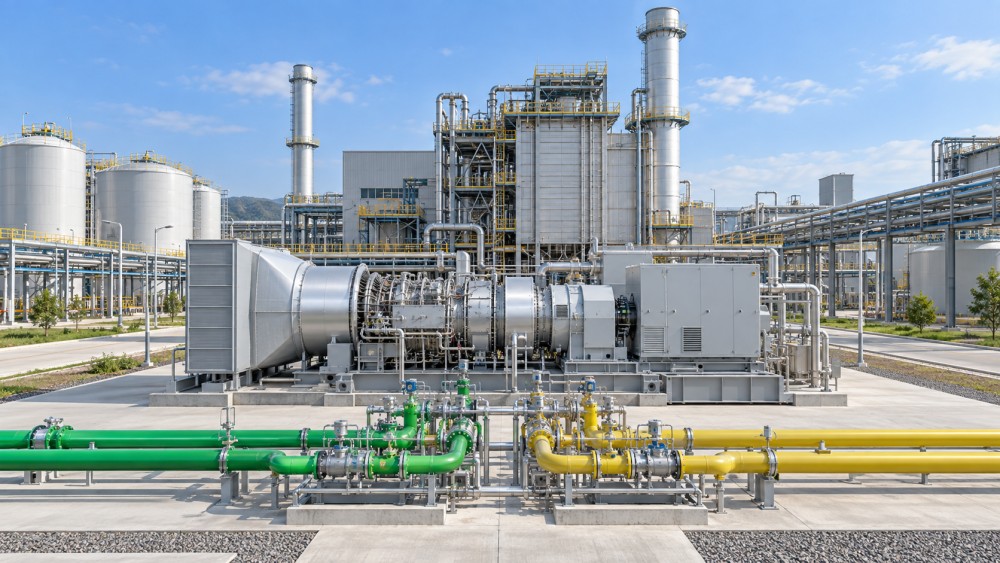
Fuel composition changes the engineering problem
Hydrogen has different combustion properties from methane-rich natural gas. It can burn with a faster flame speed and has a wider flammability range. These characteristics can affect flame stability, combustion dynamics, flashback risk, fuel metering, and the formation of nitrogen oxides. The technical response depends on the combustor design, the blend ratio, inlet conditions, fuel temperature, and the turbine’s operating point.
For that reason, a project specification should avoid broad statements such as “capable of hydrogen blending” without defining the intended fuel envelope. A useful fuel specification normally identifies the expected hydrogen concentration range, allowable variation rate, lower heating value or Wobbe-related control basis where applicable, pressure conditions at the package battery limit, temperature range, moisture content, and known contaminants. It should also distinguish normal operating fuel from upset, start-up, backup, and commissioning fuels.
Hydrogen’s lower volumetric energy content can require a higher fuel volume flow for the same energy input. That can influence valves, piping, pressure-drop allowances, metering accuracy, gas skids, and fuel-control valve sizing. Existing natural-gas infrastructure may have insufficient capacity or unsuitable components even when the blend appears modest on an energy basis. Project teams should evaluate fuel flow on both mass and volumetric terms rather than assuming that a percentage blend translates directly into unchanged hardware requirements.
Fuel-system materials deserve similar attention. Hydrogen service may raise questions about compatibility of seals, gaskets, valve components, instruments, and piping materials, particularly where pressure, temperature, cycling, and component condition create a risk of leakage or degradation. The assessment should cover the entire fuel path, including isolation valves, vents, drains, sample points, pressure regulators, analyzers, and connections between vendor package boundaries. A turbine can be technically compatible with a blend while adjacent site piping or instrumentation remains the limiting factor.
Select output and operating duty before defining fuel flexibility
Output requirements still come first. A project that needs reliable power during high ambient temperatures, elevated site altitude, or frequent part-load operation should establish the required delivered output at those conditions before comparing fuel options. Nameplate capacity alone is an incomplete procurement basis. Available turbine output changes with inlet air temperature, elevation, pressure loss, humidity, fuel characteristics, and auxiliary loads.
Fuel flexibility should then be assessed against the duty profile. A peaking generator that runs for short intervals has different priorities from a turbine operating continuously in a process plant. A unit with frequent starts may require particular scrutiny of ignition behavior, thermal cycling, control logic, and maintenance planning. A base-load combined heat and power machine may place more emphasis on fuel consumption, exhaust energy, emissions at steady state, and the consequences of planned fuel composition changes.
When comparing packages, project teams can use a selection matrix that separates essential operating requirements from desirable future options:
Within this framework, a review of available gas turbine solutions can help a team compare output classes, fuel arrangements, and efficiency considerations against the project’s defined operating case. The useful comparison is not simply which unit has the highest stated efficiency, but whether the package can maintain the required performance and control stability under the fuels and ambient conditions specified for the site.
Efficiency must be evaluated at the point of use
Hydrogen blending does not remove the need to assess fuel efficiency in conventional engineering terms. The relevant measure depends on the project boundary. For an electricity-only installation, net electrical efficiency should account for auxiliary loads such as inlet filtration, fuel compression where applicable, cooling systems, and balance-of-plant equipment. For combined heat and power, the more relevant question may be total useful energy recovered from the fuel after considering the required steam pressure, hot-water temperature, and annual heat demand.
A turbine with strong simple-cycle efficiency at full load may not provide the best annual outcome if the facility operates much of the year at low load or cannot use the available exhaust heat. Conversely, a lower-output unit with closer load matching may reduce cycling and avoid excess generation that must be curtailed or exported under unfavorable conditions.
Hydrogen availability can complicate this assessment. If hydrogen is produced with electricity during periods of low-cost power or curtailed renewable generation, the project should examine the full energy pathway rather than treating the hydrogen as fuel with no upstream consequence. Where hydrogen is a process by-product, its availability, purity, and alternative uses may shape the economics more strongly than turbine heat rate alone. These are site-specific decisions, and a robust feasibility study should keep fuel production, storage, transport, and turbine consumption within the same evaluation boundary.
Combustion emissions and permitting need an early interface
Hydrogen contains no carbon, but hydrogen blending does not automatically settle the emissions question for a turbine project. Carbon dioxide emissions associated with combustion generally depend on the carbon-containing portion of the fuel. Nitrogen oxides, however, are influenced by combustion temperature, residence time, air-fuel mixing, combustor configuration, load, and ambient conditions. A changed fuel blend can shift the emissions profile even if the project’s carbon-related fuel intensity is reduced.
For facilities subject to emissions limits, the project should identify the applicable fuel cases in the permitting and performance-guarantee documents. A stack emissions test based only on conventional natural gas may not answer whether the unit complies during blended-fuel operation. The issue is especially important where selective catalytic reduction, oxidation catalysts, water or steam injection, or other emissions-control arrangements are part of the plant design. Catalyst temperature windows, reagent consumption, control response, and monitoring arrangements should be considered as part of the integrated package.
Permitting teams also need reliable definitions. “Hydrogen-capable” can refer to very different conditions: a limited blend under steady load, a broader blend range with defined controls, or operation on substantially hydrogen-rich fuel after hardware changes. Contract documents should state what is included at delivery, what future modifications may be required, and who is responsible for proving operation at each fuel condition.
Procurement documents should make the future option measurable
The most common project risk is not necessarily a turbine failure; it is an ambiguous interface. A supplier may provide a package designed for a certain fuel range while the owner assumes that piping, detection systems, electrical classification, ventilation, and control integration are included elsewhere. Clear responsibility matrices help prevent this problem.
Technical bid documents should request evidence in a form that can be evaluated. Rather than asking whether a turbine is “hydrogen ready,” ask bidders to describe the permitted fuel composition range, operating restrictions, required fuel quality, changes to expected output or efficiency, emissions implications, fuel-system modifications, instrument requirements, control-system changes, and maintenance effects. If capability depends on future upgrades, those upgrades should be identified by scope rather than left as a general possibility.
Items to address before placing an order
- Define the normal, minimum, and maximum hydrogen blend expected during the project life, including how quickly the blend may change.
- Confirm the gas analysis method, sampling location, analyzer response time, and actions required when composition moves outside the approved range.
- Map package battery limits for fuel piping, pressure control, venting, purge systems, hazardous-area design, leak detection, and emergency shutdown functions.
- Identify performance tests for the fuels that will actually be used, including the reference ambient conditions and allowable measurement tolerances.
- Review whether start-up, shutdown, islanding, and low-load operation impose blend restrictions.
- Establish documentation requirements for materials, valves, instruments, control logic, and any modifications needed for future fuel cases.
Factory acceptance testing and site commissioning should follow the same logic. A control system may require validated fuel-composition inputs, revised alarm limits, or updated sequencing to manage an approved blend range. Operators need procedures that explain when a fuel change is permitted, which signals must be healthy, how blend excursions are handled, and when the unit must return to its baseline fuel. These details are operational safeguards, not paperwork added after the package is installed.
Use phased capability when the fuel transition is uncertain
Many industrial projects do not have a firm hydrogen supply at the time a turbine is purchased. In that situation, a phased approach can be more practical than designing the entire plant around an uncertain future blend. The initial installation can be based on the available fuel, while allowing space, isolation points, instrumentation provisions, control-system capacity, and electrical interfaces for a later fuel-system upgrade. The value of this approach depends on whether the future provisions are specific enough to avoid major rework.
Phasing should not become a vague deferral of engineering decisions. The project team still needs to determine whether future hydrogen use would require a combustor change, additional compression, modified gas detection, different valves, revised permitting, or altered emissions controls. Reserving plot space alone may have limited value if the turbine, balance of plant, or permit basis cannot accommodate the intended fuel case.
Hydrogen blending fits industrial turbine projects when it is treated as a defined design condition with boundaries, test methods, and operating rules. A carefully selected turbine can support a transition in fuel supply, but only when output needs, fuel quality, thermal integration, emissions obligations, and site safety systems are evaluated together. For project managers, the durable decision is not to buy flexibility in the abstract; it is to specify the flexibility the facility can realistically use and verify.
Related News
- When Does a Hydrogen-Ready Gas Turbine Pay Off?Apr 27, 2026Hydrogen-ready gas turbine economics explained: evaluate industrial decarbonization, hydrogen blending, hydrogen infrastructure, and utility-scale power ROI to see when future-proof flexibility truly pays off.
- RWE Wins German Capacity Auction for 2.1 GW of Hydrogen-Ready Gas PlantsNov 04, 2026RWE wins German capacity auction for 2.1 GW of hydrogen-ready gas plants. Discover what the award could mean for suppliers and contractors.
- German Economy Ministry Announces €1.5 Billion Hydrogen Support PackageOct 20, 2026Germany’s €1.5 billion hydrogen support package could reshape industrial investment. Explore 2027 CCfD funding, blue hydrogen support and procurement opportunities, pending EU approval.
- How to compare hydrogen turbine suppliers by proven blend capabilityOct 14, 2026Compare hydrogen turbine systems suppliers by proven blend capability, emissions, operating range, and guarantees. Discover how to choose a supplier that fits your plant’s needs.
Related News
- 00
0000-00
Hydrogen Energy Storage for Data Centers Gets Costly Fast - 00
0000-00
When 99.999% Hydrogen Purity Still Is Not Good Enough - 00
0000-00
When Does a Hydrogen-Ready Gas Turbine Pay Off? - 00
0000-00
Electricity Price Volatility Is Rewriting Hydrogen Cost Models - 00
0000-00
PSA Recovery Rate Drops for Reasons Operators Miss
Dr. Hideo Torque
Weekly Insights
Stay ahead with our curated technology reports delivered every Monday.