Why Is Hydrogen Infrastructure Slowing the Energy Transition?




The constraint is no longer just hydrogen production
Hydrogen still occupies an unusual place in energy-transition planning. It is regularly presented as a flexible answer to hard-to-electrify industry, seasonal energy storage, heavy transport, and firm low-carbon power. Yet the practical question behind “Why is energy transition slowing in hydrogen infrastructure?” is not whether hydrogen can be produced. It is whether a complete system can move, store, certify, consume, and finance hydrogen at the required scale without creating unacceptable cost, safety, or reliability exposure.
That distinction matters. A large electrolyzer can demonstrate that low-carbon hydrogen production is technically possible. It does not prove that an industrial customer can receive molecules at a predictable quality and pressure, that a port can handle liquid hydrogen safely, that a pipeline can retain its integrity over decades, or that a power plant can operate on hydrogen-rich fuel without compromising availability. The energy transition slows when these linked decisions are made in different places, on different timelines, and under incompatible technical assumptions.
For national energy planners, utility CTOs, industrial buyers, and infrastructure investors, hydrogen should therefore be treated as a system-integration challenge. The central task is to identify which parts of the chain must be built together, which can be staged, and where a project is relying on assumptions that have not yet been commercially or technically validated.
Why individual projects can look viable while the network does not
Hydrogen value chains are highly interdependent. Production economics depend on electricity cost, electrolyzer utilization, water treatment, and grid connection. Delivered-hydrogen economics depend on compression, liquefaction or conversion, transport distance, storage duration, terminal handling, and losses. End-use economics depend on the customer’s equipment, purity requirements, emissions obligations, and willingness to sign a long-term contract.
When each link is assessed independently, optimistic conclusions are easy to produce. A developer may model a low-cost renewable power source. A logistics provider may demonstrate a technical transport route. A manufacturer may advertise a hydrogen-capable turbine or burner. But the combined system can still fail to reach bankability if the plant operates at low utilization, the import terminal is delayed, the buyer cannot take contracted volumes, or a safety approval changes the design late in the process.
This is one reason hydrogen deployment often appears slower than its strategic importance would suggest. The bottleneck is not a single missing invention. It is the difficulty of synchronizing capital-intensive assets whose commercial lives can extend for decades.
Hydrogen projects also face a sequencing problem. Demand-side customers hesitate to invest in modified furnaces, fleet depots, turbines, or storage systems until supply is credible. Supply-side developers hesitate to build electrolyzers or import capacity until demand is contracted. Pipeline and terminal developers need both sides to commit before they can justify shared infrastructure. Public policy can reduce this deadlock, but policy support does not eliminate the need for a credible operating model.
Transport and storage are where scale becomes expensive
Hydrogen has low volumetric energy density in its gaseous form. Moving useful quantities therefore requires compression, liquefaction, conversion into a carrier, or dedicated pipeline infrastructure. Each route introduces a different cost profile, energy penalty, asset requirement, and risk register.
Compressed gaseous hydrogen may be appropriate for shorter routes, distributed industrial demand, and certain refueling applications. It becomes more difficult as volume and distance rise because compression equipment, trailer movements, storage cascades, and handling procedures multiply. Liquid hydrogen can carry more energy per unit volume, but it requires cryogenic temperatures and vacuum-insulated equipment. Boil-off management, terminal operations, vessel performance, and specialist maintenance all become material operational considerations.
For long-distance trade, some projects evaluate derivatives or chemical carriers. That may make logistical sense in particular corridors, especially where the receiving market can use the derivative directly. It should not be assumed, however, that every carrier route delivers equivalent hydrogen to the final user. If reconversion is required, the energy, plant, emissions-accounting, and cost implications need to be modeled explicitly.
Storage is equally consequential. A system designed around variable renewable electricity may need storage to manage production swings. A large industrial user may need inventory to protect continuous operations. A power system may seek longer-duration storage for periods of low renewable output. Above-ground tanks, underground caverns, linepack, and other approaches have different geographic, regulatory, and commercial limits. The best option cannot be chosen from a generic cost curve alone.
Decision-makers should insist on a delivered-cost model rather than a production-cost model. The relevant comparison is not merely the price at the electrolyzer outlet. It is the cost, quality, pressure, availability, and carbon attribute of hydrogen at the point where the customer uses it.
Material integrity is an infrastructure issue, not a procurement detail
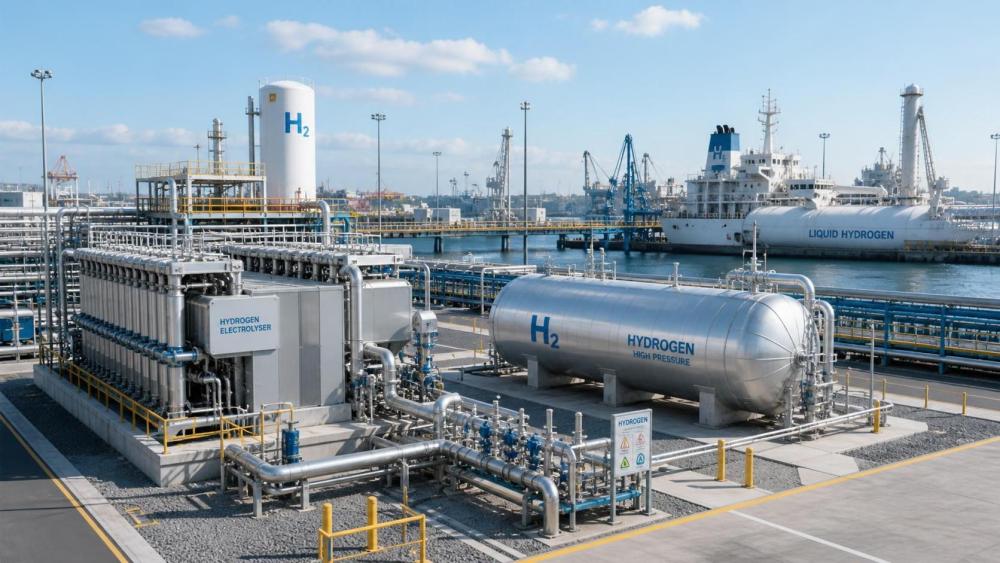
Hydrogen changes the engineering questions that apply to pipelines, valves, compressors, storage vessels, joints, seals, and turbines. Material compatibility, leakage management, fatigue behavior, pressure cycling, weld quality, and inspection access require attention throughout the asset lifecycle. Risks associated with hydrogen embrittlement and permeation are well understood as engineering topics, but their practical significance depends on material grade, operating conditions, component design, manufacturing quality, and duty cycle.
This is where broad claims about “hydrogen-ready” equipment need scrutiny. The phrase can describe very different levels of readiness. A gas turbine may be capable of operating on a limited hydrogen blend, be designed for a future retrofit, or have a pathway toward higher hydrogen shares subject to site-specific modifications. A gas network may technically accommodate a blend under certain conditions while still facing constraints from downstream industrial processes, customer appliances, metering, odorization, compression, or local regulation.
Buyers should translate such claims into verifiable operating conditions. Ask what fuel composition has been demonstrated, at what load range, under what ambient conditions, and with what effect on maintenance intervals, emissions, efficiency, and warranty terms. Ask whether the stated capability applies to a new installation, a retrofit, or only a future equipment configuration. A capability roadmap is not the same as installed operational capacity.
Standards provide an important baseline, but they do not remove the need for project-specific engineering. Frameworks such as ISO 19880 for hydrogen fueling systems, ASME B31.12 for hydrogen piping and pipelines, and SAE J2601 for fueling protocols are often relevant reference points. Their applicability depends on jurisdiction, system type, and the edition adopted by the authority having jurisdiction. Project teams should verify current requirements, local legal incorporation, and any additional insurer or operator obligations rather than treating a standard citation as a completed compliance strategy.
The standards problem is really an interface problem
Hydrogen infrastructure crosses sectors that have historically been governed separately: power generation, gas networks, chemical processing, transport, port operations, buildings, and vehicle fueling. A project can meet the expectations of one segment and still encounter delays at the boundary with another.
Consider a high-pressure refueling project. The dispenser, storage banks, compressors, pre-cooling equipment, fuel-quality monitoring, vehicle interface, emergency shutdown systems, and site permitting process must function as one operating system. A mismatch between fuel specification, pressure protocol, equipment certification, or local fire-safety interpretation can delay commissioning even when all major hardware has been delivered.
The same pattern appears in large electrolyzer projects. PEM and alkaline systems have different operating characteristics and supply-chain considerations. The choice should reflect the expected power profile, water quality, product pressure, maintenance approach, footprint, integration requirements, and availability strategy. Selecting a technology solely because it has favorable headline efficiency under a narrow test condition is a common error. The more useful question is how the plant will perform across the actual hourly operating profile and how its output will connect to compression, storage, offtake, and grid constraints.
For complex programs, an interface register is as valuable as a technology comparison. It should identify who owns each boundary: electricity supply to electrolyzer, electrolyzer to purification, storage to transport, terminal to customer, and fuel delivery to end-use equipment. It should also specify accepted operating ranges, measurement methods, emergency responsibilities, data access, and change-control procedures. Many late-stage disputes begin as undocumented interface assumptions.
How to evaluate whether a hydrogen project is ready to move
A useful first step is to stop asking whether hydrogen is “the answer” and instead define the service the project must provide. Is the goal continuous industrial heat, feedstock supply, fleet fueling, dispatchable generation, seasonal storage, export revenue, or resilience for a strategic asset? These uses have different tolerance for interruption, different purity and pressure needs, and different willingness to pay for low-carbon attributes.
Then test the project through four connected lenses:
- Physical feasibility: Can the proposed production, transport, storage, and end-use configuration meet the required volume, purity, pressure, and availability under real operating conditions?
- Commercial alignment: Are offtake commitments, electricity arrangements, transport capacity, and risk allocation aligned for long enough to support financing?
- Regulatory and safety readiness: Have permitting pathways, standards applicability, emergency-response expectations, land-use constraints, and certification needs been mapped early?
- Execution resilience: Is there a realistic plan for specialist equipment lead times, qualified contractors, spares, inspection, digital monitoring, and operational training?
The review should include downside cases, not just a base case. Model lower electrolyzer utilization, higher power prices, delayed pipeline completion, constrained water supply, changed carbon-accounting rules, reduced customer demand, and a slower-than-expected permit process. A project that only works under a narrow combination of favorable assumptions may still have strategic value, but it should be funded and governed accordingly.
Where hydrogen is likely to earn its place first
Hydrogen is not equally compelling across all energy uses. Its strongest near-term cases are generally those where direct electrification is constrained, where low-carbon molecules are intrinsically required, or where the value of reliability and energy density outweighs conversion losses. Examples may include selected chemical feedstocks, refining transitions, steelmaking pathways, high-temperature industrial processes, strategic port and maritime applications, and certain forms of firm power or long-duration storage. The suitability of each case depends on local energy resources and infrastructure, not only on sector labels.
By contrast, using hydrogen where direct electrical solutions are readily available can add conversion losses, infrastructure requirements, and operating complexity without creating proportionate value. This does not make hydrogen irrelevant in those applications, but it raises the burden of proof. A sound investment case should state why electricity cannot be used directly, why a hydrogen derivative is needed, or why the system-level resilience benefit justifies the additional cost.
For policymakers, this points toward corridor-based development rather than dispersed announcements. Concentrating early investment around industrial clusters, ports, storage geology, established gas assets that can be safely adapted, and anchor customers can lower interface risk. It can also create shared demand sufficient to justify common infrastructure. The objective should be to build operating systems that can expand, not isolated demonstration assets that cannot connect to a durable market.
What energy leaders should watch next
The most meaningful signals will not be the number of memoranda signed or the aggregate gigawatts announced. Watch for projects that secure credible long-term offtake, demonstrate repeatable permitting, publish clear delivery specifications, and establish practical risk sharing between power suppliers, infrastructure owners, and end users. Watch also for evidence on equipment reliability, maintenance needs, fuel quality, transport losses, and actual availability after commissioning.
Supply-chain maturity deserves the same attention as project finance. Large-scale electrolyzers, specialized compressors, cryogenic vessels, high-pressure storage equipment, qualified materials, sensors, and experienced engineering labor cannot always be procured on the schedule implied by a policy target. A credible delivery plan distinguishes between equipment that is commercially available, equipment that is available with long lead times, and equipment that still depends on scale-up by suppliers.
The transition is slowing in hydrogen infrastructure because the industry is moving from aspiration to accountability. That is not simply a failure of momentum. It is the point at which technical claims, commercial contracts, safety cases, and physical networks must withstand real operating conditions. The projects that progress will be those that treat hydrogen not as a standalone fuel, but as a tightly managed industrial system with clear interfaces, disciplined standards, and a defined reason for every molecule delivered.
Related News
- When Does a Hydrogen-Ready Gas Turbine Pay Off?Apr 27, 2026Hydrogen-ready gas turbine economics explained: evaluate industrial decarbonization, hydrogen blending, hydrogen infrastructure, and utility-scale power ROI to see when future-proof flexibility truly pays off.
- What Limits Hydrogen Blend Ratios in Existing Gas Turbine Fleets?Oct 11, 2026Gas turbines hydrogen blend limits depend on combustor design, emissions, controls, fuel systems, and operating conditions. Explore the key constraints for safer fleet upgrades.
- Where Hydrogen-Blending Gas Turbine Solutions Fit in Industrial Power ProjectsOct 06, 2026Gas turbine solutions for hydrogen blending: explore fuel flexibility, emissions, efficiency, safety, and procurement strategies for industrial power projects.
- What to verify before selecting hydrogen blending technology suppliersSep 19, 2026Compare hydrogen blending technology suppliers with confidence. Verify controls, gas quality, materials, safety, integration, and scalability before selecting a trusted partner.
Related News
- 00
0000-00
Hydrogen Energy Storage for Data Centers Gets Costly Fast - 00
0000-00
When 99.999% Hydrogen Purity Still Is Not Good Enough - 00
0000-00
When Does a Hydrogen-Ready Gas Turbine Pay Off? - 00
0000-00
Electricity Price Volatility Is Rewriting Hydrogen Cost Models - 00
0000-00
PSA Recovery Rate Drops for Reasons Operators Miss
Dr. Hideo Torque
Weekly Insights
Stay ahead with our curated technology reports delivered every Monday.