
A sustainable energy guide for choosing stationary fuel cell power




Choosing stationary fuel cell power is no longer a narrow equipment decision. For an enterprise, it can shape exposure to grid disruption, fuel-price volatility, carbon constraints, site permitting, and long-term infrastructure strategy. A fuel cell may provide dependable on-site electricity with low local emissions, but its real sustainability depends on the source of hydrogen, the design of the balance-of-plant, and the organization’s ability to operate safely over decades rather than months.
This sustainable energy guide is designed for decision-makers who need to assess stationary fuel cells as strategic energy assets. It looks beyond stack efficiency or nameplate capacity and focuses on the questions that determine whether a project is genuinely resilient, commercially credible, and aligned with a zero-carbon pathway.
Start with the operating problem, not the fuel cell technology
A stationary fuel cell is often considered when conventional backup generation no longer satisfies corporate, regulatory, or operational requirements. A data-intensive facility may need clean, long-duration resilience. A port, logistics campus, hospital, semiconductor plant, remote industrial site, or utility substation may need firm power where grid capacity is constrained. A manufacturer may be seeking a credible route away from diesel generators while also electrifying process loads.
These situations sound similar, yet their requirements are not. The right system for emergency standby power is not necessarily appropriate for continuous baseload operation. A project intended to absorb variable renewable hydrogen has different controls, storage, and commercial risks from one supplied by a dedicated pipeline. Before comparing technologies, define the duty profile in practical terms:
- Is the asset intended for emergency backup, prime power, peak shaving, microgrid support, or continuous power generation?
- How many hours or days of autonomous operation are required during a grid outage?
- Which loads are truly critical, and what power-quality requirements do they impose?
- Will the site use hydrogen only, or begin with another fuel and transition over time?
- Does the business case value avoided downtime, carbon reduction, grid-service revenue, or all three?
These answers prevent a common procurement mistake: buying a technically impressive fuel cell system with a fuel and storage package that cannot sustain the actual resilience objective.
The carbon question begins upstream
Fuel cells produce electricity electrochemically rather than through combustion. With hydrogen as the fuel, their point-of-use emissions are primarily water and heat. That characteristic is valuable for sites where local air quality, noise, or permitting conditions limit conventional generators. Yet “zero-carbon” should not be assigned automatically to every hydrogen-powered system.
The lifecycle carbon profile depends on how hydrogen is produced, transported, compressed, stored, and delivered. Hydrogen produced through electrolysis powered by appropriately matched low-carbon electricity will present a different emissions profile from hydrogen derived from fossil feedstocks without effective carbon capture. Delivery distance, liquefaction, compression energy, and losses also matter—especially for projects that depend on cryogenic liquid hydrogen logistics or frequent tube-trailer deliveries.
For enterprise governance, the useful question is not merely, “Will the fuel cell reduce site emissions?” It is, “Can we document the emissions intensity of each unit of delivered energy and maintain that claim as our supply chain changes?” Procurement teams should require clear boundaries for carbon accounting, including electricity inputs for electrolysis, upstream methane emissions where relevant, transport energy, and treatment of any co-products.
A credible sustainability plan therefore connects the stationary power asset to a hydrogen sourcing strategy. In regions with growing electrolyzer capacity, co-locating production, storage, and power conversion may improve supply visibility. In other locations, contracted delivery may be more realistic, but the commercial agreement must address both physical availability and verifiable environmental attributes.
Match the fuel cell family to the site’s energy architecture
Fuel cell selection is often presented as a contest between technologies. In practice, the better comparison is between system behavior and site requirements. Proton exchange membrane fuel cells (PEMFCs) are commonly associated with rapid response, relatively low operating temperatures, and applications that benefit from flexible output. They can fit dynamic microgrids and facilities where variable renewable generation or changing critical loads require fast adjustment.
Solid oxide fuel cells (SOFCs) operate at substantially higher temperatures. Their thermal output can be valuable where a facility has sustained demand for useful heat, steam, or combined heat and power. That same temperature profile, however, changes start-up, cycling, material durability, maintenance planning, and integration requirements. A project that requires frequent cold starts should investigate these implications carefully rather than assuming a high electrical efficiency figure tells the whole story.
Other stationary fuel cell chemistries may remain relevant in specific operating environments, fuel strategies, or legacy installations. The decision should not be driven by a generic ranking. It should consider ramp rate, part-load behavior, expected service intervals, degradation assumptions, thermal integration, footprint, water needs, and the supplier’s ability to support the asset in the intended jurisdiction.
Where hydrogen availability is phased, some organizations explore systems that can operate on reformed fuels initially. This can ease early deployment, but it introduces a strategic tension. A system that uses natural gas or another hydrocarbon fuel may improve local air quality and efficiency relative to combustion-based generation, while still retaining upstream and on-site carbon implications. If the stated destination is hydrogen-based power, the transition pathway must be technically proven, contractually defined, and reflected in the economics from the beginning.
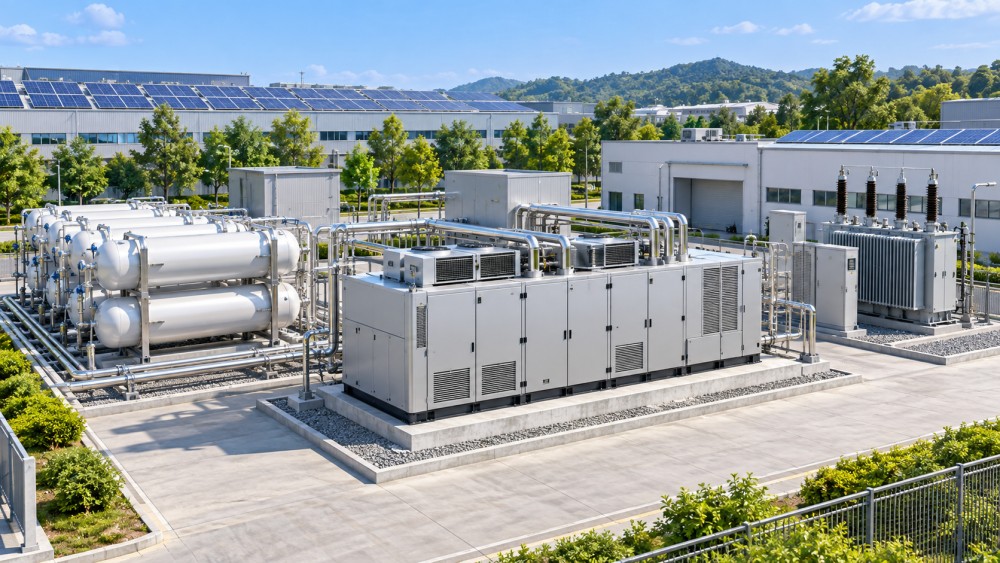
Resilience is a fuel-storage calculation as much as a power calculation
Electrical capacity is easy to see on a specification sheet. Fuel autonomy is where many projects become fragile. A stationary fuel cell rated for a critical load must be paired with enough usable fuel inventory to cover the required duration at realistic operating conditions, including reserve margins, ambient effects, auxiliary loads, and the possibility that resupply routes are unavailable during the same event that disrupts the grid.
Compressed gaseous hydrogen can be appropriate for certain site scales and operating profiles, but it requires careful consideration of storage volume, pressure management, setback distances, compression energy, and delivery logistics. Liquid hydrogen can increase stored energy density and support larger demand, yet it adds cryogenic handling, boil-off management, specialized equipment, and a more demanding logistics chain. Pipeline supply can simplify daily operation where available, but it creates dependency on network reliability and hydrogen quality.
For high-consequence facilities, planners should model at least three scenarios: normal operations, an extended outage with no delivery access, and a constrained-fuel event where critical loads must be prioritized. The goal is not to eliminate every risk; it is to make trade-offs visible before capital is committed.
Efficiency should be evaluated at the system boundary
Fuel cell projects are sometimes assessed using stack-level or nominal electrical efficiency. Those values are useful, but they do not represent the energy performance experienced by the enterprise. Hydrogen compression, purification, vaporization, cooling, controls, storage losses, transformers, inverters, and thermal management all affect delivered electricity. If a project includes electrolysis, the chain becomes longer: electricity is converted to hydrogen, stored and conditioned, then converted back to electricity when needed.
That does not mean the architecture lacks value. It may provide resilience, flexible demand, renewable-energy balancing, or avoided grid upgrades that a simple efficiency comparison misses. The point is to use the correct boundary. Ask for expected annual performance under the site’s load profile, not only performance at one ideal operating point.
Where heat can be recovered and used reliably, combined heat and power can materially change the value proposition. But useful heat is not a theoretical credit. It must have a real year-round sink, compatible temperature and pressure characteristics, and integration that does not compromise the facility’s primary processes. Heat that is regularly rejected should not be used to justify a CHP business case.
Safety and material integrity belong in the board-level decision
Hydrogen is manageable, but it is not forgiving of casual design. Its small molecular size, wide flammability range, and interaction with certain materials require disciplined engineering across piping, valves, joints, ventilation, detection, electrical classification, emergency isolation, and maintenance access. The fuel cell enclosure is only one part of the safety case. Storage, pressure regulation, transfer connections, and the surrounding site layout are equally important.
Applicable requirements differ by location and project configuration. Internationally recognized references may include hydrogen-specific piping frameworks such as ASME B31.12, alongside local building, fire, electrical, pressure-equipment, and occupational safety rules. Standards used for hydrogen dispensing infrastructure, including ISO 19880 and SAE J2601 in relevant contexts, can offer useful lessons on pressure management, fueling interfaces, and operating discipline, but they should not be treated as a substitute for a stationary installation’s complete compliance assessment.
Decision-makers should ask who owns the integrated hazard analysis and whether responsibilities are clear across the fuel supplier, storage provider, fuel cell integrator, engineering contractor, and site operator. A credible plan includes leak detection, ventilation philosophy, hazardous-area classification where required, shutdown logic, emergency response coordination, inspection schedules, and workforce training. Material selection deserves particular scrutiny in high-pressure hydrogen service, where compatibility and fatigue performance cannot be assumed.
Build a lifecycle business case, not a purchase-price comparison
Stationary fuel cell economics are shaped by more than the cost of the generation unit. Capital expenditure may include civil works, electrical interconnection, power conditioning, hydrogen storage, compression or vaporization equipment, monitoring systems, safety infrastructure, and permitting. Operating costs can include fuel, service agreements, replacement components, inspection, insurance, water treatment, and electricity used by auxiliary systems.
On the value side, the calculation may include avoided outage losses, lower diesel use, emissions compliance, reduced local pollutants, demand-charge management, deferment of grid upgrades, use of recovered heat, and possible participation in flexibility markets. Some of these benefits are site-specific and difficult to price, but excluding them can distort the decision just as much as overstating them.
A robust investment model should use scenarios rather than a single fuel-price assumption. Test the project against delayed hydrogen availability, lower-than-expected utilization, changes in electricity tariffs, stack replacement timing, and different carbon-accounting outcomes. The best result is not always the lowest modeled cost. It is often the option that maintains acceptable performance under a range of plausible conditions.
Questions to put in front of prospective suppliers
Supplier discussions become more useful when questions connect hardware claims to the enterprise’s operating reality. Request evidence of performance at part load, start-stop behavior, expected degradation mechanisms, maintenance windows, remote monitoring arrangements, and the availability of critical spares. Clarify what is guaranteed, what is estimated, and which assumptions are outside the supplier’s control.
- What hydrogen quality range is required, and how will quality be monitored at the site boundary?
- What autonomy is delivered at our critical-load profile, not simply at rated output?
- Which components are included in the guaranteed system boundary?
- How is thermal energy recovered, measured, and protected from disruption to electrical service?
- What codes, approvals, and third-party reviews are anticipated for this location?
- What maintenance activities require shutdown, and what redundancy is available during service?
- How will performance, hydrogen consumption, and emissions attributes be reported for internal governance?
A decision framework for hydrogen-ready power
For organizations building toward a hydrogen economy, stationary fuel cells should be assessed as part of a larger infrastructure portfolio. They can complement megawatt-scale electrolysis, buffer renewable supply through hydrogen storage, support critical loads during grid disruptions, and create early demand that strengthens a regional hydrogen ecosystem. They can also become stranded or underutilized if production, logistics, safety systems, and offtake arrangements develop on different timelines.
This is why a systems view is essential. G-HEI’s benchmarking perspective across electrolysis, cryogenic logistics, hydrogen-ready power assets, CCUS pathways, and high-pressure infrastructure is relevant here: each asset must be evaluated not only for its individual performance, but for the interfaces that determine the security of the full energy chain.
The sound choice is rarely the fuel cell with the most attractive headline specification. It is the configuration that matches critical-load needs, has a defensible hydrogen supply and carbon basis, meets the jurisdiction’s safety expectations, and remains economically intelligible as energy markets evolve. When those conditions are met, stationary fuel cell power can move from a promising technology demonstration to a durable component of enterprise energy resilience.
Related News
- Hydrogen Energy Storage for Data Centers Gets Costly FastApr 27, 2026Hydrogen energy storage for data centers gets costly fast as hydrogen storage, cryogenic liquid hydrogen, safety standards, and utility-scale power needs reshape the energy transition case. Learn the real trade-offs.
- Beijing Targets Hydrogen Industry Chain Above 40 Billion Yuan by 2030Nov 01, 2026Beijing's hydrogen industry plan targets over 40 billion yuan by 2030. Explore vehicle, refueling and industrial goals and their potential supply-chain impact.
- Beijing Hydrogen Plan Targets Industry Chain Scale Above 40 Billion Yuan by 2030Oct 31, 2026Beijing's hydrogen plan targets a 40 billion yuan industry chain by 2030. Explore its vehicle, refueling and technology goals and potential business implications.
- HDF Energy Selects Topsoe Technology for 250 MW Texas Power ProjectOct 30, 2026HDF Energy selects Topsoe's SynCOR technology for its planned 250 MW Texas project, targeting lower-carbon baseload power for data centers by 2030.
Related News
- 00
0000-00
Hydrogen Energy Storage for Data Centers Gets Costly Fast - 00
0000-00
When 99.999% Hydrogen Purity Still Is Not Good Enough - 00
0000-00
When Does a Hydrogen-Ready Gas Turbine Pay Off? - 00
0000-00
Electricity Price Volatility Is Rewriting Hydrogen Cost Models - 00
0000-00
PSA Recovery Rate Drops for Reasons Operators Miss
Dr. Hideo Torque
Weekly Insights
Stay ahead with our curated technology reports delivered every Monday.