Hydrogen Energy Storage for Data Centers: Backup Power Options Compared




Why Hydrogen Energy Storage for Data Centers Is Moving Into Serious Consideration
As uptime pressure grows, backup strategy is no longer only about emergency runtime.
It now sits at the intersection of resilience, carbon targets, local permitting, and fuel security.
That shift is why hydrogen energy storage for data centers is gaining attention beyond pilot projects.
For many facilities, diesel still dominates because it is familiar, fast to deploy, and widely bankable.
But diesel also brings emissions exposure, noise, logistics risk, and stricter air quality review.
Battery systems solve part of that problem, especially for ride-through and short-duration support.
Still, batteries become expensive and space-intensive when backup duration stretches into many hours.
Hydrogen offers a different value proposition.
It decouples stored energy from power output more effectively than batteries.
That matters when a campus needs long-duration backup without oversizing the electrical conversion equipment.
In practical terms, hydrogen energy storage for data centers can support sustainability goals while improving fuel flexibility.
The real question is not whether hydrogen is interesting.
The real question is where it outperforms diesel, batteries, or hybrid architectures in actual project conditions.
How Backup Options Compare in Real Data Center Scenarios
A useful comparison starts with runtime, response speed, footprint, compliance burden, and lifecycle emissions.
Each option performs well somewhere, but none wins across every site condition.
Diesel Generators
Diesel remains the benchmark for high-load standby power.
It delivers mature supply chains, proven maintenance practices, and strong acceptance by insurers and financiers.
However, emissions permitting is getting tougher in urban and hyperscale expansion zones.
Fuel polishing, storage degradation, and delivery disruption during regional emergencies are also recurring concerns.
Battery Energy Storage Systems
Batteries excel at immediate response and power quality support.
They reduce generator starts, smooth transfers, and align well with UPS strategies.
Their limitation is duration economics.
Once backup expectations move past a few hours, capital cost and footprint often rise sharply.
Hydrogen Fuel Cells and Hydrogen Storage
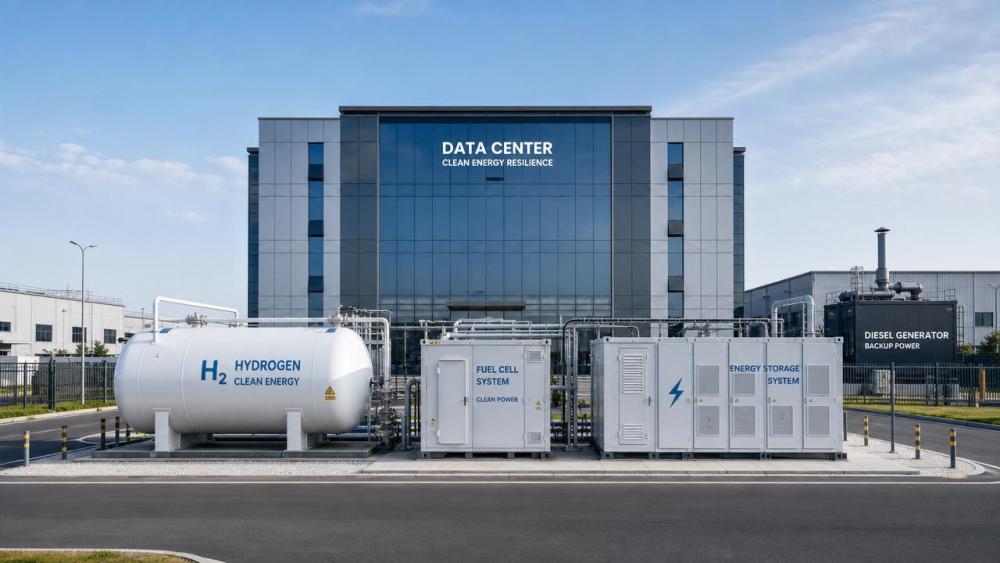
Hydrogen energy storage for data centers usually pairs stored hydrogen with fuel cells or hydrogen-ready turbines.
Fuel cells offer quiet operation, low local emissions, and modular scaling.
Stored hydrogen can be compressed gas or liquid hydrogen, depending on duration and logistics strategy.
The tradeoff is higher design complexity around storage, ventilation, codes, and supply contracts.
Hybrid Backup Architectures
In many projects, the strongest answer is not a single technology.
A battery handles fast response, while hydrogen covers multi-hour or multi-day resilience.
This approach often reduces transition risk while still moving backup power away from heavy fossil dependence.
Decision Factors That Matter Most Before Choosing Hydrogen
Hydrogen is promising, but a good decision depends on disciplined screening.
Several factors usually decide whether hydrogen energy storage for data centers is practical or premature.
- Required runtime: Eight hours and seventy-two hours create very different storage and refueling designs.
- Load profile: Critical IT loads, cooling loads, and staged restart sequences shape system sizing.
- Site constraints: Land availability, setbacks, blast considerations, and traffic access can favor one option over another.
- Fuel supply: On-site production, tube trailer delivery, or liquid hydrogen supply each carry different reliability assumptions.
- Regulatory path: Local fire code interpretation and permitting maturity can accelerate or delay deployment.
- Carbon strategy: Backup systems increasingly affect enterprise reporting, procurement standards, and investor narratives.
From recent market movement, one signal is especially clear.
The strongest hydrogen cases often appear where diesel permits are constrained and outage tolerance is near zero.
That combination pushes teams to consider long-duration clean backup, not just short-term bridging power.
Safety, Standards, and Delivery Risks Cannot Be Treated as Afterthoughts
Any serious discussion of hydrogen energy storage for data centers must address safety from day one.
Hydrogen behaves differently from diesel and differently from battery systems.
It disperses quickly, has a wide flammability range, and demands careful attention to leak detection and ventilation.
That does not make it unmanageable.
It means system design must align with recognized frameworks and proven engineering practice.
Key checkpoints usually include material compatibility, pressure management, emergency isolation, gas detection, and hazardous area classification.
For larger installations, teams also need a clear path through storage vessel selection and piping integrity review.
Standards such as ISO 19880, ASME B31.12, and related fire code requirements help reduce ambiguity.
In practice, early engagement with authorities having jurisdiction can save months later in the project cycle.
Where Hydrogen Energy Storage for Data Centers Makes the Most Sense
Not every facility is a strong candidate today.
But several scenarios already show strong alignment with hydrogen backup design.
- Urban or regulated regions where diesel emissions permits are difficult, slow, or politically sensitive.
- Large campuses pursuing net-zero roadmaps and needing backup power that supports corporate decarbonization claims.
- Sites with renewable power integration plans, where electrolytic hydrogen may later support broader energy balancing.
- Remote or resilience-focused facilities that need long-duration storage beyond economical battery ranges.
- Phased developments where hybrid systems can start small and expand as hydrogen supply infrastructure matures.
A weaker fit appears when local supply is uncertain, land is constrained, or approval pathways are undefined.
In those cases, a battery plus efficient generator strategy may remain the better interim solution.
A Practical Evaluation Framework for Near-Term Projects
A workable decision process should stay simple, measurable, and tied to business risk.
That is usually the fastest way to compare hydrogen energy storage for data centers with other backup options.
- Define outage scenarios by duration, restart conditions, and acceptable load shedding.
- Model three cases: diesel-only, battery plus diesel, and battery plus hydrogen.
- Compare lifecycle cost, not only equipment cost, across fuel, maintenance, and permitting impacts.
- Stress-test fuel availability during regional disruptions, not only under normal delivery assumptions.
- Review safety compliance early with code specialists and local authorities.
- Use a phased deployment path if supply certainty or organizational readiness is still developing.
This also helps teams avoid a common mistake.
Too many decisions compare technologies in isolation rather than against the site’s real failure modes.
When that happens, the selected system may look efficient on paper but underperform during an actual disruption.
A grounded framework keeps the conversation tied to uptime, compliance, and expansion flexibility.
That is where hydrogen energy storage for data centers should be judged.
Not as a trend, but as an infrastructure choice.
For sites needing long-duration clean resilience, it can be a serious contender.
For others, it may serve better as a phased second step behind batteries or hybrid backup.
Either way, the market has moved beyond casual interest.
The next smart move is a site-specific comparison that tests hydrogen against real uptime, carbon, and permitting constraints.
Related News
- Hydrogen Energy Storage for Data Centers Gets Costly FastApr 27, 2026Hydrogen energy storage for data centers gets costly fast as hydrogen storage, cryogenic liquid hydrogen, safety standards, and utility-scale power needs reshape the energy transition case. Learn the real trade-offs.
- A sustainable energy guide for choosing stationary fuel cell powerSep 29, 2026Sustainable energy guide to choosing stationary fuel cell power: assess hydrogen sourcing, resilience, safety, lifecycle costs, and zero-carbon strategy.
- When industrial hydrogen applications justify a stationary fuel cell systemSep 15, 2026Industrial hydrogen applications: discover when stationary fuel cells deliver resilient power, credible efficiency, and a bankable path to lower-emission operations.
- How hydrogen purity specification affects fuel cell performanceAug 25, 2026Hydrogen purity specification directly shapes fuel cell efficiency, durability, and warranty risk. Learn how trace contaminants impact PEM performance and lifecycle cost.
Related News
- 00
0000-00
Hydrogen Energy Storage for Data Centers Gets Costly Fast - 00
0000-00
When 99.999% Hydrogen Purity Still Is Not Good Enough - 00
0000-00
When Does a Hydrogen-Ready Gas Turbine Pay Off? - 00
0000-00
Electricity Price Volatility Is Rewriting Hydrogen Cost Models - 00
0000-00
PSA Recovery Rate Drops for Reasons Operators Miss
Dr. Hideo Torque
Weekly Insights
Stay ahead with our curated technology reports delivered every Monday.