
Are G-HEI’s PEM Electrolyzer Benchmarks Reliable?




G-HEI’s PEM electrolyzer benchmarks warrant confidence only when the underlying evidence supports the comparison being made. A headline efficiency figure cannot establish reliability on its own. The decisive evidence is a traceable test record showing what electricity was counted, how hydrogen output was measured, which operating conditions applied, and whether performance persisted over time. The supplied description establishes a benchmarking focus, but it does not establish that these requirements have been met.
Reliability therefore has two separate meanings: confidence that a reported measurement is accurate, and confidence that it predicts performance in the intended installation. A controlled stack test can satisfy the first while leaving the second unresolved. Comparing those forms of evidence prevents an attractive laboratory result from becoming an unsupported assumption about annual hydrogen production.
A lower electricity figure needs a shared measurement boundary
Specific electricity consumption, expressed as kilowatt-hours per kilogram of hydrogen, is useful only when the numerator and denominator describe the same process boundary and measurement period. Stack measurements count direct-current power delivered to the electrochemical cells. A complete installation also consumes electricity through power conversion, circulation, cooling, controls, water treatment, and gas conditioning. Compression belongs within the comparison when it is required to reach the agreed delivery pressure.
A stack-only value will normally be lower than a whole-system value because it excludes these additional loads. Comparing them directly creates a ranking that reflects accounting choices. Even two results labeled “system efficiency” remain incomparable if one ends at wet hydrogen leaving the separator and the other ends at dry hydrogen meeting a defined delivery specification.
Percentage efficiency introduces another ambiguity: the hydrogen energy basis. Higher heating value and lower heating value produce different percentages for identical electricity consumption. A credible comparison states the basis explicitly and retains the underlying electricity-per-mass result. Converting percentages to a common basis fixes that reporting difference; it does not fix mismatched equipment boundaries.
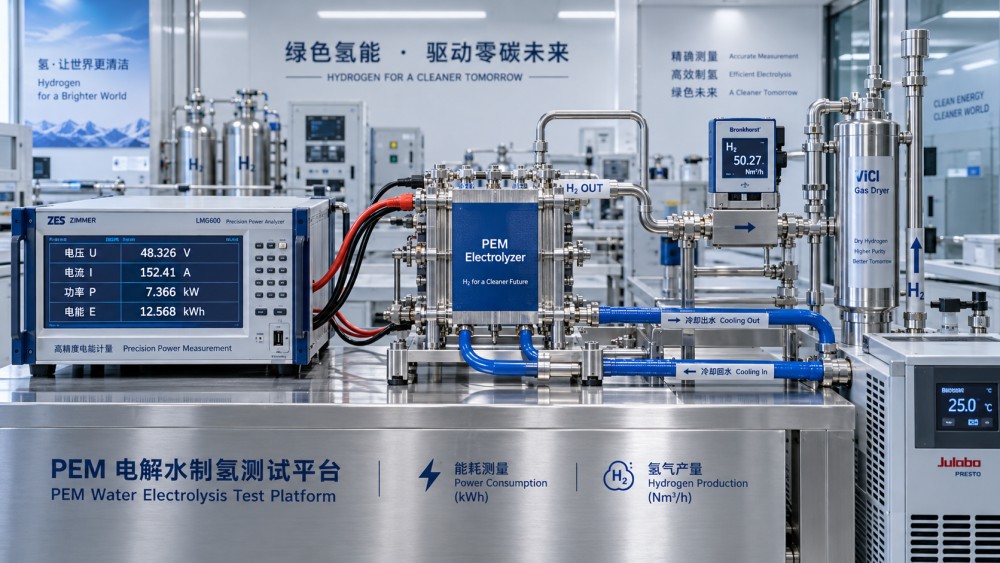
Better efficiency can come from a less demanding operating point
PEM stack performance changes with current density. Increasing current density generally raises cell voltage as electrochemical and resistive losses increase, while producing more hydrogen from a given active area. A benchmark taken at a lighter load can therefore report favorable electricity consumption without demonstrating equivalent production capacity.
The useful comparison pairs energy consumption with hydrogen throughput and active area, or with clearly defined rated capacity when active area is unavailable. Otherwise, a lightly loaded stack can appear superior to a stack operating nearer its intended production rate. Neither result is inherently misleading; the error arises when different operating points are presented as equivalent.
Temperature also changes the result. Warmer operation generally improves reaction kinetics and membrane conductivity, reducing voltage at a comparable current density. That advantage must be evaluated alongside cooling demand, material limits, and durability under the stated conditions. A favorable hot-stack result does not establish favorable whole-system performance if the thermal-management burden falls outside the reported boundary.
Pressure adds a further trade-off. Producing hydrogen at elevated pressure can reduce downstream compression requirements, while changing electrochemical conditions and gas crossover behavior. Comparing a low-pressure stack against a pressurized system solely by stack electricity consumption misses the energy required to deliver both streams at the same final pressure.
A credible ranking should survive comparison at equivalent output conditions. Results measured at different conditions can still be informative, but any adjustment needs an explicit calculation method. Extrapolating beyond tested loads or pressures adds uncertainty that should remain visible in the result.
Hydrogen measurement can change the apparent winner
Electrical measurements often attract the most attention, yet errors in hydrogen accounting directly change the reported kilowatt-hours per kilogram. Wet gas flow requires appropriate correction. Volumetric measurements need declared reference conditions. Flow instruments require calibration appropriate to the gas, pressure, and measurement range.
Theoretical hydrogen production calculated from current is useful as a consistency check, but it is insufficient as the sole output measurement for a delivered-hydrogen benchmark. Gas crossover, venting, purging, and conditioning losses affect how much hydrogen reaches the delivery boundary. Assuming all theoretical production becomes usable output can make reported consumption appear artificially favorable.
Timing matters as well. Gas held temporarily in separators or piping can distort short measurement windows, particularly during startup or load changes. Electricity and delivered hydrogen should be integrated over synchronized periods, with changes in stored gas accounted for where material. Steady-state tests should explain how stable operation was established.
Measurement uncertainty determines whether small differences deserve a ranking. If two reported results differ by less than their combined uncertainty, the evidence does not support a clear efficiency winner. Additional decimal places do not improve confidence unless calibration, repeatability, and the uncertainty calculation justify that precision.
Durability evidence must separate aging from changing conditions
A beginning-of-life result establishes an initial operating point. It says little about electricity consumption after extended service unless it is accompanied by degradation evidence. In a PEM stack, membrane condition, catalyst activity, interfaces, and resistive losses influence how voltage evolves during operation.
Voltage rise is often used to describe degradation, but it needs a stable reference. A hotter stack can show lower voltage even as irreversible deterioration develops. Differences in hydration, pressure, current density, or feedwater quality can also shift voltage without representing the same aging mechanism. Periodic measurements at a common reference condition make those effects easier to distinguish.
Reversible losses require separate treatment. A conditioning procedure or recovery period can restore some performance, so a result recorded immediately afterward may conceal the losses experienced during routine duty. A meaningful test record identifies conditioning events and shows performance before and after them.
Reported operating hours should be accompanied by the duty profile. Continuous operation at a stable load does not establish resistance to repeated starts, shutdowns, standby periods, or variable renewable-power input. Cycling changes thermal and pressure conditions and introduces operating transitions absent from a steady-load test. The relevant question is whether the tested exposure resembles the intended service.
A single average degradation rate can hide an accelerating trend or a late failure. Time-series data, interruptions, maintenance records, and the number of tested units provide stronger evidence. Extrapolating a short, stable interval into a lifetime estimate should remain clearly identified as a projection, with its assumptions stated.
Controlled tests and field records answer different questions
Laboratory testing offers controlled conditions and detailed instrumentation. It is well suited to comparing stack behavior, identifying the effects of operating variables, and repeating measurements. Field records capture interactions with the installed power supply, cooling system, water-treatment equipment, controls, and gas-handling train. Those interactions affect production and electricity consumption even when the stack itself performs as expected.
Neither evidence source replaces the other. A field installation with unsuitable cooling or a restricted operating schedule does not automatically demonstrate poor intrinsic stack performance. Conversely, a successful laboratory test does not demonstrate that an integrated installation will maintain the same operating conditions throughout service.
Annual performance should use total relevant electricity consumption divided by total specification-compliant hydrogen delivered over the same period. This treatment captures startup energy, standby consumption, off-specification output, and interruptions within the declared boundary. A short steady-state measurement answers a narrower question and should retain that label.
Availability also needs a stated definition. Planned maintenance, stack replacement, balance-of-plant failures, and periods without an external power supply have different causes. Combining them into one unexplained percentage makes comparisons difficult. Reporting outage categories alongside production records allows equipment performance and site constraints to be assessed separately.
Water quality illustrates why supporting conditions matter. Contaminants can affect membrane and catalyst performance, while treatment equipment adds maintenance and energy requirements. A test supplied with tightly controlled water cannot be transferred directly to a site with different feedwater conditions unless the treatment boundary and resulting inlet quality are established.
Independent verification is strongest when the record is reproducible
A third-party statement adds confidence only to the extent that its scope is clear. Witnessing one performance run, auditing instruments, reviewing supplied data, and independently repeating a test are different activities. A claim of independent verification should identify which activity occurred, what equipment was covered, and which conclusions were supported.
The evidence should allow the reported value to be recalculated. That requires synchronized electrical and hydrogen data, relevant operating conditions, calibration records, a calculation method, and an explanation of exclusions. Public release of every proprietary detail is unnecessary, but controlled access to sufficient underlying evidence is essential for a technically meaningful audit.
Equipment identity matters. Results from one stack configuration do not automatically transfer to a revised membrane, catalyst loading, active area, power converter, or control strategy. The benchmark should identify the tested configuration and distinguish subsequent changes. Otherwise, a valid measurement can become attached to equipment it never represented.
References to safety or engineering standards need equally careful interpretation. Compliance within a particular scope does not establish efficiency, durability, or a comparative performance ranking. Any cited assessment should be tied to the specific claim it supports, with performance measurements documented separately.
When a benchmark is strong enough to use
Evidence supports different levels of use. A documented stack test can support comparison of electrochemical performance under its stated conditions. An integrated system test can support comparison of electricity consumption at a defined delivery boundary. Extended operating records under representative duty provide the stronger basis for estimating sustained production, degradation, and maintenance exposure.
Procurement specifications can preserve these distinctions by separating guaranteed acceptance-test performance from projected lifetime behavior. The acceptance test needs agreed measurement boundaries, operating conditions, uncertainty treatment, and handling of off-specification gas. A lifetime projection needs an explicit degradation model and a defined operating profile; an initial efficiency guarantee cannot substitute for those inputs.
Where the supporting record contains only headline figures, the appropriate finding is that reliability remains unestablished. Where calibrated measurements, comparable boundaries, representative duty, and traceable verification are available, confidence can attach to the particular claims those records support. The defensible endpoint is a benchmark with a stated range of applicability and uncertainty, so that a measured result is used only as far as its evidence reaches.
Related News
- Electricity Price Volatility Is Rewriting Hydrogen Cost ModelsApr 27, 2026Impact of electricity price on hydrogen cost is transforming industrial decarbonization and large-scale electrolysis. Explore LCOH trends, PPA strategies, and resilient hydrogen infrastructure planning.
- Energy Transition Plans Often Fail at the Grid Connection StageApr 27, 2026Sustainable energy and energy transition projects often fail at grid connection. Learn how hydrogen infrastructure, PEM electrolysis, and industrial decarbonization can avoid delays and protect investment value.
- What Is Slowing Industrial Decarbonization Projects in 2026?Apr 27, 2026Industrial decarbonization faces delays in 2026 as hydrogen infrastructure, sustainable energy access, grid limits, safety standards, and project bankability challenge the energy transition.
- Are G-HEI’s PEM Electrolyzer Benchmarks Reliable?Oct 13, 2026Assess G-HEI PEM electrolyzer benchmarking reliability through test boundaries, hydrogen measurement, and durability evidence. Discover what makes a benchmark worth trusting.
Related News
- 00
0000-00
Hydrogen Energy Storage for Data Centers Gets Costly Fast - 00
0000-00
When 99.999% Hydrogen Purity Still Is Not Good Enough - 00
0000-00
When Does a Hydrogen-Ready Gas Turbine Pay Off? - 00
0000-00
Electricity Price Volatility Is Rewriting Hydrogen Cost Models - 00
0000-00
PSA Recovery Rate Drops for Reasons Operators Miss
Dr. Aris Aero
Weekly Insights
Stay ahead with our curated technology reports delivered every Monday.