Can Benchmarking Tools Reliably Compare Hydrogen Suppliers?




Benchmarking Is Useful, but Only After the Comparison Has a Real Boundary
Can I use benchmarking tools to compare hydrogen economy suppliers? Yes, but the answer is more conditional than many procurement teams expect. A benchmarking platform can quickly organize supplier data, reveal major gaps, and make complex bids easier to compare. It cannot, by itself, prove that two suppliers are technically interchangeable or that the lowest-ranked risk will remain low after equipment reaches the field.
That distinction matters because “hydrogen supplier” can describe very different businesses. One company may provide megawatt-scale PEM electrolyzer stacks, another alkaline electrolyzer balance-of-plant equipment, another liquid hydrogen storage vessels, and another 70 MPa refueling hardware. They may all operate in the hydrogen economy, but they should not be scored through one generic supplier matrix.
For public infrastructure owners, utilities, industrial buyers, and investors, the real task is to compare the supplier against the operating case. A tool becomes reliable when it connects technical evidence, compliance obligations, manufacturing capability, logistics constraints, and lifecycle economics to a defined project boundary. Without that discipline, benchmarking risks becoming a polished comparison of marketing claims.
Start With the Decision You Are Actually Making
Before selecting categories or assigning scores, define what the supplier must deliver and what failure would mean. This sounds basic, yet it is where many comparisons go wrong. A project intended to absorb variable renewable power has different priorities from a refinery replacing captive grey hydrogen. A national liquid hydrogen import terminal has a different risk profile from a regional heavy-duty vehicle refueling network.
The operating model should answer several practical questions:
- What hydrogen volume, purity, pressure, and availability are required at the delivery point?
- Will the asset run steadily, cycle frequently, follow renewable generation, or serve intermittent peak demand?
- What is the consequence of an unplanned outage: lost production, a safety event, a supply interruption, or grid instability?
- Which party owns integration risk between generation, compression, storage, transport, and end use?
- Which standards, permitting rules, local-content obligations, and certification requirements apply in the jurisdictions involved?
- Is the buyer procuring equipment, an integrated package, long-term service, or delivered hydrogen under a performance contract?
These answers determine the weighting model. A hydrogen project that depends on high availability should not treat installed capacity as the dominant criterion. Likewise, a supplier with a strong electrolyzer stack may not be the best partner for a site where water treatment, power conversion, compression, controls integration, and remote service response determine actual plant uptime.
For sovereign-scale projects, the benchmark should also distinguish between a vendor’s ability to sell equipment and its ability to support a strategically important asset through its full operating life. Spare-parts access, cybersecurity governance, engineering documentation, repair rights, and geographic concentration of critical manufacturing may be as material as quoted efficiency.
Compare Like With Like, Then Compare the Interfaces
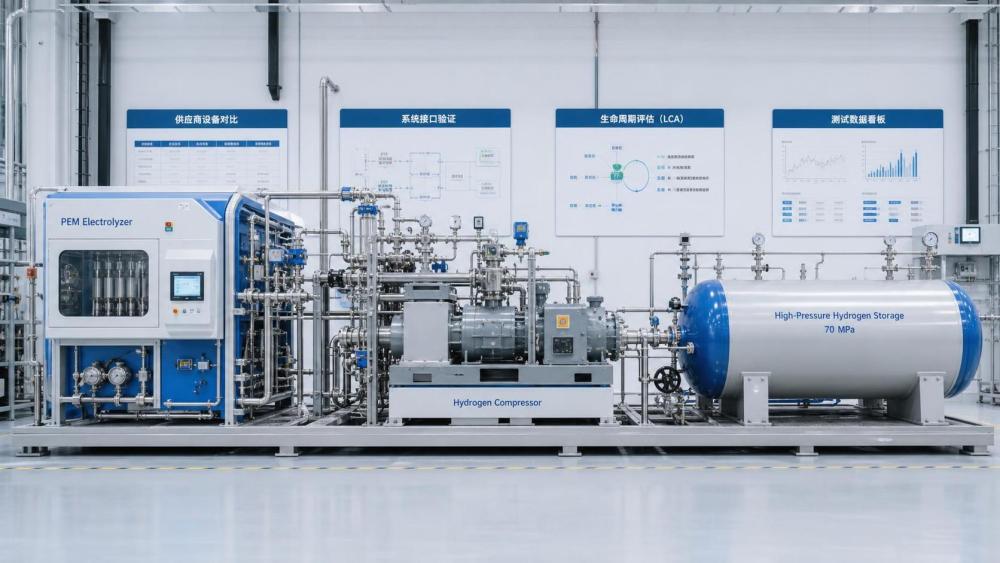
A useful benchmark has two layers. The first compares suppliers within a defined equipment category. The second tests how their equipment behaves at the interfaces where hydrogen projects often fail: electricity input, water supply, gas processing, compression, storage, transport, dispensing, and end-use equipment.
For electrolysis, headline production capacity is only a starting point. Buyers should seek evidence for specific energy consumption under the intended operating profile, hydrogen purity, turndown range, ramp behavior, degradation assumptions, stack replacement requirements, water quality limits, and availability guarantees. PEM and alkaline systems have different operating characteristics and supply-chain exposures; a high-level comparison that treats their nameplate output as equivalent can obscure those differences.
For cryogenic liquid hydrogen logistics, storage volume alone says little about operational fitness. Boil-off management, loading and unloading procedures, insulation performance, pressure-control design, transfer losses, vessel inspection requirements, and emergency isolation arrangements are central. The supplier’s experience may also be limited to stationary storage, while the proposed project requires marine, road, or rail interfaces. Those should not be assumed to be transferable without evidence.
High-pressure refueling systems require another set of tests. A station can meet a nominal pressure rating while still underperforming under realistic vehicle throughput, ambient temperatures, pre-cooling demand, and back-to-back fills. Where applicable, the comparison should map design and operating claims to relevant frameworks such as ISO 19880 and SAE J2601, while confirming the current edition, local adoption status, and scope with qualified compliance specialists.
Pipeline, compressor, and storage decisions also require material-integrity scrutiny. Hydrogen can create risks associated with embrittlement, permeation, seals, welds, fatigue, and pressure cycling. References to ASME B31.12 or other recognized standards are meaningful only when the supplier can show how its design basis, material selection, fabrication controls, testing, and inspection plans align with the project conditions. A standards reference in a brochure is not the same as demonstrated conformity.
Do Not Let Price Become a Substitute for Lifecycle Cost
Hydrogen infrastructure procurement often places excessive confidence in the capital quote because it is visible, comparable, and available early. Yet the commercial difference between proposals may emerge later through electricity consumption, stack life, planned maintenance, compressor downtime, spare-parts pricing, water-treatment requirements, transport losses, and the cost of maintaining a safety case.
A more defensible comparison uses scenario-based lifecycle cost rather than one assumed operating condition. At minimum, test the commercial model against changes in electricity price, renewable curtailment, utilization rate, financing assumptions, replacement intervals, and hydrogen demand. If the supplier’s economics only work at a high capacity factor but the site expects variable renewable input, that inconsistency should be treated as a central decision risk, not a sensitivity footnote.
There is also a difference between a vendor’s warranted performance and an internal financial-model assumption. Benchmarking tools should record both separately. A supplier may estimate a favorable degradation curve, for example, while offering a narrower contractual commitment. Procurement and investment teams need to know which number is enforceable, which is estimated, and which depends on the buyer maintaining site conditions that may be difficult to control.
When comparing delivered hydrogen, define the delivery point precisely. “Cost per kilogram” can refer to hydrogen at the electrolyzer outlet, after purification, at a storage terminal, at a refueling station, or delivered to an industrial consumer. It may or may not include compression, storage losses, transport, certificates, taxes, and infrastructure availability. A benchmark that does not normalize the delivery basis is not comparing the same product.
Score Evidence Quality, Not Just Supplier Performance
One of the most effective changes a buyer can make is to score confidence in the evidence alongside the claimed result. A supplier’s claimed 98 percent availability, for example, should receive a different confidence score depending on whether it is derived from a controlled pilot, a multi-year fleet operating record, an independently witnessed test, or an unverified proposal statement.
This avoids a familiar failure mode: established suppliers can appear less attractive than newer entrants simply because they disclose realistic limits, while newer entrants provide optimistic claims with less operating history. The purpose is not to punish innovation. It is to price uncertainty openly and decide where the project can tolerate it.
A practical evidence hierarchy might give greatest weight to contractual guarantees, third-party certification relevant to the proposed configuration, audited manufacturing records, and operating data from comparable installations. Lower weight should go to laboratory results, generalized references, simulation outputs, and claims that depend on future product releases.
Comparable installation is the crucial phrase. A small demonstration plant does not necessarily validate a utility-scale build. A stationary hydrogen system does not automatically validate mobile refueling duty. A project operating in a mild climate may offer limited evidence for a site with extreme temperatures, limited water availability, salt exposure, or unstable grid conditions.
Audit the Supplier Behind the Equipment
Hydrogen projects are long-lived, but many supply relationships are being formed in a market still scaling its manufacturing capacity. The benchmark should therefore include supplier resilience. This is especially important where components have long lead times, specialized metallurgy, limited qualified fabricators, or concentrated global supply.
Questions worth asking include whether the supplier has qualified production capacity rather than only announced capacity; whether critical components have more than one approved source; whether the organization can provide local commissioning and emergency support; and whether the service organization has authority to resolve technical problems without lengthy escalation.
Financial assessment is relevant, but it should not be reduced to a pass-fail credit check. A supplier may be financially sound while relying on one constrained membrane, catalyst, vessel, valve, or controls supplier. Conversely, an early-stage technology company may offer a valuable capability but require different contract protections, staged acceptance milestones, escrowed technical documentation, or a contingency supply plan.
Cybersecurity and data access deserve similar attention. Modern hydrogen systems are controlled assets, often connected to site energy-management systems, remote diagnostic platforms, and cloud-based performance tools. Buyers should understand who owns operational data, what remote access is available, how patches are governed, and what happens if the service relationship ends. For critical infrastructure, these questions belong in the benchmark and the contract.
Standards Matter Most When They Are Used as Verification Gates
International standards create a common language, but they should not be treated as a universal seal of suitability. ISO 19880, ASME B31.12, SAE J2601, and related standards can help frame design, testing, and operating expectations. Their relevance depends on the asset type, jurisdiction, intended use, and applicable edition. Local regulations, insurer requirements, fire authority expectations, and permitting conditions may impose additional obligations.
The stronger approach is to turn standards into verification gates. Instead of asking whether a bidder is “compliant,” ask for the design documents, test records, certification scope, deviations, and responsible engineering sign-off that demonstrate compliance for the exact configuration being offered. Any exceptions should be visible in the scoring output, assigned an owner, and priced into the risk register.
This is also where independent review has value. A technical advisor, insurer’s engineer, or specialist inspection body can challenge ambiguous claims before they become embedded in a procurement decision. The cost of that review is usually modest relative to redesign, delayed permitting, or a later dispute over performance acceptance.
Use Benchmarking as a Living Procurement Process
The most reliable tools do not deliver a single winner at the end of a spreadsheet exercise. They create an auditable decision record that changes as engineering matures. Early screening can focus on strategic fit, basic technical feasibility, and supply capacity. During tender, the model should become more detailed around warranties, interfaces, delivery schedules, safety documentation, and cost assumptions. Before contract award, it should identify which claims need acceptance tests and which risks require commercial protections.
It is often sensible to run at least three views of the same supplier set: a base-case score, a conservative score using warranted rather than claimed performance, and a disruption score that assumes delays in a critical component or loss of remote support. If the preferred supplier changes dramatically between those views, the decision is not necessarily wrong. It means the buyer has identified a risk that requires executive attention.
The broader hydrogen market will continue to change as policy support, certification methods, electricity availability, manufacturing scale, and end-use demand develop. That makes static vendor rankings quickly obsolete. The useful benchmark is not a league table. It is a disciplined way to understand what a supplier has proven, what it is promising, what the project depends on, and where the buyer still needs protection before committing capital.
- hydrogen economy
- cryogenic liquid hydrogen
- hydrogen storage
- hydrogen infrastructure
- Electrolyzer stacks
- Liquid hydrogen storage
- Hydrogen logistics
- liquid hydrogen logistics
- liquid hydrogen storage vessels
- PEM electrolyzer stacks
- hydrogen storage vessels
- Can I use benchmarking tools to compare hydrogen economy suppliers?
Related News
- Electricity Price Volatility Is Rewriting Hydrogen Cost ModelsApr 27, 2026Impact of electricity price on hydrogen cost is transforming industrial decarbonization and large-scale electrolysis. Explore LCOH trends, PPA strategies, and resilient hydrogen infrastructure planning.
- Energy Transition Plans Often Fail at the Grid Connection StageApr 27, 2026Sustainable energy and energy transition projects often fail at grid connection. Learn how hydrogen infrastructure, PEM electrolysis, and industrial decarbonization can avoid delays and protect investment value.
- What Is Slowing Industrial Decarbonization Projects in 2026?Apr 27, 2026Industrial decarbonization faces delays in 2026 as hydrogen infrastructure, sustainable energy access, grid limits, safety standards, and project bankability challenge the energy transition.
- Can a PEM water electrolysis plant handle variable renewable power?Oct 18, 2026Can a PEM water electrolysis plant handle variable wind and solar power? Explore load limits, hydrogen purity, cycling risks, and design choices to make a smarter investment.
Related News
- 00
0000-00
Hydrogen Energy Storage for Data Centers Gets Costly Fast - 00
0000-00
When 99.999% Hydrogen Purity Still Is Not Good Enough - 00
0000-00
When Does a Hydrogen-Ready Gas Turbine Pay Off? - 00
0000-00
Electricity Price Volatility Is Rewriting Hydrogen Cost Models - 00
0000-00
PSA Recovery Rate Drops for Reasons Operators Miss
Dr. Aris Aero
Weekly Insights
Stay ahead with our curated technology reports delivered every Monday.