Green Hydrogen Certification (GO): What Changes Project Bankability




For finance approvers, green hydrogen certification (GO) is no longer a compliance detail—it is a core factor in project bankability. As hydrogen markets mature, credible guarantees of origin now influence revenue certainty, offtake quality, policy eligibility, and investor confidence. Understanding how certification frameworks reshape risk allocation is essential for evaluating whether a project can move from technical promise to financeable infrastructure.
In 2026, lenders and investment committees are no longer assessing hydrogen projects on electrolyzer efficiency alone. They are testing whether certification can support a durable cash flow model across 10–20 year asset lives, multiple jurisdictions, and increasingly strict carbon-accounting rules.
For institutions operating around sovereign-scale decarbonization, such as utilities, infrastructure funds, export credit stakeholders, and industrial offtakers, green hydrogen certification (GO) now sits beside power sourcing, offtake structure, logistics integrity, and technical compliance as a decisive financing variable.
Why green hydrogen certification (GO) now directly affects bankability
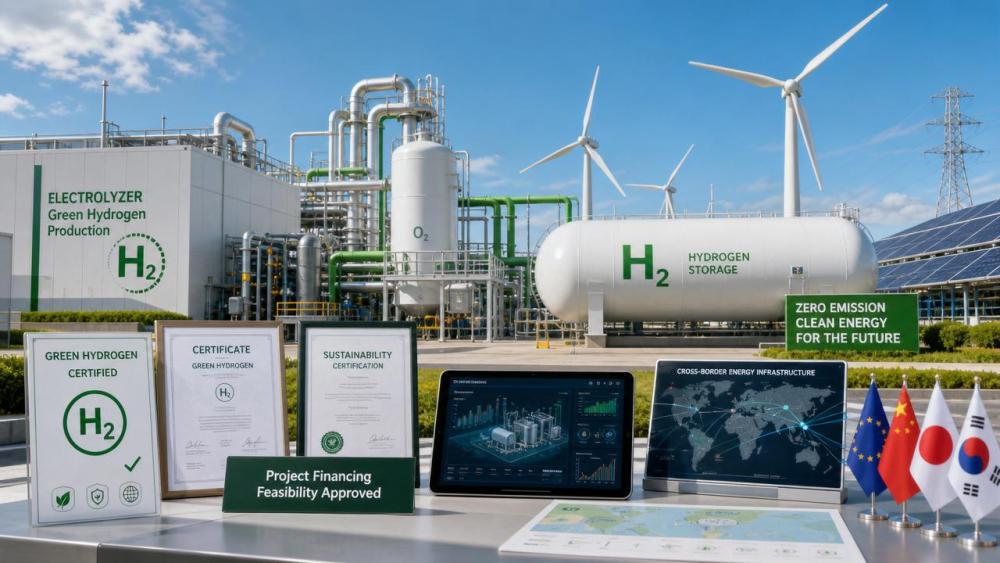
At its core, a guarantee of origin links every kilogram of hydrogen to a verifiable production pathway. For finance approvers, that link matters because it reduces uncertainty in 4 areas: revenue recognition, subsidy eligibility, buyer acceptance, and downstream reporting obligations.
A project may reach mechanical completion in 18–30 months, yet still fail financial close if its certified output cannot be accepted by priority buyers. In practical terms, a 100 MW electrolysis project without accepted certification may face weaker offtake pricing, shorter contract duration, or exclusion from procurement programs.
Certification is no longer just an environmental label
In early hydrogen pilots, certification often functioned as a market differentiator. Today it behaves more like a financing control layer. It determines whether the product qualifies as renewable, whether emissions intensity thresholds are met, and whether counterparties can rely on the environmental attribute in audited statements.
This matters especially in projects tied to grid-connected electrolysis, temporal matching requirements, imported ammonia chains, or hydrogen-ready turbine applications. A mismatch between physical production and documentary proof can erode project value even when technical performance remains within design range.
The financial lens: what lenders and committees are actually checking
Most credit teams review certification through a structured diligence lens rather than a sustainability narrative. They ask whether the GO framework is recognized by the target market, whether issuance is timely, whether chain-of-custody data are auditable, and whether compliance costs are stable over a 5–15 year horizon.
- Does certification support contracted price premiums or market access?
- Can the project maintain eligibility if power sourcing changes within 12–24 months?
- Are metering, data logging, and mass-balance systems robust enough for third-party verification?
- Will non-compliance trigger step-down pricing, cure periods, or contract termination?
Those questions move certification from an ESG discussion into core project finance analysis. For large-scale infrastructure, especially where transport, storage, and industrial conversion are involved, documentation quality can become as material as equipment availability.
The table below outlines how green hydrogen certification (GO) changes the financial risk profile of a project across the approval process.
The key conclusion is simple: certification does not create project value by itself, but it can determine whether value is recognized, contractible, and financeable. For approval teams, that distinction is critical when comparing technically similar projects.
What finance approvers should examine inside a GO framework
Not all certification systems carry the same bankability impact. A finance-grade review should go beyond the headline claim of “renewable hydrogen” and test how the framework handles electricity sourcing, emissions methodology, traceability intervals, verification governance, and transferability across the value chain.
1. Electricity sourcing and matching rules
This is often the first value breakpoint. A project using fully dedicated renewable power may present a cleaner narrative, but many bankable projects rely on hybrid structures: grid supply, power purchase agreements, curtailed renewables, or behind-the-meter assets. Certification rules must clarify how these sources are counted.
Approvers should review whether the framework requires annual, monthly, or hourly matching. Moving from annual to hourly matching can materially change effective electrolyzer utilization, power costs, and certified output volumes. A plant modelled at 55–65% utilization may underperform if certificate rules tighten after close.
Due diligence checkpoints
- Type of renewable power evidence accepted
- Geographic correlation between power source and hydrogen production site
- Temporal matching window and potential future tightening
- Treatment of storage, curtailment, and balancing energy
2. Emissions accounting methodology
A second critical layer is how lifecycle emissions are calculated. Finance teams do not need to perform a laboratory-grade analysis, but they do need clarity on system boundaries. Does the methodology cover water treatment, compression, liquefaction, transport, reconversion, or only production at the electrolyzer boundary?
This becomes especially important in export projects involving ammonia, liquid hydrogen, or tube-trailer delivery. If the project’s sales contract is tied to delivered-carbon intensity rather than plant-gate intensity, certification assumptions must align with the commercial boundary.
3. Auditability, digital traceability, and issuance speed
Certification only supports bankability if data can be verified on time. Delayed certificate issuance by 30–90 days can create cash flow frictions, especially where invoices, premiums, or support payments depend on documentary completion. Metering architecture, timestamp integrity, and reconciliation routines deserve direct review.
In sophisticated projects, the traceability stack spans power input metering, electrolyzer operational logs, compression records, storage withdrawals, and delivery confirmation. Weak integration across these systems increases dispute risk even when hydrogen molecules are physically delivered as agreed.
The table below summarizes the certification design features that most often influence committee confidence and lender appetite.
For finance approvers, the strongest frameworks are not always the most restrictive on paper. They are the ones that remain understandable, auditable, and commercially usable across the project’s operating geography and contractual lifecycle.
How certification changes risk allocation across the hydrogen value chain
One reason green hydrogen certification (GO) matters so much is that it reallocates risk among sponsors, operators, offtakers, traders, and lenders. In conventional energy infrastructure, volume and price risk often dominate. In hydrogen, certification adds a parallel layer of eligibility risk.
Production risk and operational discipline
Sponsors may assume that if the electrolyzer is available and power is procured, hydrogen can be sold. But certification can disqualify portions of output if metering intervals are incomplete, renewable evidence is mismatched, or process emissions exceed the applicable threshold. That turns routine operational issues into revenue events.
This is why technical systems and certification systems must be integrated from day 1. In utility-scale assets, a 1–2% discrepancy in measured energy input or timestamp reconciliation can have outsized consequences when multiplied across 30,000–80,000 operating hours over the financing period.
Offtake risk and contract quality
Offtakers increasingly define product acceptance around certified status, not just delivery quantity. Industrial buyers in refining, steel, chemicals, and mobility applications may include carbon-intensity thresholds, documentary delivery deadlines, or substitution remedies directly in the contract.
For finance committees, this means offtake review must test 3 things at once: physical delivery obligations, certificate transfer mechanics, and failure consequences. A contract that looks robust on volume may still be weak if certificate invalidation automatically triggers price resets or take-or-pay carve-outs.
Infrastructure interfaces: storage, transport, and conversion
In projects involving liquefaction, ammonia synthesis, blending, or export terminals, certification complexity rises with every interface. The more conversion steps involved, the more important it becomes to define where attributes are retained, split, retired, or reissued.
This is highly relevant for the zero-carbon infrastructure environment covered by G-HEI, where electrolysis, cryogenic logistics, hydrogen-ready power systems, and refueling assets interact under strict technical standards. A financeable project needs both asset integrity and documentary continuity.
Common allocation tools used in bankable structures
- Certification compliance covenants at project company level
- Independent verification rights for lenders or facility agents
- Buffer provisions for non-certified output over defined settlement periods
- Step-in or remediation plans if methodology changes within 6–12 months
- Separate treatment of physical hydrogen and environmental attributes in contracts
When these tools are absent, committees often compensate through higher contingency, more conservative debt sizing, or delayed approval pending further legal and technical alignment.
A practical approval framework for evaluating GO-driven bankability
For financial decision-makers, the most effective approach is to turn certification into a structured approval workflow. Instead of asking whether a project is “green enough,” ask whether the certification architecture is resilient enough to support debt, equity, and long-term commercial performance.
Step 1: Test market recognition before technical finalization
Before locking power design or export strategy, confirm which GO systems are accepted by the intended offtaker market. Recognition risk can destroy value late in development. A project designed for one jurisdiction’s rules may need redesign if the destination market requires different temporal or emissions treatment.
Step 2: Align technical design with certification evidence requirements
Metering, SCADA integration, data retention, and batch tracking should be designed to satisfy certification evidence from the start. Retrofitting traceability after EPC award is usually slower and more expensive. In many projects, this work should begin 6–9 months before final investment decision.
Step 3: Reflect certification risk explicitly in contracts
Offtake agreements, O&M scopes, power supply contracts, and logistics contracts should state who bears the cost of certificate failure, methodology change, or delayed issuance. If responsibilities remain vague, the project company often absorbs the risk by default.
Step 4: Build a policy-change stress test
Hydrogen policy remains dynamic. Approval teams should model at least 2–3 downside scenarios, such as tighter hourly matching, stricter lifecycle boundaries, or a reduced list of accepted renewable power sources. A project that remains financeable under these scenarios is materially stronger.
Step 5: Use an integrated technical benchmark
For large-scale assets, certification analysis should not be isolated from materials, safety, transport, and utilization pathways. Electrolyzer selection, cryogenic storage design, hydrogen-ready turbine operation, and fueling infrastructure all influence the data quality and chain-of-custody reliability behind certified output.
This is where benchmark-driven technical review becomes valuable. A disciplined framework that aligns production systems with recognized engineering and infrastructure standards helps finance teams assess whether certified claims can be sustained operationally, not just promised contractually.
Frequent approval mistakes and how to avoid them
Assuming certification is interchangeable across markets
One common mistake is assuming that any green hydrogen certification (GO) will satisfy every buyer or regulator. In reality, equivalence is often partial, conditional, or still evolving. Approval should be tied to the specific sales market, not a generic “green” claim.
Underestimating documentary operating costs
Another mistake is treating certification as a one-off audit. In practice, projects may require recurring verification, data reconciliation, registry interaction, and compliance reporting over the full asset life. These costs may be modest per kilogram, but they are not negligible at infrastructure scale.
Separating technical integrity from certification integrity
A project may comply with critical engineering standards such as ISO 19880, ASME B31.12, or SAE J2601 where relevant, yet still face commercial weakness if the certification chain is fragmented. Finance approvers should treat technical conformity and certification credibility as linked, not separate, pillars.
Ignoring change management after financial close
A final error is assuming the certification environment stays fixed. Market rules can evolve over 12–36 months, especially in scaling sectors. Bankable projects include governance for methodology updates, document retention, and operational adaptation rather than relying on static assumptions.
Green hydrogen certification (GO) has become a commercial and financial control point, not just a sustainability credential. For finance approvers, the decisive question is whether the certification framework can preserve revenue quality, contractual enforceability, and policy alignment across the full infrastructure chain.
Projects that combine robust certification design with disciplined technical benchmarking are more likely to secure lender confidence, withstand regulatory change, and convert low-carbon ambition into durable asset performance. If you are evaluating hydrogen production, storage, transport, or utilization infrastructure, now is the time to assess certification readiness with the same rigor applied to EPC, safety, and offtake risk.
To explore a more decision-ready framework for bankable hydrogen infrastructure, contact G-HEI, request a tailored assessment, or learn more about benchmark-driven solutions for green hydrogen certification, technical compliance, and zero-carbon project execution.
Related News
- Electricity Price Volatility Is Rewriting Hydrogen Cost ModelsApr 27, 2026Impact of electricity price on hydrogen cost is transforming industrial decarbonization and large-scale electrolysis. Explore LCOH trends, PPA strategies, and resilient hydrogen infrastructure planning.
- Energy Transition Plans Often Fail at the Grid Connection StageApr 27, 2026Sustainable energy and energy transition projects often fail at grid connection. Learn how hydrogen infrastructure, PEM electrolysis, and industrial decarbonization can avoid delays and protect investment value.
- What Is Slowing Industrial Decarbonization Projects in 2026?Apr 27, 2026Industrial decarbonization faces delays in 2026 as hydrogen infrastructure, sustainable energy access, grid limits, safety standards, and project bankability challenge the energy transition.
- When do industrial parks need megawatt-scale hydrogen production?Sep 28, 2026Hydrogen for industrial projects: discover when industrial parks need megawatt-scale production, from firm demand and power supply to storage, safety, and phased hub design.
Related News
- 00
0000-00
Hydrogen Energy Storage for Data Centers Gets Costly Fast - 00
0000-00
When 99.999% Hydrogen Purity Still Is Not Good Enough - 00
0000-00
When Does a Hydrogen-Ready Gas Turbine Pay Off? - 00
0000-00
Electricity Price Volatility Is Rewriting Hydrogen Cost Models - 00
0000-00
PSA Recovery Rate Drops for Reasons Operators Miss
Dr. Aris Aero
Weekly Insights
Stay ahead with our curated technology reports delivered every Monday.