PPA for Hydrogen: What Terms Change Project Bankability




For finance decision-makers, a PPA (Power Purchase Agreement) for hydrogen is no longer just a supply contract—it is a core determinant of project bankability. Pricing formulas, offtake commitments, credit support, curtailment clauses, and indexation mechanisms can materially reshape lender confidence, cash-flow visibility, and long-term risk allocation across hydrogen infrastructure investments.
In the hydrogen economy, power cost often defines competitiveness more than equipment cost. A weak PPA for hydrogen can undermine a technically strong project. A well-structured contract can unlock debt, improve valuation, and reduce refinancing pressure.
This matters across integrated energy systems, export hubs, industrial decarbonization projects, and sovereign infrastructure programs. For platforms such as G-HEI, the commercial architecture around energy supply now sits beside safety, efficiency, and asset integrity as a strategic benchmark.
When project context changes, the right PPA for hydrogen also changes
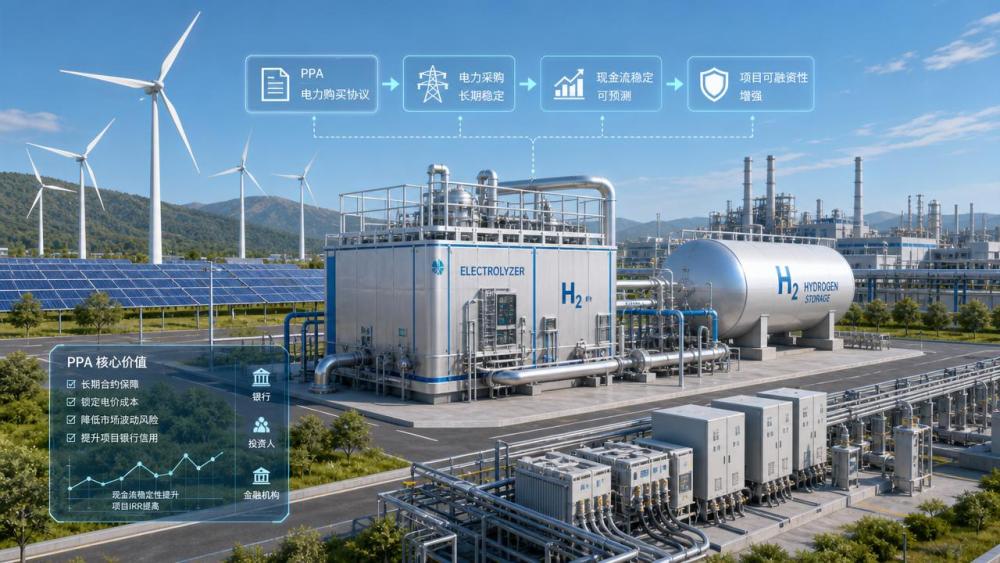
Not every hydrogen project should sign the same PPA (Power Purchase Agreement) for hydrogen. Bankability depends on production profile, grid exposure, storage design, offtake structure, and regulatory treatment of renewable attributes.
A baseload industrial hydrogen plant needs different protections than a merchant export terminal. A co-located electrolyzer with dedicated renewables faces different risks than a grid-connected plant buying shaped power.
The key question is not whether the PPA is renewable. The real question is whether the contract allocates energy, price, and availability risk in a way lenders can model with confidence.
Scenario 1: Industrial decarbonization projects need cash-flow certainty first
Hydrogen supply for refineries, ammonia, methanol, steel, or chemicals usually prioritizes stable production. In these settings, a PPA for hydrogen must support predictable electricity cost and operational continuity.
Lenders usually test whether the power contract aligns with plant utilization targets. If the electrolyzer requires high load factors, intermittent supply without firm balancing support can weaken debt sizing assumptions.
Core judgment points in this scenario
- Is the electricity price fixed, indexed, or partially floating?
- Does the contract include minimum delivery obligations?
- Who absorbs balancing and shaping costs?
- Can curtailment trigger compensation or replacement power?
- Are renewable certificates contractually secured and auditable?
For these projects, the best PPA (Power Purchase Agreement) for hydrogen often looks less like a merchant energy deal and more like infrastructure risk engineering. Contract simplicity can be more valuable than apparent headline discounts.
Scenario 2: Export-oriented hydrogen hubs need flexibility and traceability
Projects targeting ammonia exports, liquid hydrogen shipping, or cross-border green fuels face stricter requirements. Their PPA for hydrogen must satisfy not only economics, but also certification rules, carbon accounting, and delivery timing.
In this scenario, hourly matching rules, temporal correlation, and emissions-factor methodologies can directly affect product eligibility. A cheap power contract can become a liability if it weakens market access.
Core judgment points in this scenario
- Does the PPA support recognized green hydrogen certification?
- Can renewable attributes be transferred without legal ambiguity?
- Is hourly or sub-hourly matching required by the target market?
- Are congestion and curtailment risks reflected in export volume planning?
- Can future regulation change the value of contracted power attributes?
For global benchmark platforms like G-HEI, this is where contract design intersects with sovereign competitiveness. Traceable low-carbon power is becoming an infrastructure qualification issue, not only a procurement issue.
Scenario 3: Grid-connected merchant projects are shaped by downside protection
Some hydrogen assets are built around power market volatility. They buy electricity when prices are low, reduce load when prices rise, and monetize flexibility. In this model, the PPA for hydrogen cannot eliminate all risk.
Instead, the contract should define acceptable downside. Floors, collars, optional volumes, and imbalance-sharing mechanisms become more important than pure fixed pricing. Bankability depends on disciplined risk boundaries.
Core judgment points in this scenario
- Is there a pricing floor to protect minimum contribution margin?
- Can volumes be flexed without punitive take-or-pay exposure?
- How are negative prices treated in settlement?
- Who carries imbalance costs during operational ramping?
- Does the credit package match merchant revenue volatility?
A merchant-friendly PPA (Power Purchase Agreement) for hydrogen should still provide lender visibility. If every major variable floats, the project may remain equity-heavy longer than expected.
Which PPA terms most often change hydrogen project bankability
Across scenarios, several contract terms consistently drive credit outcomes. These terms affect debt service coverage, reserve sizing, contingency assumptions, and sponsor support requirements.
How scenario-driven needs differ across hydrogen infrastructure models
The same PPA (Power Purchase Agreement) for hydrogen can be strong in one setting and weak in another. Comparing scenarios helps clarify what should be negotiated first.
Practical adaptation steps before signing a PPA for hydrogen
A bankable structure usually starts with an integrated model, not a term sheet alone. Technical design, energy profile, storage strategy, and offtake obligations should be modeled together.
- Map hourly power needs against electrolyzer flexibility and maintenance assumptions.
- Test multiple price paths, including curtailment, congestion, and negative-price periods.
- Verify that renewable attributes match target certification and disclosure rules.
- Stress-test counterparty strength and replacement cost if default occurs.
- Align PPA tenor with debt tenor, equipment life, and offtake commitments.
- Review change-in-law clauses for carbon accounting and grid access rules.
For zero-carbon infrastructure, commercial terms should be benchmarked with the same rigor as pressure systems, cryogenic logistics, or electrolyzer efficiency. Weak contract architecture can impair strong physical assets.
Common misjudgments that weaken project finance outcomes
One frequent mistake is focusing only on the lowest nominal electricity price. A low tariff with broad curtailment rights or unclear balancing obligations may produce worse long-term economics.
Another mistake is assuming certification value will remain constant. In hydrogen markets, rules around additionality, temporal matching, and emissions accounting may evolve faster than contract terms.
A third issue is contract mismatch. If the PPA for hydrogen is short, but debt and offtake are long, refinancing risk can grow. Lenders often discount projected margins beyond the contracted period.
Credit risk is also underestimated. Counterparty weakness, collateral gaps, and uncertain step-in rights can materially reduce financing appetite, even when headline project economics look attractive.
Next-step framework for evaluating a PPA (Power Purchase Agreement) for hydrogen
The most effective next step is a scenario-based contract review. Start by classifying the project as baseload, export-led, merchant-flexible, or hybrid. Then test whether each key term supports that operating reality.
A robust PPA for hydrogen should answer five questions clearly: what power is delivered, when it is delivered, how it is priced, who carries disruption risk, and whether environmental attributes remain financeable.
In today’s hydrogen market, bankability is built at the contract level as much as at the equipment level. Projects that align PPA structure with asset design, certification logic, and debt expectations are better positioned to scale.
Related News
- Electricity Price Volatility Is Rewriting Hydrogen Cost ModelsApr 27, 2026Impact of electricity price on hydrogen cost is transforming industrial decarbonization and large-scale electrolysis. Explore LCOH trends, PPA strategies, and resilient hydrogen infrastructure planning.
- Energy Transition Plans Often Fail at the Grid Connection StageApr 27, 2026Sustainable energy and energy transition projects often fail at grid connection. Learn how hydrogen infrastructure, PEM electrolysis, and industrial decarbonization can avoid delays and protect investment value.
- What Is Slowing Industrial Decarbonization Projects in 2026?Apr 27, 2026Industrial decarbonization faces delays in 2026 as hydrogen infrastructure, sustainable energy access, grid limits, safety standards, and project bankability challenge the energy transition.
- AEM Stability Remains the Big Question for Scale-UpApr 27, 2026Anion exchange membrane stability is the key barrier to large-scale electrolysis. Discover how AEM impacts industrial decarbonization, hydrogen infrastructure, safety, and scale-up economics.
Related News
- 00
0000-00
Hydrogen Energy Storage for Data Centers Gets Costly Fast - 00
0000-00
When 99.999% Hydrogen Purity Still Is Not Good Enough - 00
0000-00
When Does a Hydrogen-Ready Gas Turbine Pay Off? - 00
0000-00
Electricity Price Volatility Is Rewriting Hydrogen Cost Models - 00
0000-00
PSA Recovery Rate Drops for Reasons Operators Miss
Dr. Aris Aero
Weekly Insights
Stay ahead with our curated technology reports delivered every Monday.