Wind-to-Hydrogen Project ROI: What Makes the Payback Drift Off Plan




For financial approvers, wind-to-hydrogen project ROI rarely misses target because of one headline variable alone. Payback often drifts when capex assumptions, electrolyzer utilization, power-price volatility, storage constraints, and compliance costs interact in ways early models understate. This article examines the hidden drivers behind return erosion and shows how to evaluate bankability with a more disciplined, infrastructure-level lens.
Why a checklist-first review is the right way to assess bankability
For finance teams, the main risk in evaluating wind-to-hydrogen project ROI is not a lack of ambition. It is approving a model that looks robust in isolation while its assumptions fail once connected to the real operating chain. A wind-powered hydrogen project ties together renewable generation, electrolyzer loading, water treatment, compression, storage, transport, offtake, and compliance. If one block underperforms, the cash flow profile can shift quickly.
That is why a checklist approach works better than a single headline metric. It forces decision-makers to test not just expected return, but return resilience. For large-scale hydrogen infrastructure, especially in sovereign and utility-grade contexts, ROI should be reviewed as a system outcome shaped by asset integrity, utilization discipline, market access, and standards-driven execution.
First-pass checklist: the items financial approvers should verify before trusting projected wind-to-hydrogen project ROI
- Confirm whether the model uses realistic wind capacity factors by season, not annual averages only.
- Check if electrolyzer utilization is based on actual wind intermittency, curtailment, and maintenance windows.
- Verify whether capex includes compression, storage, interconnection, water purification, safety systems, and civil works.
- Review whether the project assumes merchant hydrogen pricing or contracted offtake, and how price downside is handled.
- Test the impact of degradation in wind assets and electrolyzer stacks over the full investment horizon.
- Confirm grid backup assumptions, balancing costs, and the cost of maintaining hydrogen quality during variable operation.
- Check whether compliance with ISO 19880, ASME B31.12, SAE J2601, and related permitting obligations is budgeted.
- Review logistics constraints: on-site storage, tube trailer dispatch, liquefaction options, or pipeline readiness.
- Ensure tax incentives, carbon credits, or subsidy support are modeled conservatively, not as guaranteed value.
The five biggest causes of ROI drift
1. Utilization assumptions that do not match wind reality
A frequent reason wind-to-hydrogen project ROI underperforms is that electrolyzer utilization is built from nameplate logic instead of dispatch reality. Wind does not arrive in a flat profile, and electrolyzers do not always operate efficiently across the full load range. If the financial model assumes high operating hours without accounting for start-stop cycling, partial-load efficiency loss, and downtime coordination, the levelized hydrogen cost will be understated.
Financial approvers should ask for an hourly or sub-hourly operating simulation, not just annual averages. The key question is simple: how many kilograms of compliant hydrogen can the system deliver after real intermittency, not before it?
2. Capex scope gaps hidden outside the electrolyzer package
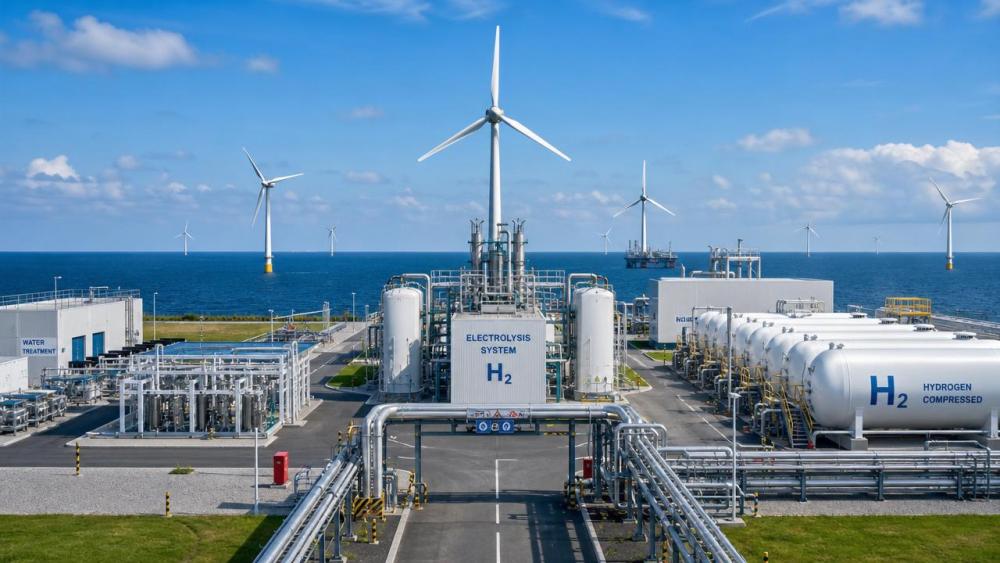
Many proposals present the electrolyzer as the centerpiece and push surrounding infrastructure into secondary budgets. Yet wind-to-hydrogen project ROI is often damaged by costs outside the stack itself. These include foundations, transformers, rectifiers, deionized water systems, compression trains, storage vessels, fire protection, vent systems, instrumentation, hazardous area design, and redundant safety controls.
In utility-scale settings, the balance of plant can materially reshape payback. The review standard should be: if the item is required to produce, condition, store, or export hydrogen safely, it belongs in the ROI case.
3. Revenue modeled from ideal offtake rather than constrained market access
Hydrogen demand may look strong on strategy slides, but wind-to-hydrogen project ROI depends on bankable demand, not theoretical demand. A project with no firm offtake contract may face lower delivered prices, volume variability, or delayed ramp-up. If transport or storage infrastructure is not synchronized with production, hydrogen can become stranded inventory rather than monetized output.
Approvers should separate three revenue cases: contracted base volume, probable spot or indexed volume, and speculative upside. A project relying too heavily on upside pricing usually carries a wider payback drift risk than sponsors admit.
4. Compliance, integrity, and permitting costs that appear late
For strategic hydrogen infrastructure, compliance is not an administrative side note. It affects design choices, material selection, inspection frequency, and commissioning timelines. Hydrogen embrittlement risk, pressure-system rules, fueling specifications, cryogenic interfaces, and emergency shutdown architecture all influence capex and opex. If these items are introduced after front-end financial approval, wind-to-hydrogen project ROI can drift significantly.
This is especially relevant where public-sector scrutiny, sovereign procurement, or export certification is involved. The higher the technical standard, the more dangerous it is to use a generic energy-project cost template.
5. Underestimating degradation and replacement cycles
Electrolyzer stacks degrade. Wind assets degrade. Compressors wear under cycling duty. Storage systems and seals require maintenance that can escalate with high-pressure service. Yet some investment cases use flat-performance assumptions for too long. This can create a false impression of smooth cash generation and a shorter payback period than operations can sustain.
A better review asks whether replacement reserves, efficiency decay, and major maintenance intervals are explicitly modeled. If not, wind-to-hydrogen project ROI is being judged on a best-case technical profile instead of an investable one.
A practical decision table for financial review
How project context changes the ROI checklist
For utility-scale power firms
If the sponsor is a utility-scale power firm, wind-to-hydrogen project ROI should be examined alongside transmission strategy, curtailment reduction value, and flexible dispatch potential. The project may create system benefits beyond direct hydrogen sales, but those benefits must be quantified carefully. Do not let grid-support narratives replace measurable cash value unless policy mechanisms make them monetizable.
For national or sovereign infrastructure planners
Where the project supports energy sovereignty, industrial decarbonization, or strategic export positioning, payback may be judged on wider criteria. Even then, financial approvers should isolate the commercial case from the policy case. Wind-to-hydrogen project ROI can be acceptable at a sovereign level, but only if non-financial benefits are explicitly valued rather than silently used to hide weak project economics.
For investors focused on bankability and downside protection
Investment directors typically need downside discipline more than headline upside. Their review should prioritize covenant resilience, merchant exposure, technology warranty strength, replacement liabilities, and the alignment between production profile and offtake commitment. In many cases, a slightly lower nominal return with stronger operational certainty is more financeable than an aggressive wind-to-hydrogen project ROI forecast built on fragile assumptions.
Commonly missed issues that move payback off plan
- Water sourcing risk is underestimated in dry regions or where treatment quality is stricter than expected.
- Hydrogen purity requirements for downstream users create extra conditioning or rejection losses.
- Compression energy demand is treated as minor, although it can materially affect operating cost.
- Permitting lead times delay revenue start while interest during construction grows.
- Interconnection upgrades and grid-code requirements are budgeted too late.
- Insurance premiums and risk engineering obligations are not reflected in early financial models.
- Domestic content, safety audits, and export certification rules alter procurement cost and schedule.
Execution advice: what to request before approval
Before approving a project or moving to final investment decision, finance leaders should request a concise but disciplined data pack. This should include an hourly energy-to-hydrogen model, a full balance-of-plant capex breakdown, a degradation and replacement schedule, the standards compliance matrix, a logistics plan for storage and delivery, and sensitivity analysis for hydrogen price, capacity factor, utilization, and cost of capital.
It is also wise to ask one direct question: what must go right for the base-case wind-to-hydrogen project ROI to occur? The more dependencies a sponsor lists, the more carefully downside scenarios should be weighted. A strong proposal can explain not only the upside case, but the mechanisms that protect cash flow when weather, market price, or permitting do not cooperate.
FAQ for financial approvers
Is the lowest electrolyzer capex always best for wind-to-hydrogen project ROI?
No. Lower equipment cost can be offset by lower efficiency, poorer turndown behavior, weaker warranties, or higher replacement frequency. ROI depends on life-cycle economics, not procurement price alone.
Should a model rely on average annual wind output?
Not by itself. Average annual output can hide volatility that affects electrolyzer loading, hydrogen quality control, and storage needs. Temporal granularity is essential for realistic ROI assessment.
Can policy incentives make a weak project acceptable?
They can improve returns, but they should not replace operational discipline. If incentives expire, are delayed, or become conditional, a weak core project may still fail to meet expected payback.
Final action guide
The most reliable way to judge wind-to-hydrogen project ROI is to treat it as an integrated infrastructure review, not a narrow generation-plus-electrolyzer estimate. Financial approvers should prioritize checklist-based validation of utilization, full-scope capex, contracted demand, compliance exposure, logistics readiness, and asset-life assumptions. That approach reduces the chance of approving a project whose payback only works on paper.
If your organization needs to confirm parameters, scenario sensitivity, standards alignment, technology fit, timeline risk, or budget realism, the first discussion should focus on production profile, balance-of-plant scope, offtake structure, safety and certification pathway, and replacement-cycle economics. Those are the questions that most often determine whether wind-to-hydrogen project ROI holds steady or drifts off plan.
Related News
- Electricity Price Volatility Is Rewriting Hydrogen Cost ModelsApr 27, 2026Impact of electricity price on hydrogen cost is transforming industrial decarbonization and large-scale electrolysis. Explore LCOH trends, PPA strategies, and resilient hydrogen infrastructure planning.
- Energy Transition Plans Often Fail at the Grid Connection StageApr 27, 2026Sustainable energy and energy transition projects often fail at grid connection. Learn how hydrogen infrastructure, PEM electrolysis, and industrial decarbonization can avoid delays and protect investment value.
- What Is Slowing Industrial Decarbonization Projects in 2026?Apr 27, 2026Industrial decarbonization faces delays in 2026 as hydrogen infrastructure, sustainable energy access, grid limits, safety standards, and project bankability challenge the energy transition.
- AEM Stability Remains the Big Question for Scale-UpApr 27, 2026Anion exchange membrane stability is the key barrier to large-scale electrolysis. Discover how AEM impacts industrial decarbonization, hydrogen infrastructure, safety, and scale-up economics.
Related News
- 00
0000-00
Hydrogen Energy Storage for Data Centers Gets Costly Fast - 00
0000-00
When 99.999% Hydrogen Purity Still Is Not Good Enough - 00
0000-00
When Does a Hydrogen-Ready Gas Turbine Pay Off? - 00
0000-00
Electricity Price Volatility Is Rewriting Hydrogen Cost Models - 00
0000-00
PSA Recovery Rate Drops for Reasons Operators Miss
Dr. Aris Aero
Weekly Insights
Stay ahead with our curated technology reports delivered every Monday.