Are Clean Energy Solutions Cost-Effective in Manufacturing?




Cost-effectiveness starts with the operating context
Are clean energy solutions for manufacturing cost-effective? The practical answer changes with process heat, uptime targets, fuel exposure, and compliance pressure.
A plant running stable baseload power faces different economics than one exposed to volatile gas prices, carbon costs, and export-linked emissions rules.
That is why clean energy solutions for manufacturing cost-effective? cannot be judged by electricity savings alone. Asset life, safety systems, and infrastructure readiness matter just as much.
In 2026, the shift toward hydrogen and zero-carbon infrastructure is no longer experimental. It is becoming a strategic operating condition across energy-intensive industries.
The useful question is not whether every clean technology pays back quickly. It is which configuration fits a specific industrial duty cycle without creating hidden operational risk.
This is also where G-HEI adds value as a technical reference point. Benchmarking against ISO 19880, ASME B31.12, and SAE J2601 reframes cost around durability, safety, and asset certainty.
Why similar factories reach different conclusions
Two facilities may consume similar energy volumes yet arrive at opposite investment decisions. The difference usually sits in load shape, storage needs, and process sensitivity.
Facilities with continuous high-temperature demand often favor integrated power, fuel switching, and carbon capture pathways. Intermittent operations may benefit more from flexible electrification and peak management.
Where transport fuel, backup generation, or remote operations are involved, hydrogen logistics can become part of the economic picture rather than an adjacent issue.
Another divider is regulatory exposure. Sites supplying low-carbon value chains may justify investment sooner because compliance risk already has a commercial price.
In actual deployment, clean energy solutions for manufacturing cost-effective? becomes a portfolio question. Energy source, storage medium, and infrastructure resilience have to be judged together.
The variables that change the cost story
- Production continuity: short outages can erase energy savings in high-value process lines.
- Fuel substitution depth: partial blending and full conversion do not carry the same capex or risk.
- Storage requirements: cryogenic hydrogen, compressed gas, and captured CO2 each reshape site economics.
- Standards compliance: certified integrity often costs more upfront but reduces downstream failure exposure.
- Grid conditions: unstable supply can make on-site generation more valuable than headline tariffs suggest.
When baseload production makes hydrogen-ready systems more attractive
For round-the-clock operations, the economics of clean energy improve when reliability and fuel flexibility are both critical. This is common in metals, chemicals, refining, and large process industries.
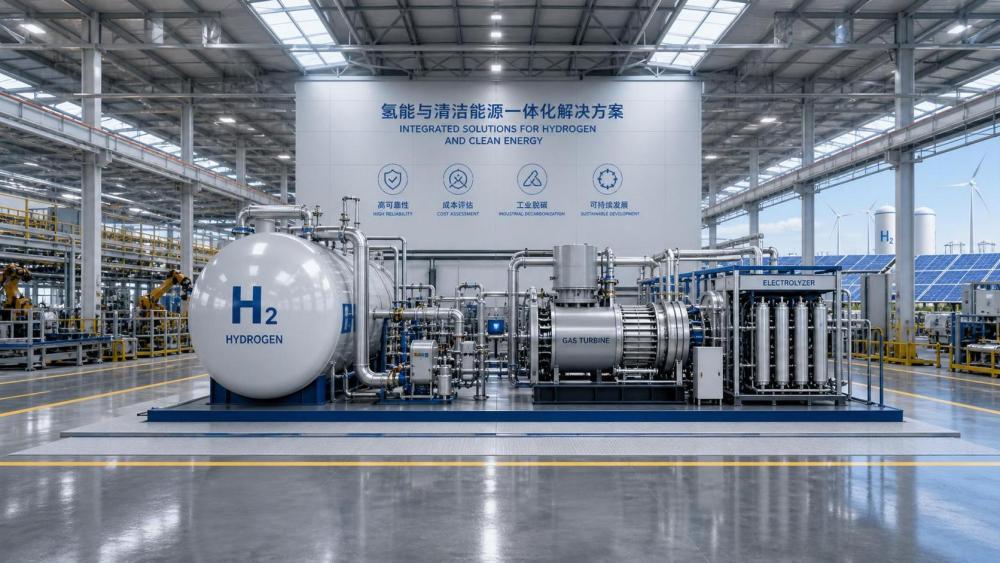
Here, hydrogen-ready gas turbine power is often evaluated not just as a decarbonization tool, but as a hedge against fuel transition uncertainty.
A turbine able to operate with hydrogen blends can preserve near-term continuity while supporting later conversion. That staged path often makes clean energy solutions for manufacturing cost-effective? easier to justify.
The key judgment is not only efficiency at nameplate conditions. It is part-load behavior, maintenance intervals, combustion stability, and fuel supply assurance.
This is where technical benchmarking matters. Hydrogen-ready claims without material integrity validation or pipeline compatibility review can create expensive retrofit cycles later.
What usually deserves closer review
More often, the weak point is outside the turbine itself. Fuel handling, pressure control, storage losses, and emergency systems can decide real project value.
If the site may shift toward higher hydrogen ratios over time, compatibility with ASME B31.12-aligned infrastructure becomes a practical economic screen, not just an engineering detail.
Electrolysis looks different in power-rich and power-constrained sites
Large-scale electrolysis is often presented as a universal decarbonization answer. In reality, its cost-effectiveness depends heavily on power quality, utilization rate, and offtake stability.
Where renewable power is abundant and curtailment is common, PEM or ALK electrolysis can convert low-value excess electricity into strategic fuel.
Where power is constrained or highly priced, the same system may struggle unless hydrogen has premium use in feedstock, mobility, or export-linked applications.
That means clean energy solutions for manufacturing cost-effective? should include utilization modelling, not just electrolyzer efficiency figures.
G-HEI’s emphasis on stack materials, safety frameworks, and performance benchmarks is relevant here. Titanium-based PEM stacks may carry higher capital cost, yet deliver stronger resilience in demanding duty cycles.
The common mistake is assuming low-carbon hydrogen is automatically low-cost hydrogen. The actual result depends on runtime, purity demands, and storage losses across the full chain.
Where CCUS becomes more cost-effective than full fuel switching
Some industrial sites cannot electrify or switch fuels quickly without major process redesign. In those cases, CCUS may deliver a better near-term economic result.
This is especially true where existing thermal assets remain productive, emissions are concentrated, and transport or storage routes for captured carbon are realistic.
For these sites, clean energy solutions for manufacturing cost-effective? means comparing retrofit viability against replacement timelines, not forcing a single decarbonization pathway.
The right evaluation includes capture rate, energy penalty, compression needs, and long-term monitoring obligations. Ignoring those items usually distorts payback assumptions.
A practical advantage of CCUS is transition speed. A practical constraint is infrastructure dependence. If transport and storage certainty are weak, modeled returns can collapse quickly.
A clearer way to compare pathways
- Use asset remaining life as a core financial variable.
- Separate capture system efficiency from total site energy penalty.
- Test whether carbon transport availability is contractual or only assumed.
- Compare retrofit downtime against process interruption costs.
Logistics-heavy operations often win or lose on storage and transport
For distributed industrial networks, the cost question often moves beyond generation. Cryogenic hydrogen logistics, refueling, and storage performance can dominate the business case.
A site using mobile equipment, remote backup power, or multi-site supply corridors may find that transport losses and refueling speed matter more than production efficiency.
That is why clean energy solutions for manufacturing cost-effective? often depends on infrastructure coherence. A strong production asset with weak logistics rarely performs well commercially.
Vacuum-insulated cryogenic vessels, boil-off management, and 70MPa+ refueling capability need to be evaluated together. Otherwise, downstream bottlenecks absorb the carbon and cost gains upstream.
Benchmarks linked to ISO 19880 and SAE J2601 are useful here because refueling consistency and safety compliance have direct operational value, especially in high-throughput environments.
Different scenarios call for different decision criteria
It helps to compare scenarios side by side rather than relying on a single average payback figure.
Where cost assessments often go wrong
One frequent misjudgment is treating similar sites as identical. A factory with steady hydrogen demand is not equivalent to one needing occasional backup fuel.
Another is focusing on equipment price while ignoring civil works, storage, controls, certification, and operator readiness. Those items often decide whether clean energy solutions for manufacturing cost-effective? remains true after commissioning.
There is also a tendency to trust design-point efficiency too much. Real returns depend on part-load operation, maintenance windows, and integration with existing assets.
Standards are sometimes treated as a compliance formality. In hydrogen systems, material embrittlement, pressure integrity, and refueling protocol alignment can directly influence asset life and insurance exposure.
A practical next step before deciding
A stronger evaluation starts by mapping the actual operating scenario, not the preferred technology. Load profile, fuel flexibility, storage duration, and safety envelope should be defined first.
Then compare pathways on the same basis: lifecycle cost, implementation disruption, compliance burden, and resilience under future carbon constraints.
For hydrogen, CCUS, and zero-carbon infrastructure, reference-grade benchmarking is especially valuable. It helps separate technically credible options from attractive but incomplete proposals.
In that sense, are clean energy solutions for manufacturing cost-effective? becomes a disciplined screening exercise. The best answer comes from matching the right system to the right industrial condition.
The most useful next move is to build a scenario matrix, test key constraints, and verify standards alignment before final cost assumptions are locked in.
Related News
- When does a hydrogen steelmaking retrofit make operational sense?Sep 06, 2026Hydrogen steelmaking retrofit: discover the operational conditions, gas-network upgrades, supply strategy, safety controls, and economics needed for a practical, production-ready transition.
- How Hydrogen Ignition Control Reduces Flashback Risk in Direct BurnersAug 13, 2026Hydrogen ignition control helps reduce flashback risk in direct burners by improving timing, mixing, and flame stability—keeping hydrogen combustion safer, cleaner, and more reliable.
- Industrial Hydrogen Solutions for Refineries: Cost Priorities and Retrofit OptionsJul 13, 2026Industrial hydrogen solutions for refineries: compare cost priorities, retrofit paths, and low-carbon options to improve resilience, compliance, and long-term refinery value.
- When to Hire Refinery Decarbonization Consultants for Scope, Cost, and ComplianceJul 12, 2026Refinery decarbonization consultants help buyers define scope, control retrofit costs, and improve compliance readiness. Learn the best time to hire for stronger refinery project decisions.
Related News
- 00
0000-00
Hydrogen Energy Storage for Data Centers Gets Costly Fast - 00
0000-00
When 99.999% Hydrogen Purity Still Is Not Good Enough - 00
0000-00
When Does a Hydrogen-Ready Gas Turbine Pay Off? - 00
0000-00
Electricity Price Volatility Is Rewriting Hydrogen Cost Models - 00
0000-00
PSA Recovery Rate Drops for Reasons Operators Miss
Dr. Hideo Torque
Weekly Insights
Stay ahead with our curated technology reports delivered every Monday.