Refinery Decarbonization Strategies Using Direct Hydrogen Burners




Refinery decarbonization strategies are moving from concept to capital-priority execution, especially as hydrogen infrastructure scales across global energy systems. For project managers and engineering leaders, direct hydrogen burners offer a practical pathway to cut process emissions, improve thermal efficiency, and align refinery upgrades with stringent safety, materials, and performance standards.
Why a checklist-first approach works better for refinery upgrades
For most project teams, the challenge is not understanding that emissions must fall. The challenge is deciding which retrofit path can be justified technically, financially, and operationally without disrupting throughput, reliability, or compliance. That is why refinery decarbonization strategies should be reviewed through a checklist rather than through broad ambition statements. Direct hydrogen burners affect combustion behavior, fuel delivery, metallurgy, controls, hazard management, and utility integration at the same time.
A checklist-based method helps engineering leaders prioritize what must be confirmed first: burner duty, fuel quality, flame characteristics, NOx control, tie-in scope, shutdown windows, and long-term hydrogen supply security. It also reduces a common project risk in refinery decarbonization strategies: advancing concept design before confirming whether the existing fired heater, reformer, boiler, or process furnace can safely handle hydrogen-rich firing conditions.
First-pass screening: the key questions to answer before selecting direct hydrogen burners
Before detailed engineering begins, project managers should run a fast but disciplined screening review. This stage determines whether direct hydrogen burners are a near-term retrofit option, a phased upgrade, or a later-stage decarbonization step linked to wider hydrogen infrastructure expansion.
- Is the target asset a fired heater, crude unit furnace, hydrocracker heater, coker heater, steam boiler, or sulfur recovery-related combustion system? Burner suitability varies by duty profile and flame envelope requirements.
- What is the current fuel mix and carbon intensity baseline? A credible refinery decarbonization strategy needs a measurable starting point for emissions reduction.
- Will the hydrogen fuel be pure hydrogen or a blended stream? Burner design, piping, valve selection, and control philosophy depend heavily on this answer.
- Can the site provide stable hydrogen pressure, flow rate, and purity under all operating modes, including startup and turndown?
- What are the emissions constraints for NOx, CO, and unburned species under local permitting rules?
- Does the existing combustion air system support the revised flame speed and heat release characteristics?
- Is there enough turnaround time to complete burner replacement, refractory checks, controls migration, and safety validation?
If several of these answers remain uncertain, the most practical next step is not procurement. It is a front-end technical screening package with combustion modeling, materials review, and fuel system hazard assessment.
Core technical checklist for direct hydrogen burner projects
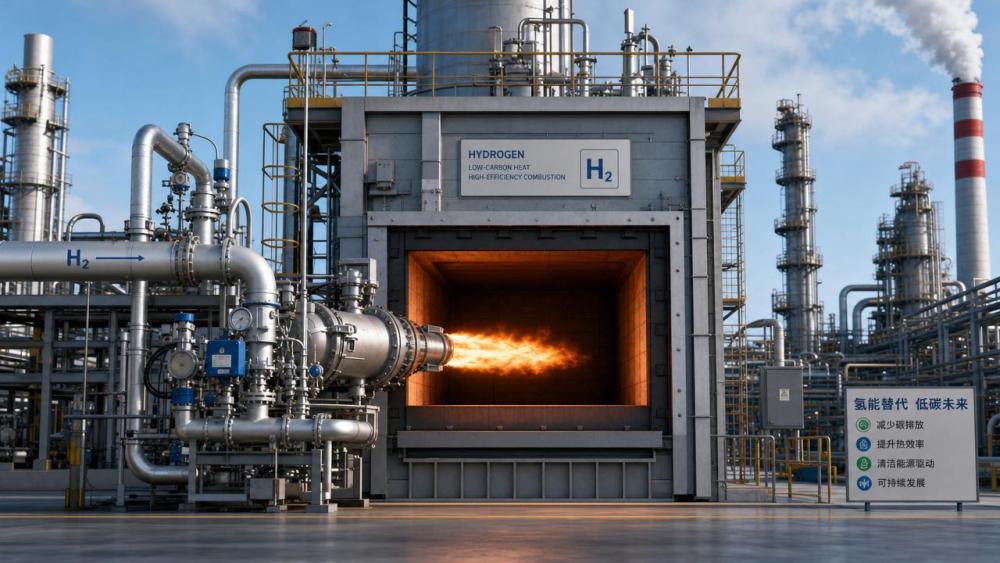
Among refinery decarbonization strategies, direct hydrogen burners are attractive because they can decarbonize heat demand without waiting for complete process electrification. However, they introduce a different combustion regime. The following checklist should be treated as a minimum review set.
1. Combustion performance checks
- Confirm flame speed, flame stability, and flashback resistance at full load and low load.
- Assess heat flux distribution to avoid tube hot spots, refractory damage, or uneven thermal profiles.
- Verify burner turndown capability for variable refinery operations.
- Review ignition reliability and flame detection performance under hydrogen service.
2. Materials and mechanical integrity checks
- Check piping, valves, seals, and fittings for hydrogen compatibility and embrittlement risk.
- Evaluate burner tip materials and thermal cycling resistance.
- Review flange management, leak tightness, and inspection access for high-frequency maintenance zones.
- Benchmark design choices against recognized frameworks such as ASME B31.12 where applicable.
3. Safety and controls checks
- Update hazard and operability studies to reflect hydrogen dispersion, ignition energy, and leak detection requirements.
- Confirm shutdown logic, purge sequences, interlocks, and emergency isolation philosophy.
- Revalidate gas detection placement, ventilation performance, and hazardous area classification.
- Ensure operator training covers new startup windows, burner management behavior, and abnormal event response.
4. Emissions and efficiency checks
- Model expected NOx formation and determine whether staged combustion, flue gas recirculation, or burner geometry changes are required.
- Compare thermal efficiency before and after retrofit, not just carbon intensity.
- Confirm stack monitoring upgrades and reporting readiness for ESG, permitting, and internal performance guarantees.
A practical decision table for project managers
The table below helps refine refinery decarbonization strategies into an actionable go, hold, or phase decision for direct hydrogen burners.
How priorities change by refinery scenario
Not all refinery decarbonization strategies should apply the same implementation logic. Project leaders should adapt the checklist to the actual site context.
Brownfield refineries with aging fired assets
In older facilities, mechanical integrity usually becomes the gating factor. Even if direct hydrogen burners are technically available, old manifolds, legacy burner management systems, and limited shutdown windows can undermine execution. In this case, prioritize asset condition surveys, tie-in simplification, and phased conversion by heater train rather than sitewide replacement.
Refineries linked to low-carbon hydrogen production
Where electrolysis or imported hydrogen logistics are already expanding, direct hydrogen burners become more attractive within refinery decarbonization strategies. The emphasis shifts toward fuel supply resilience, storage philosophy, and cross-plant load balancing. Teams should coordinate with hydrogen infrastructure planners, not treat the burner project as an isolated retrofit.
Sites under strict emissions or investor pressure
If the main driver is rapid carbon reduction reporting, project governance matters as much as hardware selection. Define auditable baselines, expected CO2 reduction, NOx mitigation measures, and verification methodology from day one. This prevents later disputes between engineering, finance, and sustainability functions.
Commonly overlooked risks in refinery decarbonization strategies
Several issues are frequently underestimated when direct hydrogen burners are introduced into refinery decarbonization strategies:
- Assuming hydrogen supply will be stable simply because production exists somewhere on site. Production capacity, compression, storage, and dispatch are not the same issue.
- Focusing on CO2 reduction while underestimating NOx compliance challenges.
- Treating burner replacement as a mechanical swap instead of a combustion, controls, and safety system change.
- Ignoring workforce readiness, especially operator familiarity with hydrogen-specific upset conditions.
- Failing to align the project with broader standards, asset security expectations, and sovereign-grade hydrogen infrastructure planning.
Execution roadmap: what to prepare before requesting proposals
If an owner-operator is ready to advance refinery decarbonization strategies involving direct hydrogen burners, the most useful preparation is structured information. This improves bid quality, shortens clarification cycles, and reduces redesign risk.
- Compile heater or furnace design data, recent inspection findings, and operating range history.
- Define the expected hydrogen fuel envelope, including purity, pressure, contaminants, and supply interruptions.
- Prepare emissions targets with local permit constraints and internal decarbonization KPIs.
- Document shutdown windows, tie-in limitations, and commissioning milestones.
- Request a combined review covering burner technology, safety systems, metallurgy, and integration with plant utilities.
FAQ for engineering leaders and project managers
Are direct hydrogen burners always the fastest decarbonization option?
Not always. They are often faster than full electrification, but only when hydrogen supply, burner compatibility, and safety modifications are realistic within the project window.
Can they be introduced as part of phased refinery decarbonization strategies?
Yes. Many sites begin with hydrogen-capable or hydrogen-blend-capable burners, then move toward higher hydrogen fractions as infrastructure matures.
What should be validated first: economics or technical feasibility?
Technical feasibility should be screened first at a practical level. Economic models are not dependable until fuel quality, burner scope, emissions controls, and outage impacts are reasonably defined.
What to discuss next if your team is moving from concept to execution
The strongest refinery decarbonization strategies are the ones that connect carbon reduction targets with asset-level engineering reality. For teams evaluating direct hydrogen burners, the next conversation should focus on a few priority items: target units for retrofit, hydrogen source and logistics, required standards alignment, expected shutdown duration, emissions compliance pathway, and the decision gate between pilot deployment and broader rollout.
If you need to confirm technical fit, project sequencing, asset integrity requirements, budget sensitivity, or the role of hydrogen infrastructure within a larger zero-carbon roadmap, prepare those inputs first. A structured discussion around parameters, safety expectations, performance guarantees, and implementation timing will produce far better outcomes than starting with equipment price alone.
Related News
- When does a hydrogen steelmaking retrofit make operational sense?Sep 06, 2026Hydrogen steelmaking retrofit: discover the operational conditions, gas-network upgrades, supply strategy, safety controls, and economics needed for a practical, production-ready transition.
- How Hydrogen Ignition Control Reduces Flashback Risk in Direct BurnersAug 13, 2026Hydrogen ignition control helps reduce flashback risk in direct burners by improving timing, mixing, and flame stability—keeping hydrogen combustion safer, cleaner, and more reliable.
- Industrial Hydrogen Solutions for Refineries: Cost Priorities and Retrofit OptionsJul 13, 2026Industrial hydrogen solutions for refineries: compare cost priorities, retrofit paths, and low-carbon options to improve resilience, compliance, and long-term refinery value.
- When to Hire Refinery Decarbonization Consultants for Scope, Cost, and ComplianceJul 12, 2026Refinery decarbonization consultants help buyers define scope, control retrofit costs, and improve compliance readiness. Learn the best time to hire for stronger refinery project decisions.
Related News
- 00
0000-00
Hydrogen Energy Storage for Data Centers Gets Costly Fast - 00
0000-00
When 99.999% Hydrogen Purity Still Is Not Good Enough - 00
0000-00
When Does a Hydrogen-Ready Gas Turbine Pay Off? - 00
0000-00
Electricity Price Volatility Is Rewriting Hydrogen Cost Models - 00
0000-00
PSA Recovery Rate Drops for Reasons Operators Miss
Dr. Hideo Torque
Weekly Insights
Stay ahead with our curated technology reports delivered every Monday.