Electrolysis Plant Solutions: Key Balance of Plant Choices




Electrolysis Plant Solutions: Key Balance of Plant Choices
Selecting the right Electrolysis plant solutions balance of plant strategy shapes far more than equipment layout.
It determines project bankability, operating resilience, safety margin, and long-term hydrogen cost.
For large-scale hydrogen assets, the stack is only one decision layer.
The harder work usually sits inside the balance of plant.
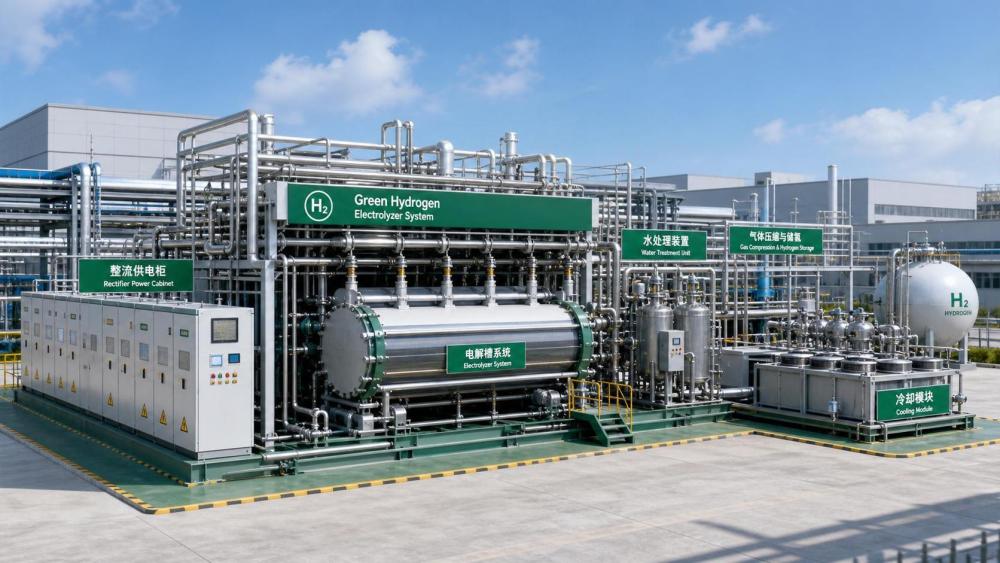
That includes power conditioning, water treatment, gas handling, compression, cooling, controls, and safety systems.
Each choice affects uptime, ramping behavior, maintenance intervals, and compliance exposure.
From a project leadership view, Electrolysis plant solutions balance of plant decisions should be treated as risk allocation choices.
They define how well the facility handles variable renewables, water quality swings, heat rejection limits, and downstream delivery constraints.
This also means early engineering cannot stop at nameplate hydrogen output.
A credible selection process must evaluate the full plant envelope under real operating conditions.
Start with the operating profile, not the equipment list
A common mistake is choosing balance-of-plant packages before defining the plant duty profile.
That often leads to overbuilt auxiliaries or underperforming interfaces.
In practical terms, Electrolysis plant solutions balance of plant selection begins with five questions.
- Will the plant run baseload, load-following, or highly intermittent service?
- What hydrogen purity, pressure, and daily delivery profile are required?
- What are the site limits for water, power quality, and heat rejection?
- Which codes and standards govern the final installation?
- How much redundancy is needed to protect contracted supply?
These answers drive the real design basis.
They also prevent a misleading comparison between low-capex offers and high-availability plant architectures.
Recent market shifts make this more important.
More projects now pair electrolysis with renewable variability, merchant offtake uncertainty, and stricter infrastructure safety review.
So the balance of plant must absorb real-world instability without forcing frequent shutdowns.
Power systems usually decide efficiency faster than expected
Power conversion is one of the most underestimated Electrolysis plant solutions balance of plant decisions.
Rectifiers, transformers, harmonic control, and load management directly affect stack stability and plant efficiency.
This is especially true for PEM systems operating against fluctuating renewable input.
When evaluating options, focus on part-load efficiency and dynamic response, not only full-load performance.
The electrical package should also be checked for grid code compliance and expansion flexibility.
In many projects, future capacity upgrades become expensive because switchgear and transformer margins were too narrow.
A sound decision framework includes:
- AC to DC conversion efficiency across the expected load range
- Harmonic mitigation requirements at the point of interconnection
- Black-start, restart, and ramp-rate behavior
- Thermal losses and cooling integration
- Space reservation for future modules
This is where the cheapest package often stops being the lowest-cost option over the plant life.
Water treatment and thermal control are core reliability decisions
Water quality is not a supporting detail.
It is central to Electrolysis plant solutions balance of plant performance, especially for long stack life.
Poor inlet quality can increase degradation, maintenance frequency, and purity risk.
That means water treatment should be sized around actual feedwater variability, not nominal laboratory values.
Reverse osmosis, polishing, deionization, and monitoring loops should be assessed as one integrated chain.
The same logic applies to thermal management.
Cooling loops determine stable operation, stack protection, and seasonal output consistency.
Air cooling may simplify permitting in water-constrained regions.
However, water-based cooling can offer better temperature control for larger continuous-duty plants.
A robust review should compare ambient extremes, fouling risk, parasitic load, and maintainability.
In bankability reviews, weak thermal design usually surfaces later as an availability problem.
Gas conditioning, compression, and storage define downstream value
Hydrogen production alone does not complete the plant.
The gas must be dried, separated, compressed, stored, or transferred to the next use point.
This makes gas handling a decisive Electrolysis plant solutions balance of plant workstream.
For some projects, the right answer is minimal intermediate storage and direct pipeline dispatch.
For others, buffer storage is essential to smooth electrolyzer output and protect delivery commitments.
Compression selection should reflect duty cycle, discharge pressure, maintenance support, and contamination control.
Material compatibility is equally critical across separators, dryers, piping, valves, and storage vessels.
Hydrogen service introduces embrittlement, leak-tightness, and seal-life concerns that cannot be handled as generic gas design.
The most useful comparison table usually includes these decision points:
These details often separate demonstration plants from sovereign-grade infrastructure.
Controls, safety architecture, and compliance should be designed together
Control philosophy is another major Electrolysis plant solutions balance of plant choice.
It affects startup time, trip recovery, remote diagnostics, and operator workload.
More importantly, controls must align with the plant safety case.
Hydrogen detection, venting, emergency shutdown logic, hazardous area classification, and alarm management should not be handled in isolation.
The stronger approach is an integrated architecture tied to codes, owner standards, and insurer expectations.
Frameworks such as ISO 19880 and ASME B31.12 provide practical direction for hydrogen installations.
That still leaves project teams with several decision calls.
- Define clear shutdown states for stack, compressor, and storage subsystems.
- Separate critical protection functions from routine process control.
- Verify sensor placement against realistic leak and ventilation scenarios.
- Require cyber and remote-access controls for distributed plant operations.
- Document test procedures for commissioning and recurring proof checks.
When these elements are fragmented across vendors, hidden interface risks usually appear during startup.
A disciplined integration review reduces that exposure early.
How to compare options without losing time in procurement
The best Electrolysis plant solutions balance of plant comparison models are simple, but not superficial.
They translate engineering detail into decision-ready criteria.
In actual project execution, a weighted matrix works well when it covers technical, commercial, and compliance factors together.
Useful categories include efficiency, redundancy, operability, materials, standards alignment, delivery risk, and lifecycle service capability.
It is also worth separating guaranteed values from expected values.
Vendors often optimize proposals around ideal boundary conditions.
Procurement teams need performance commitments tied to site-specific assumptions.
A practical short list should confirm:
- Defined battery limits and interface responsibilities
- Guaranteed utility consumption by operating mode
- Availability assumptions and spare parts philosophy
- Compliance documentation for hydrogen service components
- Factory and site acceptance testing scope
This keeps the Electrolysis plant solutions balance of plant decision grounded in measurable project outcomes.
A stronger balance-of-plant strategy supports sovereign-scale deployment
Electrolysis at industrial scale is no longer only a technology question.
It is an infrastructure decision with direct consequences for national energy resilience and investment confidence.
That is why Electrolysis plant solutions balance of plant planning deserves the same scrutiny as stack selection.
The winning approach is rarely the one with the shortest equipment list.
It is the one that matches site reality, protects safety integrity, and preserves performance under variable operating conditions.
When project teams structure decisions around operating profile, power quality, water, thermal control, gas logistics, and compliance, selection becomes clearer.
It also becomes easier to defend in front of investors, regulators, insurers, and internal technical review boards.
The next practical step is to turn these criteria into a site-specific balance-of-plant screening matrix before vendor down-selection begins.
That single move usually saves time, reduces interface risk, and improves final plant readiness.
Related News
- Electricity Price Volatility Is Rewriting Hydrogen Cost ModelsApr 27, 2026Impact of electricity price on hydrogen cost is transforming industrial decarbonization and large-scale electrolysis. Explore LCOH trends, PPA strategies, and resilient hydrogen infrastructure planning.
- Energy Transition Plans Often Fail at the Grid Connection StageApr 27, 2026Sustainable energy and energy transition projects often fail at grid connection. Learn how hydrogen infrastructure, PEM electrolysis, and industrial decarbonization can avoid delays and protect investment value.
- What Is Slowing Industrial Decarbonization Projects in 2026?Apr 27, 2026Industrial decarbonization faces delays in 2026 as hydrogen infrastructure, sustainable energy access, grid limits, safety standards, and project bankability challenge the energy transition.
- Choosing hydrogen production capacity for a megawatt PEM electrolyzerOct 07, 2026Hydrogen solution selection by capacity: learn how to size a megawatt PEM electrolyzer for real demand, storage, power variability, and reliable delivery.
Related News
- 00
0000-00
Hydrogen Energy Storage for Data Centers Gets Costly Fast - 00
0000-00
When 99.999% Hydrogen Purity Still Is Not Good Enough - 00
0000-00
When Does a Hydrogen-Ready Gas Turbine Pay Off? - 00
0000-00
Electricity Price Volatility Is Rewriting Hydrogen Cost Models - 00
0000-00
PSA Recovery Rate Drops for Reasons Operators Miss
Dr. Aris Aero
Weekly Insights
Stay ahead with our curated technology reports delivered every Monday.