Direct Seawater Electrolysis: Can It Reduce Pretreatment Costs?




Direct Seawater Electrolysis: Can It Reduce Pretreatment Costs?
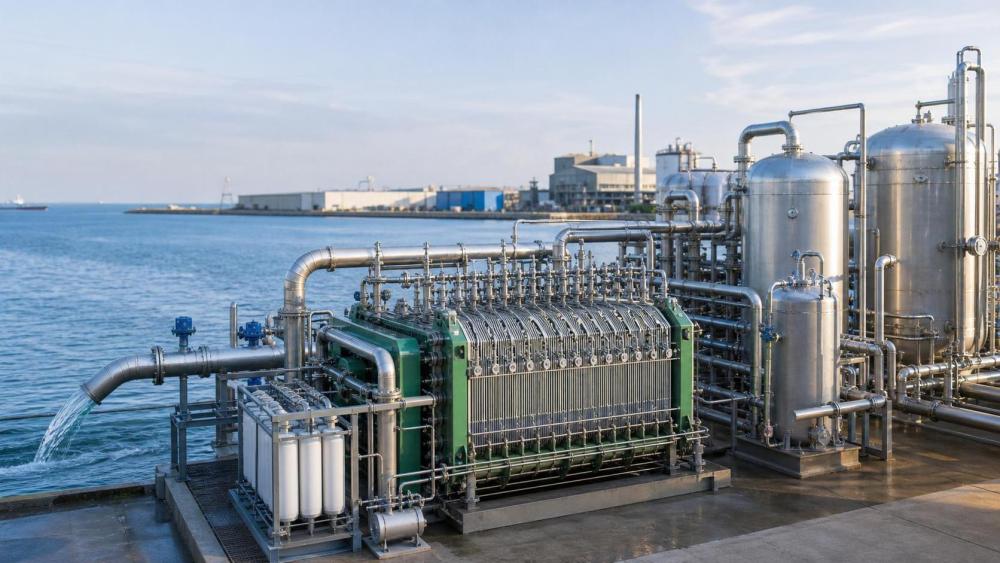
Direct seawater electrolysis has moved from lab curiosity to boardroom discussion.
The core question is simple.
Can it remove costly water pretreatment and make green hydrogen projects cheaper?
At first glance, the logic looks attractive.
Seawater is abundant, available near many industrial corridors, and does not compete with freshwater supply.
That can appear to reduce front-end capital needs.
But procurement decisions rarely turn on one line item.
For bankable hydrogen infrastructure, direct seawater electrolysis must be judged on total lifecycle economics.
That includes efficiency, corrosion, stack life, maintenance cycles, product purity, and compliance exposure.
In practice, pretreatment savings may be real, but often smaller than expected.
More importantly, those savings can be offset by higher downstream risk.
Why Pretreatment Costs Matter in Hydrogen Procurement
Conventional electrolysis usually depends on purified water.
That means intake, filtration, desalination, polishing, and monitoring systems.
For coastal projects, pretreatment can raise both CAPEX and OPEX.
It also adds footprint, permitting complexity, and integration work.
This is why direct seawater electrolysis gets attention from cost-focused buyers.
If a system can use raw seawater directly, project teams may reduce balance-of-plant spending.
The appeal is strongest in remote coastal zones.
These include ports, islands, offshore hubs, and export-oriented hydrogen terminals.
However, a narrow pretreatment comparison misses the full procurement picture.
Lower front-end water treatment cost does not automatically mean lower levelized hydrogen cost.
What Direct Seawater Electrolysis Must Overcome
The chemistry is the problem.
Seawater contains chloride, sulfate, magnesium, calcium, organics, and biological contaminants.
These species create side reactions and accelerate material degradation.
Chloride is especially important.
It can trigger chlorine evolution instead of oxygen evolution.
That raises safety, equipment compatibility, and gas-purity concerns.
For procurement teams, this changes the cost equation immediately.
A cheaper feedwater train may require more expensive catalysts, coatings, membranes, and separators.
It may also require tighter inspection and replacement intervals.
That is where many early cost assumptions become fragile.
The Main Cost Shifts
- Higher materials cost for corrosion-resistant stack components
- Greater uncertainty around stack durability and warranty terms
- Additional gas-cleaning and purity-control equipment
- More frequent shutdowns for cleaning, flushing, or inspection
- Stricter validation to satisfy lenders, insurers, and regulators
Can Direct Seawater Electrolysis Actually Cut Costs?
Yes, but only under specific conditions.
The most credible savings come from simplified intake and reduced desalination scope.
That can matter where freshwater is scarce or desalination power is expensive.
Even so, direct seawater electrolysis rarely eliminates all pretreatment steps.
Most practical systems still need screening, particle removal, and biofouling control.
Some also need partial conditioning to stabilize operation.
This is the key distinction.
Direct seawater electrolysis can reduce pretreatment intensity, but not always remove pretreatment entirely.
For cost models, that difference is significant.
A partial saving is useful, but it should not be priced like a complete system deletion.
Where the Economics Look Stronger
- Coastal sites with high freshwater scarcity premiums
- Projects where land constraints penalize larger water-treatment packages
- Locations with expensive desalination brine management
- Pilot or niche operations where flexibility matters more than maximum efficiency
The Hidden Financial Risks Behind Direct Seawater Electrolysis
The bigger issue is uncertainty.
Direct seawater electrolysis still has limited commercial operating history at large scale.
That affects financing terms, vendor guarantees, and technical due diligence.
A system with uncertain degradation curves can look cheap in year one.
It can become expensive by year five.
This matters even more for sovereign-scale infrastructure.
Large hydrogen assets must align with strict safety and integrity standards.
Examples include ISO 19880, ASME B31.12, and SAE J2601 within related value-chain interfaces.
If direct seawater electrolysis creates purity or corrosion issues upstream, those effects travel downstream.
Compression, storage, transport, and refueling systems all become harder to certify and insure.
That can dilute any pretreatment savings very quickly.
Questions That Should Appear in Every Procurement Review
- What stack life is contractually guaranteed under actual seawater conditions?
- How is hydrogen purity verified over seasonal seawater variation?
- What is the penalty if chlorine-related contamination occurs?
- Which materials are exposed to chloride stress and fouling risk?
- What service intervals are assumed in the vendor economic model?
- How much contingency is needed for unplanned replacements?
A Better Comparison: Pretreatment Savings Versus Lifecycle Cost
The right benchmark is not purified water versus seawater alone.
The right benchmark is total lifecycle cost per kilogram of compliant hydrogen.
That changes the evaluation framework.
Direct seawater electrolysis should be compared across six cost dimensions.
This kind of comparison is harder, but it is financially honest.
It also exposes whether direct seawater electrolysis is truly cheaper or simply structured differently.
How to Buy More Carefully
A disciplined sourcing process can prevent optimistic assumptions from entering the financial model.
In actual projects, the best results come from staged validation.
- Model direct seawater electrolysis against a conventional desalination-plus-electrolysis baseline.
- Use site-specific seawater chemistry, not generic lab assumptions.
- Demand performance data across seasonal temperature and salinity changes.
- Tie payment milestones to hydrogen purity, efficiency, and stack-life thresholds.
- Stress-test OPEX for membrane replacement, cleaning chemicals, and downtime.
- Check alignment with downstream storage, pipeline, and refueling specifications.
For large-scale programs, external technical benchmarking adds real value.
That is especially true when the asset must perform within sovereign-grade decarbonization frameworks.
A specialized reference platform such as G-HEI helps connect electrolyzer claims with standards-driven asset decisions.
That matters because procurement value is not just about buying equipment.
It is about securing long-term performance across production, storage, transport, and use.
Final Take on Direct Seawater Electrolysis
Direct seawater electrolysis can reduce pretreatment costs, but that is only part of the story.
Its real value depends on whether lower water-treatment spending survives contact with durability, efficiency, and compliance realities.
For some coastal applications, the economics may work.
For many large projects, the technology still shifts cost rather than removing it.
The practical decision is clear.
Evaluate direct seawater electrolysis on lifecycle cost, verified performance, and standards compatibility.
That approach produces better procurement outcomes than headline savings alone.
In a hydrogen market moving toward larger assets and tighter scrutiny, disciplined comparison is what protects capital.
Related News
- Electricity Price Volatility Is Rewriting Hydrogen Cost ModelsApr 27, 2026Impact of electricity price on hydrogen cost is transforming industrial decarbonization and large-scale electrolysis. Explore LCOH trends, PPA strategies, and resilient hydrogen infrastructure planning.
- Energy Transition Plans Often Fail at the Grid Connection StageApr 27, 2026Sustainable energy and energy transition projects often fail at grid connection. Learn how hydrogen infrastructure, PEM electrolysis, and industrial decarbonization can avoid delays and protect investment value.
- What Is Slowing Industrial Decarbonization Projects in 2026?Apr 27, 2026Industrial decarbonization faces delays in 2026 as hydrogen infrastructure, sustainable energy access, grid limits, safety standards, and project bankability challenge the energy transition.
- Choosing hydrogen production capacity for a megawatt PEM electrolyzerOct 07, 2026Hydrogen solution selection by capacity: learn how to size a megawatt PEM electrolyzer for real demand, storage, power variability, and reliable delivery.
Related News
- 00
0000-00
Hydrogen Energy Storage for Data Centers Gets Costly Fast - 00
0000-00
When 99.999% Hydrogen Purity Still Is Not Good Enough - 00
0000-00
When Does a Hydrogen-Ready Gas Turbine Pay Off? - 00
0000-00
Electricity Price Volatility Is Rewriting Hydrogen Cost Models - 00
0000-00
PSA Recovery Rate Drops for Reasons Operators Miss
Dr. Aris Aero
Weekly Insights
Stay ahead with our curated technology reports delivered every Monday.