Electrolyzer Manufacturing Scale-Up Reports: Signals Behind Supply Risk




For procurement teams navigating the hydrogen transition, electrolyzer manufacturing scale-up reports reveal more than production ambition—they expose the real signals behind supply risk, delivery reliability, and long-term project bankability. In a market shaped by rapid capacity expansion, material constraints, and tightening technical standards, understanding these reports is essential for making resilient sourcing decisions across large-scale electrolysis and zero-carbon infrastructure investments.
In practice, these reports are not just investor-facing updates or capacity announcements. For buyers responsible for megawatt-scale electrolysis systems, hydrogen logistics interfaces, or broader zero-carbon infrastructure, they function as an operational early-warning tool. A manufacturer may announce 2 GW of annual capacity, yet still face bottlenecks in stack coating, titanium supply, membrane sourcing, automated testing, or final acceptance throughput. The gap between nameplate output and deliverable systems is where procurement risk emerges.
For organizations benchmarking suppliers through a technical lens, including institutions such as G-HEI and its audience of ministers, CTOs, and investment directors, electrolyzer manufacturing scale-up reports help connect production claims with sovereign-grade requirements: material integrity, traceability, standards alignment, and long-term serviceability. Procurement teams that learn to read these reports correctly can reduce delivery shocks, avoid underqualified vendors, and structure contracts around real manufacturing maturity rather than optimistic market narratives.
Why Electrolyzer Manufacturing Scale-Up Reports Matter in Procurement
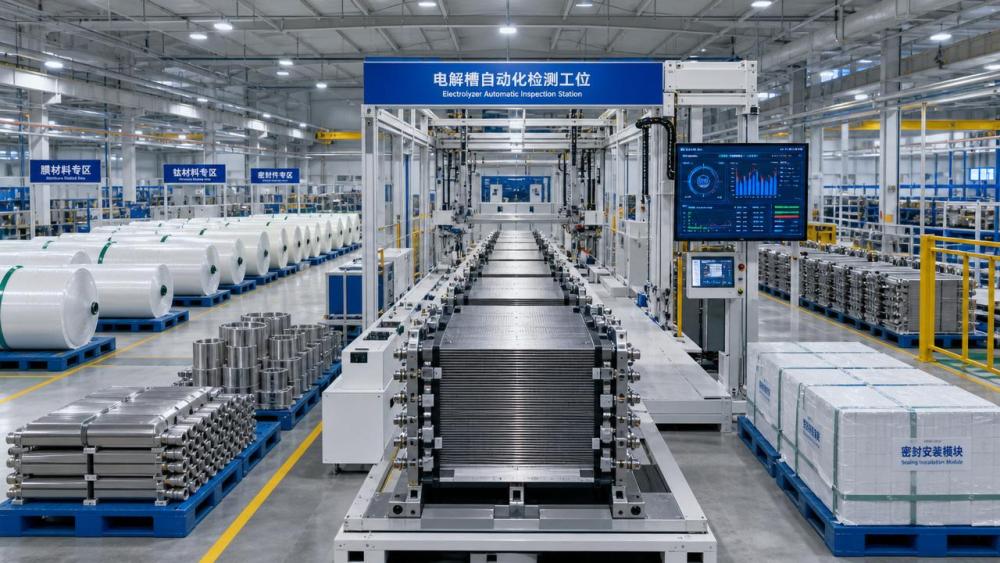
Electrolyzer manufacturing scale-up reports matter because hydrogen projects are unusually sensitive to schedule slippage and equipment inconsistency. A 100 MW project delayed by 3 to 6 months can affect EPC sequencing, grid interconnection timing, water-treatment commissioning, and downstream offtake agreements. In this context, buyers need more than a brochure or a factory visit. They need evidence that a supplier can move from pilot-level assembly to repeatable, audited, multi-line production.
The difference between announced capacity and executable capacity
A common mistake is to treat all capacity numbers as equal. Announced capacity may refer to future targets, planned lines, or partially commissioned facilities. Executable capacity refers to equipment that can be built, tested, documented, packed, and shipped within a defined period such as 12 months. For procurement, the second number matters far more. If a supplier states 1 GW per year but only one stack line is validated and balance-of-plant integration remains manual, actual throughput may be far lower.
What buyers should verify first
- How much of the reported capacity is already commissioned versus still under construction
- Whether scale-up includes stacks only, or complete systems with power electronics, skid integration, controls, and testing
- The current production yield, rework rate, and final acceptance throughput per month
- Lead times for long-cycle materials such as membranes, catalysts, titanium, nickel, valves, and rectifiers
The table below highlights how procurement teams can interpret the most common signals found in electrolyzer manufacturing scale-up reports.
The key takeaway is simple: procurement should distinguish between capacity on paper and capacity under controlled production conditions. In hydrogen infrastructure, a supplier that can reliably ship 150 MW with documented quality may be less risky than one claiming 800 MW with limited proof of stable output.
Why the issue is more acute in PEM and alkaline scale-up
Both PEM and alkaline electrolyzers face scale-up constraints, but the risk profile differs. PEM systems often depend on more specialized materials and tighter manufacturing tolerances, especially around membranes, catalysts, titanium components, and coating consistency. Alkaline systems may benefit from a broader industrial base, yet large-format module integration, sealing reliability, and response-performance consistency still create bottlenecks when annual output moves from tens of megawatts to several hundred.
For procurement teams, this means scale-up reports should be read with technology-specific filters. A 6-month delay in membrane supply or catalyst qualification can materially affect PEM delivery. In alkaline production, vessel fabrication queues, electrode consistency, and large-skid shipping readiness may be more decisive. The report is useful only when interpreted against the actual architecture of the system being sourced.
The Main Supply Risk Signals Hidden Inside Scale-Up Reports
Many buyers scan scale-up reports for growth headlines but miss the operational warning signs embedded in the details. In most cases, supply risk is not caused by a single failure. It comes from a chain of small weaknesses: underqualified secondary suppliers, low line yield, inconsistent inspection coverage, weak after-sales staffing, or standards gaps between factory output and site acceptance requirements.
Signal 1: Material concentration risk
If the report shows rapid output growth but limited discussion of raw material diversification, procurement should investigate further. For PEM systems, concentration risk can arise from a small number of membrane and catalyst sources. For both PEM and alkaline, specialty metals, seals, coating inputs, and power electronics can create a 1-to-2 supplier dependency. That is manageable at pilot scale, but much harder at 500 MW or 1 GW annual output.
Signal 2: Automation without validation depth
Automation is often presented as proof of scale readiness. It is helpful, but not sufficient. A fully automated subassembly line does not eliminate risk if end-of-line testing remains manual or if process capability has not been statistically stabilized. Buyers should ask for evidence such as batch traceability, non-conformance rates, and test coverage across electrical, pressure, leak, and performance checkpoints.
Signal 3: Weak standards integration
In sovereign and utility-scale projects, standards integration is not an accessory issue. If scale-up reports emphasize volume but say little about compliance pathways, quality documentation, or material certification, the supplier may still be immature for high-consequence deployment. Procurement teams operating across hydrogen fueling, pipeline tie-ins, or power generation interfaces should watch alignment with frameworks such as ISO 19880, ASME B31.12, and application-relevant safety and materials requirements.
Signal 4: Service model lagging behind production growth
A supplier may double production capacity in 18 months while field service capability grows only marginally. That creates post-delivery risk. Large projects need spare parts strategy, commissioning teams, remote diagnostics, response-time commitments, and change-order discipline. For procurement, a manufacturing scale-up report should be cross-checked against service headcount, regional support footprint, and critical spare availability over 24 to 60 months.
The matrix below can help buyers translate these signals into practical sourcing questions and mitigation actions.
This type of structured reading turns electrolyzer manufacturing scale-up reports into procurement intelligence. Instead of reacting only after delays occur, buyers can identify weak points during prequalification, bid evaluation, or contract negotiation.
How Procurement Teams Should Evaluate a Supplier’s Scale-Up Readiness
A disciplined evaluation process should combine document review, technical due diligence, and contract design. For large hydrogen programs, relying on a single factory presentation is not enough. Buyers should use a 4-part screening approach that links manufacturing status to delivery confidence and compliance readiness.
1. Verify manufacturing maturity at line level
Ask how many production lines are operating today, what each line produces, and the average throughput per month. A supplier with 3 active lines, each validated for a different subassembly, is generally less exposed than one building around a single bottleneck process. Where possible, request evidence of line commissioning dates, operator training cycles, and acceptance criteria for each production stage.
2. Assess whether critical inputs are contract-secured
Procurement should look beyond the OEM and ask whether upstream supply is secured for the delivery window. Typical review points include 6- to 12-month visibility on membranes, catalyst-coated components, machined plates, gaskets, rectifiers, transformers, and instrumentation. If the supplier cannot map critical inputs to specific delivery quarters, schedule confidence is weaker than it appears.
3. Check the bridge between factory standards and field standards
In zero-carbon infrastructure, manufacturing scale means little if equipment cannot move smoothly into site approval, integration, and commissioning. Procurement teams should confirm that factory documentation supports installation environments involving hydrogen fueling, pipeline connections, cryogenic interfaces, or turbine-linked systems. Material certificates, pressure boundary records, FAT procedures, and interface documentation should be reviewable before award, not after shipment.
A practical 6-point checklist
- Confirmed operating production lines versus announced future capacity
- Critical-material sourcing depth and substitution controls
- Quality yield, rework trend, and traceability method
- Delivery lead time for stacks, skids, and complete systems
- Compliance documentation aligned with target jurisdiction and application
- Field service capability for the first 24 months of operation
4. Build risk-sharing into the contract structure
Even strong suppliers face execution risk during scale-up. Procurement should not try to eliminate all uncertainty through price pressure alone. A better strategy is to structure milestones around production evidence. For example, payments can be linked to FAT completion, documentation release, spare-parts readiness, or validated throughput. For projects above 20 MW, it is also prudent to define escalation terms for material substitutions, line transfers, or revised delivery sequencing.
Using Scale-Up Reports to Improve Bankability and Long-Term Resilience
Bankability depends not only on the efficiency of an electrolyzer at nameplate conditions, but also on the credibility of its supply chain over the full project timeline. Lenders, boards, and public-sector stakeholders increasingly ask whether the selected manufacturer can deliver replacement parts, maintain output consistency, and support expansion phases 2 or 3 years later. Electrolyzer manufacturing scale-up reports provide part of that answer when interpreted rigorously.
Why procurement and investment teams should read the same report differently
Investment teams may focus on factory size, total announced capacity, or strategic partnerships. Procurement teams should focus on narrower but more actionable indicators: current line utilization, test bottlenecks, documentation discipline, and realistic shipping cadence. A report that looks impressive at the headline level may still reveal weak readiness for a 40 MW lot due in 32 weeks.
The role of independent technical benchmarking
This is where a technical benchmarking framework becomes valuable. Organizations operating in the G-HEI sphere do not evaluate electrolysis in isolation. They assess how manufacturing readiness interacts with cryogenic logistics, hydrogen-ready power systems, CCUS-linked decarbonization planning, and high-pressure refueling infrastructure. That broader view matters because delivery failure in one equipment segment can disrupt an entire zero-carbon infrastructure chain.
For procurement teams, the practical implication is clear: scale-up reports should be read together with interface risk, standards alignment, and lifecycle support capability. The more strategic the project, the less useful a narrow equipment-only view becomes.
Common buying mistakes to avoid
- Selecting a vendor primarily on announced gigawatt capacity without confirming validated output
- Assuming stack manufacturing maturity automatically means full-system delivery maturity
- Ignoring service capacity, spare-part logistics, and field response time
- Waiting until contract award to review quality records, FAT scope, or material traceability
- Treating standards compliance as a documentation issue instead of a manufacturing discipline issue
Electrolyzer manufacturing scale-up reports are most valuable when used early, before shortlist finalization and before delivery promises are locked into project financing assumptions. Read carefully, they reveal whether a supplier is building durable industrial capability or simply running ahead of its operational base.
For procurement leaders sourcing electrolysis systems within a broader hydrogen and zero-carbon infrastructure strategy, the right question is not who has the largest announced capacity. It is who can deliver technically compliant systems, on a predictable schedule, with traceable materials and credible long-term support. That is the real signal behind supply risk.
If you need deeper benchmarking of electrolyzer suppliers, manufacturing readiness, standards alignment, or cross-infrastructure procurement strategy, G-HEI can help you assess risk with greater technical precision. Contact us to discuss your sourcing priorities, request a tailored evaluation framework, or learn more solutions for resilient hydrogen infrastructure procurement.
Related News
- Electricity Price Volatility Is Rewriting Hydrogen Cost ModelsApr 27, 2026Impact of electricity price on hydrogen cost is transforming industrial decarbonization and large-scale electrolysis. Explore LCOH trends, PPA strategies, and resilient hydrogen infrastructure planning.
- Energy Transition Plans Often Fail at the Grid Connection StageApr 27, 2026Sustainable energy and energy transition projects often fail at grid connection. Learn how hydrogen infrastructure, PEM electrolysis, and industrial decarbonization can avoid delays and protect investment value.
- What Is Slowing Industrial Decarbonization Projects in 2026?Apr 27, 2026Industrial decarbonization faces delays in 2026 as hydrogen infrastructure, sustainable energy access, grid limits, safety standards, and project bankability challenge the energy transition.
- AEM Stability Remains the Big Question for Scale-UpApr 27, 2026Anion exchange membrane stability is the key barrier to large-scale electrolysis. Discover how AEM impacts industrial decarbonization, hydrogen infrastructure, safety, and scale-up economics.
Related News
- 00
0000-00
Hydrogen Energy Storage for Data Centers Gets Costly Fast - 00
0000-00
When 99.999% Hydrogen Purity Still Is Not Good Enough - 00
0000-00
When Does a Hydrogen-Ready Gas Turbine Pay Off? - 00
0000-00
Electricity Price Volatility Is Rewriting Hydrogen Cost Models - 00
0000-00
PSA Recovery Rate Drops for Reasons Operators Miss
Dr. Aris Aero
Weekly Insights
Stay ahead with our curated technology reports delivered every Monday.