Electrolyzer Scale-Up Reports: 2026 Manufacturing Signals




As 2026 reshapes the hydrogen economy, electrolyzer manufacturing scale-up reports have become essential tools for business evaluators tracking capacity expansion, supply-chain resilience, and technology readiness. This analysis highlights the manufacturing signals that matter most to decision-makers comparing sovereign-scale electrolysis investments, benchmarking cost, quality, compliance, and execution risk across an increasingly competitive zero-carbon infrastructure landscape.
For ministries, utility CTOs, and investment directors, the issue is no longer whether electrolyzer demand will grow. The harder question is which manufacturers can move from pilot output to repeatable, bankable delivery at the 100 MW, 500 MW, and multi-GW level without compromising stack durability, safety compliance, or project schedules.
That is why electrolyzer manufacturing scale-up reports now serve as more than market summaries. In a B2B evaluation context, they function as operational due diligence tools, revealing whether a supplier’s expansion plan is supported by automation maturity, qualified materials, welding and coating controls, test capacity, and a realistic supply-chain strategy for PEM and alkaline systems.
Why 2026 Is a Turning Point for Electrolyzer Scale-Up
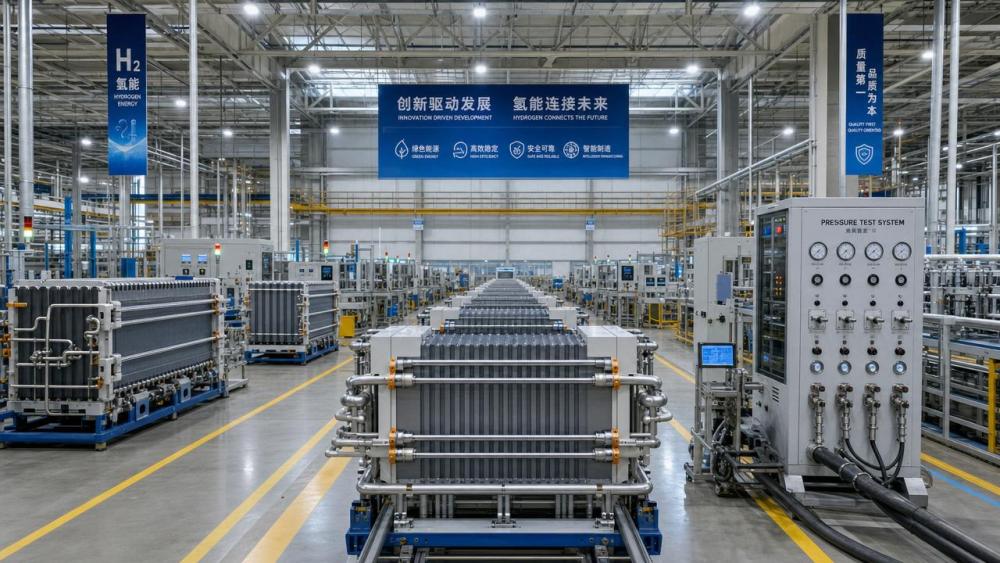
In 2026, manufacturing signals matter because the hydrogen market is entering a phase where announced capacity and deliverable capacity are no longer the same thing. Many vendors can present a 1 GW roadmap, but business evaluators need evidence that quarterly output, component qualification, and final acceptance testing can support projects with delivery windows of 6–18 months.
For sovereign-scale decarbonization programs, a delay of 12–24 weeks in stack delivery can cascade into EPC disruption, grid interconnection slippage, financing pressure, and delayed offtake milestones. This makes electrolyzer manufacturing scale-up reports especially valuable when comparing suppliers across different regions, technologies, and maturity levels.
The shift from capacity announcements to executable output
A credible report should distinguish among nameplate factory capacity, installed tooling capacity, and verified annual output. These are not interchangeable. A plant may advertise 2 GW per year, while its actual constrained output is closer to 600–900 MW if catalyst coating, membrane supply, pressure testing, or balance-of-plant integration remains a bottleneck.
For business evaluators, this distinction affects capital planning immediately. If a procurement strategy assumes four production lots over 12 months, but the supplier can only support two lots with qualified materials, the project risk profile changes significantly even if the commercial proposal remains attractive on paper.
What manufacturing signals should be tracked
The most useful electrolyzer manufacturing scale-up reports track a small set of operational signals rather than marketing claims. These signals include stack line automation rate, critical component dual-sourcing, scrap and rework trends, test-bay throughput, quality escape rates, and the ratio between announced orders and secured production slots.
- Factory ramp phases: pilot, semi-automated, or full serial production
- Stack assembly takt time: often measured per shift or per line
- Critical material dependence: iridium, nickel, titanium, separators, membranes
- Acceptance infrastructure: leak tests, electrical performance tests, pressure cycling
- Compliance readiness: ISO-aligned documentation and traceability depth
Why these signals matter in utility-scale procurement
At 20 MW, a buyer may tolerate moderate production variability if commissioning support is strong. At 200 MW or 1 GW, variability becomes a strategic risk. Small differences in stack yield, coating uniformity, or module test duration can influence total installed cost, commissioning sequence, and long-term efficiency degradation over 40,000–80,000 operating hours.
The table below summarizes the manufacturing indicators that commercial evaluators should prioritize when reviewing electrolyzer manufacturing scale-up reports in 2026.
The key conclusion is simple: the strongest reports translate factory growth into measurable project reliability. For evaluators, the difference between a supplier with documented quarterly output and one with only expansion plans can outweigh a nominal 3%–7% price advantage.
How to Read Electrolyzer Manufacturing Scale-Up Reports for Commercial Decisions
Not every report offers the same decision value. Some focus on macro demand, while others provide actionable insight into production readiness. Commercial teams should prioritize reports that connect manufacturing data to procurement outcomes such as lead time certainty, module standardization, warranty feasibility, and compliance alignment with hydrogen infrastructure frameworks.
Read beyond factory headline numbers
A headline claim of 1.5 GW annual output may look competitive, but evaluators should examine how much of that capacity applies to PEM versus alkaline systems, how many shifts the estimate assumes, and whether utilities, skid assemblies, and test stations scale proportionally. A stack line can ramp faster than downstream integration lines, creating hidden bottlenecks.
Reports should also indicate whether expansion depends on new greenfield facilities, retrofitted plants, or contract manufacturing. Each path carries different execution risks. Greenfield sites may require 9–15 months for stabilization, while retrofits can improve speed but may introduce layout constraints or mixed-process inefficiencies.
Assess the supply chain by component criticality
PEM and alkaline systems do not scale under the same constraints. PEM production is often more exposed to catalyst loading, titanium processing, membrane availability, and precision coating quality. Alkaline systems may face fewer precious-metal constraints, but they can still encounter pressure-vessel lead times, separator quality issues, and balance-of-plant integration delays.
A robust business review should separate components into three tiers: strategic, constrained, and interchangeable. If more than 30% of system value depends on single-source or regionally concentrated supply, schedule and pricing risk increase sharply during market tightness.
A practical 5-point review framework
- Validate current output against shipped systems, not future plant brochures.
- Check whether line automation supports repeatability at volume.
- Review test capacity per week for stacks, modules, and integrated skids.
- Map critical materials to lead-time ranges and backup sourcing.
- Confirm standards alignment for hydrogen handling, piping, and fueling interfaces where relevant.
The following comparison table helps commercial evaluators distinguish high-confidence supplier scale-up from high-risk expansion narratives.
For business evaluators, these distinctions often decide whether a supplier belongs in the final bid shortlist. In many cases, a manufacturer with slightly lower nameplate capacity but stronger test discipline and component sourcing will represent the lower total project risk.
The Most Important Risk Areas in 2026 Scale-Up Programs
Electrolyzer manufacturing scale-up reports are most valuable when they make risk visible early. In 2026, the major risk categories are not purely technical. They sit at the intersection of production engineering, supply-chain concentration, standards compliance, and commercial contracting structure.
Risk 1: Capacity grows faster than quality systems
When output ramps from tens of megawatts to several hundred megawatts per year, defects that were manageable in manual production can become systemic. Common weak points include gasket placement consistency, weld verification, coating thickness variation, and incomplete pressure-cycle records. A 1% escape rate at low volume can become costly at fleet scale.
Risk 2: Compliance gaps delay infrastructure integration
Large hydrogen projects rarely end at stack delivery. They connect to compression, storage, pipelines, fueling systems, or turbine-ready infrastructure. If documentation packages are weak, the path to integration with frameworks such as ISO 19880, ASME B31.12, and SAE J2601-related interfaces becomes slower, especially where permitting and insurer review are strict.
Risk 3: Commercial terms hide execution uncertainty
Some contracts appear competitive because they push schedule assumptions and acceptance definitions onto the buyer. Evaluators should examine liquidated damages boundaries, performance test conditions, spare parts assumptions, and warranty triggers. A lower EPC-facing price can become more expensive if field rectification, delayed commissioning, or replacement logistics are not clearly allocated.
Risk controls that improve decision quality
- Request quarterly ramp evidence for the previous 2–4 quarters.
- Separate stack risk from balance-of-plant risk in evaluations.
- Use milestone-based manufacturing audits before final notice to proceed.
- Ask for component traceability logic down to batch or serial level.
- Align acceptance tests with the actual operating profile of the plant.
These controls are particularly relevant to institutions using G-HEI-style benchmarking, where technical security and sovereign-level asset reliability depend on more than cost-per-kilowatt metrics alone.
What Business Evaluators Should Ask Before Shortlisting a Manufacturer
A strong shortlist process turns electrolyzer manufacturing scale-up reports into negotiation leverage. The goal is not simply to identify the largest supplier, but to identify the supplier whose manufacturing system can support bankable deployment under real project conditions.
Core commercial and technical questions
Evaluators should ask how much annual capacity is currently operational, what percentage is reserved by existing orders, and what lead-time assumptions apply to critical subcomponents. They should also verify whether performance guarantees depend on narrow inlet water, ambient temperature, or load-following conditions that may not match the intended plant profile.
Questions should also address serviceability. For example, what is the expected spare strategy for a 100 MW installation over the first 24 months? How quickly can failed modules be replaced? Is the service network regional, centralized, or partner-based? These details affect uptime, OPEX predictability, and lender comfort.
A practical shortlist checklist
- Confirm factory maturity and audited output evidence.
- Review quality documentation and FAT/SAT structure.
- Assess component sourcing resilience and inventory logic.
- Check standards compatibility across the wider hydrogen chain.
- Model commercial risk under delayed delivery and partial acceptance scenarios.
In 2026, this level of scrutiny is no longer optional. It is the baseline for responsible procurement in zero-carbon infrastructure, especially when electrolysis systems connect to cryogenic logistics, hydrogen-ready power assets, refueling stations above 70 MPa, or CCUS-linked industrial hubs.
Electrolyzer manufacturing scale-up reports are most useful when they convert factory growth into decision-grade evidence on execution, compliance, and lifecycle reliability. For business evaluators, the winning signals are verified output, resilient sourcing, disciplined quality systems, realistic lead times, and technical fit across the broader hydrogen infrastructure chain.
G-HEI helps decision-makers benchmark these signals against the safety, material-integrity, and performance requirements that matter in sovereign-scale decarbonization. If you are comparing PEM or alkaline suppliers, validating a multi-phase hydrogen investment, or building a procurement framework for utility-scale deployment, contact us to obtain a tailored benchmarking perspective, review product details, and explore the right zero-carbon infrastructure pathway.
Related News
- Electricity Price Volatility Is Rewriting Hydrogen Cost ModelsApr 27, 2026Impact of electricity price on hydrogen cost is transforming industrial decarbonization and large-scale electrolysis. Explore LCOH trends, PPA strategies, and resilient hydrogen infrastructure planning.
- Energy Transition Plans Often Fail at the Grid Connection StageApr 27, 2026Sustainable energy and energy transition projects often fail at grid connection. Learn how hydrogen infrastructure, PEM electrolysis, and industrial decarbonization can avoid delays and protect investment value.
- What Is Slowing Industrial Decarbonization Projects in 2026?Apr 27, 2026Industrial decarbonization faces delays in 2026 as hydrogen infrastructure, sustainable energy access, grid limits, safety standards, and project bankability challenge the energy transition.
- How safety layers reduce risk in utility-scale hydrogen systemsOct 05, 2026Utility scale hydrogen systems safety: discover how layered prevention, detection, shutdown, venting, and inspection controls reduce operational risk.
Related News
- 00
0000-00
Hydrogen Energy Storage for Data Centers Gets Costly Fast - 00
0000-00
When 99.999% Hydrogen Purity Still Is Not Good Enough - 00
0000-00
When Does a Hydrogen-Ready Gas Turbine Pay Off? - 00
0000-00
Electricity Price Volatility Is Rewriting Hydrogen Cost Models - 00
0000-00
PSA Recovery Rate Drops for Reasons Operators Miss
Dr. Aris Aero
Weekly Insights
Stay ahead with our curated technology reports delivered every Monday.