Electrolyzer System Integration Cost: What Drives CAPEX Beyond the Stack




For finance leaders evaluating green hydrogen projects, electrolyzer system integration cost often determines whether CAPEX remains bankable long before stack pricing becomes decisive.
Beyond the electrolyzer itself, power conditioning, water treatment, compression, controls, safety systems, and site-specific balance-of-plant requirements can materially reshape total investment.
In practice, the core search intent behind this topic is straightforward: decision-makers want to know what non-stack costs actually drive project CAPEX, how large those costs can become, and where approval risk typically hides.
For financial approvers, the central concern is not electrolysis chemistry in isolation. It is whether the full installed system can be delivered on budget, commissioned reliably, and scaled without surprise reinvestment.
The most useful answer, therefore, is not a generic description of hydrogen production. It is a capital-screening view of integration cost categories, cost escalation triggers, and the questions that strengthen investment decisions.
Why electrolyzer system integration cost often matters more than expected
Many project models begin with stack price assumptions because stack dollars per kilowatt are visible, benchmarked, and easy to compare across vendors.
Yet from an approval standpoint, stack cost is only one layer of total installed CAPEX. The harder financial problem is converting a stack into an operable, compliant, grid-connected hydrogen production asset.
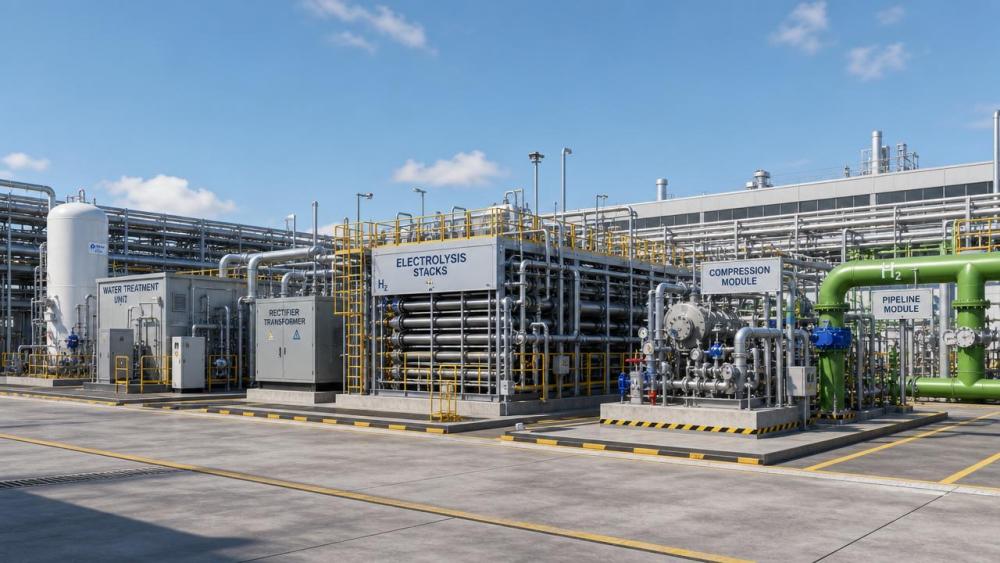
That conversion is where electrolyzer system integration cost expands. Rectifiers, transformers, deionized water systems, cooling loops, gas treatment, compression, controls, safety barriers, piping, foundations, and interconnections all accumulate quickly.
For utility-scale projects, these costs can shift economics more than expected because they are strongly influenced by local conditions, owner standards, redundancy philosophy, and downstream hydrogen specification requirements.
This is why two projects using similar PEM or alkaline stacks may show materially different CAPEX profiles. The difference is often not the electrochemical core, but the surrounding engineering and infrastructure burden.
For a finance team, the right framing is simple: if the stack produces hydrogen, the integrated plant produces bankability. Capital decisions should be made on the second number, not the first.
What financial approvers are really trying to verify before approving CAPEX
When executives search for electrolyzer system integration cost, they are usually trying to validate five investment questions before moving a project forward.
First, they need to know which cost items are structurally unavoidable and which are specific to a particular design choice, site, or contracting strategy.
Second, they want clarity on what portion of non-stack CAPEX is scalable, and what portion behaves as a fixed cost that punishes smaller projects.
Third, they need confidence that the basis of design reflects real operating requirements, not optimistic assumptions created to win internal sponsorship.
Fourth, they want to identify hidden interface risks. In hydrogen projects, vendor scope gaps between stack suppliers and balance-of-plant contractors are a common source of overruns.
Fifth, they need to understand whether higher upfront integration spend lowers lifecycle risk, especially around uptime, safety compliance, and future expansion.
An article that helps these readers must therefore translate engineering complexity into capital logic: where the money goes, what drives variance, and which trade-offs are justified.
The major cost buckets beyond the electrolyzer stack
The first major bucket is power infrastructure. Electrolyzers do not consume raw grid power directly in its incoming form. They require transformers, switchgear, harmonics management, rectification, protection, and often upgraded substation interfaces.
Power electronics can become a significant share of total installed cost, especially where grid quality is variable or renewable coupling requires flexible load response.
The second major bucket is water treatment. High-purity water production requires pretreatment, reverse osmosis in many cases, polishing, storage, dosing, and wastewater handling.
Finance teams sometimes underestimate this area because water input volumes appear modest. However, the purification standard, local feedwater quality, and discharge compliance can raise cost substantially.
The third bucket is thermal management. Large electrolyzer systems need cooling loops, heat exchangers, pumps, and control logic to protect performance and component life.
The fourth bucket is hydrogen conditioning. Depending on use case, hydrogen may require drying, purification, buffer storage, and pressure management before it can move to compression or downstream offtake.
The fifth bucket is compression and storage. If the hydrogen must be delivered above stack outlet pressure, compression can become one of the most visible integration costs, both in equipment and safety design.
The sixth bucket is plant control architecture. Distributed control systems, PLC logic, cybersecurity, remote monitoring, and emergency shutdown integration are not optional in serious industrial deployments.
The seventh bucket is safety and compliance infrastructure. Hazardous area classification, gas detection, vent stacks, fire protection, blast spacing, and code-driven civil layouts all affect CAPEX.
The eighth bucket is site works and construction. Foundations, pipe racks, cable trenches, buildings, access roads, drainage, and installation labor can be highly site dependent.
Together, these categories explain why electrolyzer system integration cost deserves separate scrutiny rather than being treated as a small percentage adder to stack pricing.
Which cost drivers create the biggest CAPEX variability
Not all integration categories fluctuate equally. Some are relatively predictable, while others swing sharply based on project context.
Grid interconnection is one of the largest variable drivers. A site with existing high-capacity electrical infrastructure looks very different from one requiring new feeders, transformer upgrades, or permitting-heavy utility work.
Hydrogen delivery pressure is another decisive factor. A project feeding nearby low-pressure industrial demand has a different cost profile from one targeting tube trailers, refueling, or high-pressure storage.
Water quality and discharge constraints also create variance. Poor source water or strict wastewater standards can add treatment stages that were absent from early conceptual budgets.
Redundancy philosophy matters as well. N+1 pumps, parallel purification trains, spare compressors, and dual control paths improve resilience, but they change first-cost economics.
Plot constraints are often overlooked. Tight industrial sites can increase construction complexity, require modularization, and force more expensive piping or safety spacing solutions.
Codes, standards, and owner specifications also influence integration cost. Compliance with hydrogen-relevant frameworks and utility-grade practices can raise engineering depth, documentation, testing, and material requirements.
Finally, contracting structure affects cost transparency. EPC wrap, multi-vendor supply, or owner-integrated execution each allocate risk differently, and risk allocation always influences price.
How project scale changes non-stack economics
Scale improves some parts of electrolysis economics, but not all categories decline smoothly with size. Financial approvers should distinguish between scalable equipment and threshold infrastructure.
Certain systems, such as control architecture, water polishing skids, safety systems, and grid connection packages, contain fixed-cost elements that weigh heavily on smaller plants.
As capacity rises, those fixed elements are spread across more hydrogen output, improving unit economics. This is one reason pilot projects often appear disproportionately expensive on a per-kilowatt basis.
However, scale can also trigger new cost layers. Larger plants may require more sophisticated substation design, advanced compression trains, larger hazardous area management plans, and more formal redundancy requirements.
There is also a modularity threshold issue. Projects that align with standard module sizes may integrate efficiently, while awkward intermediate sizes can produce poor equipment matching and higher custom engineering costs.
For CAPEX review, the key question is not simply whether bigger is cheaper. It is whether the project has reached the scale at which infrastructure efficiency offsets added complexity.
Where early budgets most often go wrong
The most common budgeting error is using a stack-centered benchmark and applying an overly low balance-of-plant multiplier without validating scope boundaries.
Another frequent mistake is assuming vendor quotations are directly comparable. One supplier may include rectification, local controls, and water treatment interfaces, while another excludes them.
Compressed schedules also distort cost. Fast-track procurement can reduce optionality, increase freight expense, and force design decisions before utility and permitting realities are known.
Many early models underestimate site preparation and installation labor. Electrolyzer projects can appear modular on paper, yet still require substantial field assembly and commissioning effort.
Hydrogen purity and pressure specifications are another source of misalignment. If downstream users or transport systems demand tighter specs than initially modeled, added conditioning equipment can emerge late.
Finance teams should also watch for under-budgeted instrumentation and safety layers. These items may seem secondary during concept development, but become mandatory during detailed engineering and HAZOP review.
Finally, contingency is often set too low for first-of-a-kind regional deployments. When local supply chains, codes, or execution partners are inexperienced with hydrogen, integration uncertainty increases materially.
A practical framework for reviewing electrolyzer system integration cost
For capital approval committees, the best defense against cost surprise is a disciplined review framework that forces design maturity and scope clarity before final authorization.
Start by separating stack supply cost from total installed system cost. Require a line-by-line breakdown of electrical, water, thermal, gas handling, compression, controls, safety, civil, and commissioning scope.
Next, ask whether each line item is vendor-packaged, EPC-supplied, owner-supplied, or still undefined. Undefined interfaces are often where late CAPEX growth originates.
Then test the basis of design. What hydrogen pressure, purity, annual availability, load-following capability, ambient envelope, and water quality assumptions have been priced?
Review the interconnection pathway separately. Utility studies, substation scope, and required power quality measures can materially affect timing and capital intensity.
Demand a clear redundancy philosophy. A bankable industrial plant should not inherit a research-project mindset if offtake obligations or strategic energy security targets require reliability.
Assess site-specific enabling works early. Space constraints, blast offsets, drainage, roads, crane access, and hazardous zoning are not peripheral items; they are integrated CAPEX drivers.
Finally, benchmark contingency against project novelty. Mature brownfield replication and first-of-a-kind greenfield deployment should not carry the same risk allowance.
How to judge whether higher integration cost is justified
Not every increase in electrolyzer system integration cost is a negative. Some forms of higher CAPEX may create better financial outcomes by reducing operational or strategic risk.
For example, better power conditioning may protect stack life and improve efficiency under variable renewable input. Higher-grade water treatment may reduce downtime and maintenance uncertainty.
Robust control systems and remote diagnostics can shorten commissioning, improve fault response, and support fleet-level performance management across multiple sites.
Additional compression or storage flexibility may open more valuable offtake pathways, increasing project resilience if one demand channel weakens.
Likewise, stronger safety design and standards compliance can reduce permitting friction, insurer concern, and counterparty hesitation. For sovereign-scale hydrogen infrastructure, that has measurable capital value.
The financial test is whether the added cost improves one or more of four outcomes: revenue certainty, asset availability, regulatory confidence, or expansion readiness.
If an integration premium strengthens these levers, it may deserve approval even when headline CAPEX rises. Cheap systems are not always economical systems.
What a bankable approval memo should conclude
A sound approval memo should conclude with more than a total CAPEX number. It should explain what portion of project cost is stack-related, what portion is integration-related, and where residual uncertainty still sits.
It should identify the top variance drivers, the unresolved interfaces, the contingency rationale, and the conditions required before notice to proceed.
It should also state whether the project’s cost structure is inherently site-specific or reasonably replicable across a portfolio, since replicability changes strategic value.
Most importantly, it should make clear that non-stack cost is not incidental. In many green hydrogen developments, it is the defining factor separating optimistic concept economics from financeable infrastructure reality.
For financial approvers, the right takeaway is clear: electrolyzer system integration cost is where project bankability is tested. The more rigorously it is understood, the stronger the capital decision becomes.
Related News
- Electricity Price Volatility Is Rewriting Hydrogen Cost ModelsApr 27, 2026Impact of electricity price on hydrogen cost is transforming industrial decarbonization and large-scale electrolysis. Explore LCOH trends, PPA strategies, and resilient hydrogen infrastructure planning.
- Energy Transition Plans Often Fail at the Grid Connection StageApr 27, 2026Sustainable energy and energy transition projects often fail at grid connection. Learn how hydrogen infrastructure, PEM electrolysis, and industrial decarbonization can avoid delays and protect investment value.
- What Is Slowing Industrial Decarbonization Projects in 2026?Apr 27, 2026Industrial decarbonization faces delays in 2026 as hydrogen infrastructure, sustainable energy access, grid limits, safety standards, and project bankability challenge the energy transition.
- AEM Stability Remains the Big Question for Scale-UpApr 27, 2026Anion exchange membrane stability is the key barrier to large-scale electrolysis. Discover how AEM impacts industrial decarbonization, hydrogen infrastructure, safety, and scale-up economics.
Related News
- 00
0000-00
Hydrogen Energy Storage for Data Centers Gets Costly Fast - 00
0000-00
When 99.999% Hydrogen Purity Still Is Not Good Enough - 00
0000-00
When Does a Hydrogen-Ready Gas Turbine Pay Off? - 00
0000-00
Electricity Price Volatility Is Rewriting Hydrogen Cost Models - 00
0000-00
PSA Recovery Rate Drops for Reasons Operators Miss
Dr. Aris Aero
Weekly Insights
Stay ahead with our curated technology reports delivered every Monday.