Electrolyzer Power Consumption: What kWh/Nm3 Tells You




For technical evaluators, electrolyzer power consumption expressed in kWh/Nm3 is not just a datasheet number. It is one of the fastest ways to judge practical efficiency, stack condition, operating realism, and whether a hydrogen project will remain defensible at scale.
The core search intent behind “electrolyzer power consumption (kWh/Nm3)” is typically evaluative rather than introductory. Readers want to know what a given figure actually means, what range is credible, what affects it, and how to compare PEM and alkaline systems fairly.
For this audience, the most important questions are direct. Is the reported value based on stack power or full system power? At what pressure, temperature, purity, and load was it measured? Does the figure hold at partial load, over time, and under real balance-of-plant conditions?
The most useful content therefore is not a generic explanation of electrolysis. It is a decision framework: how to interpret kWh/Nm3, how to normalize supplier claims, how to identify hidden energy penalties, and how the metric connects to OPEX, degradation, and bankability.
In the discussion below, the emphasis is on practical interpretation, benchmarking, and diligence. Broad hydrogen-economy narratives are intentionally minimized so that technical evaluators can use the metric as a sharper screening and procurement tool.
Why kWh/Nm3 matters more than many brochure efficiency claims
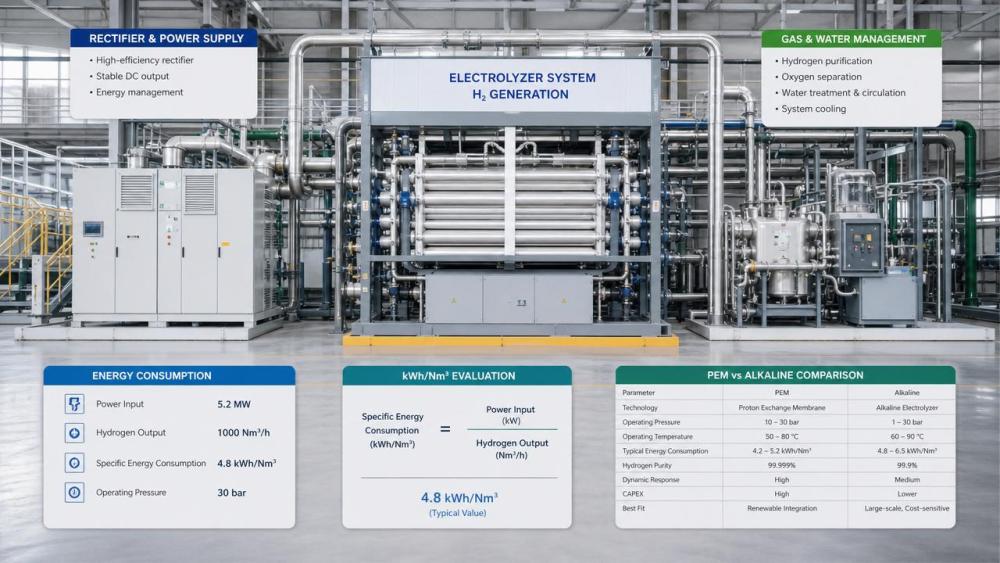
Electrolyzer power consumption in kWh/Nm3 tells you how much electrical energy is required to produce one normal cubic meter of hydrogen. Because Nm3 is normalized to standard conditions, the metric gives evaluators a practical basis for comparing output across systems and operating claims.
Its value lies in simplicity. A lower number generally means less electricity per unit of hydrogen, which directly affects operating cost. Since electricity is usually the dominant variable cost in electrolysis, even small differences in kWh/Nm3 can materially shift project economics over plant life.
But the metric does more than indicate cost. It can also reveal design quality, stack electrochemical performance, thermal management effectiveness, gas separation efficiency, and the burden imposed by auxiliary systems such as pumps, rectifiers, dryers, and cooling loops.
For technical assessment, this means kWh/Nm3 should never be read as a standalone “efficiency badge.” It should be read as an operating signature. The number reflects not only the stack, but the test boundary, system architecture, load point, pressure strategy, and aging state.
That is why two suppliers can report similarly attractive values while offering very different real-world performance. One may quote stack-only consumption at nominal load, while another reports full-system consumption including balance-of-plant parasitics. Without boundary clarity, the comparison is weak.
What exactly does the number include: stack only or full system?
The first diligence question is always about measurement boundary. A stack-level value excludes many electrical loads that matter in commercial operation. A system-level value includes power electronics, water treatment, thermal control, gas processing, compression-related interfaces, and other auxiliaries.
For procurement or bankability analysis, full-system kWh/Nm3 is usually the more relevant figure. It reflects what the plant actually draws to deliver hydrogen at specified purity and operating conditions. Stack-only numbers can still be useful, but mostly for technology benchmarking or degradation diagnostics.
Some vendors also quote different boundaries for different audiences. A performance deck may highlight stack efficiency, while a technical appendix reveals additional parasitic demand. Evaluators should therefore request a single-line energy balance and tagged power consumers under rated and part-load operation.
A practical review should ask: does the stated number include rectifier losses, deionized water circulation, electrolyte management where relevant, cooling, gas drying, controls, and safety systems? If hydrogen exits at elevated pressure, does the value include the energy required to achieve that condition?
These distinctions matter because the delta between stack and plant consumption can be meaningful. A strong stack does not guarantee an efficient package. In poorly optimized systems, auxiliary loads can erode the advantage implied by a favorable electrochemical performance claim.
What is a credible range for electrolyzer power consumption?
Technical evaluators often search this keyword because they need a reality check. They are trying to determine whether a quoted kWh/Nm3 figure is competitive, optimistic, or misleading. The answer depends on technology type, pressure, load point, and whether the number is stack-only or system-level.
At a broad level, lower power consumption indicates higher conversion efficiency, but only within a comparable test basis. Modern PEM and alkaline systems can both achieve competitive ranges, yet their performance profiles differ with current density, dynamics, thermal design, and operating pressure.
Rather than fixating on a single universal threshold, evaluators should compare values under matched conditions: hydrogen output basis, outlet pressure, ambient assumptions, water quality, degradation state, and AC-versus-DC accounting. A highly attractive value becomes less impressive if it omits major system loads.
It is also essential to check whether the reported number corresponds to beginning of life, guaranteed average over a period, or end-of-life expectation. Beginning-of-life minimum consumption is useful for laboratory benchmarking, but less useful for long-duration infrastructure planning.
When a claim looks unusually low, the right response is not immediate rejection but structured scrutiny. Ask for polarization curves, efficiency maps by load, guaranteed consumption bands, and the exact protocol used to convert measured electrical input into kWh/Nm3.
How operating conditions can distort or clarify the kWh/Nm3 figure
Power consumption is highly sensitive to operating conditions. If those conditions are not disclosed, the number has limited value. Temperature, current density, pressure, water management, and load factor all influence the electrical input required for hydrogen production.
Current density is especially important. Pushing higher current density raises throughput per unit stack area, which can reduce CAPEX intensity, but often at the cost of higher cell voltage and therefore higher kWh/Nm3. Evaluators need to understand whether the project values lower OPEX or smaller equipment footprint.
Pressure also matters. Producing hydrogen at elevated pressure can simplify downstream compression requirements, but pressurized electrolysis usually changes the energy profile. A reported consumption figure should therefore be assessed together with outlet pressure and the downstream process configuration.
Part-load behavior is another frequent blind spot. Renewable-coupled plants rarely operate at one perfect design point. If consumption degrades sharply at 30% to 60% load, a nominal value at 100% load may overstate annual efficiency. Requesting a full load-efficiency map is therefore essential.
Ambient conditions, startup frequency, and thermal cycling can also affect real energy use. A system optimized for stable baseload operation may deliver weaker average performance in highly variable duty. This is especially relevant in grids with volatile power availability or hybrid wind-solar integration.
What kWh/Nm3 reveals about stack health and degradation over time
For technical evaluators, one of the most valuable uses of electrolyzer power consumption is as a degradation indicator. As stacks age, voltage tends to rise at a given current density. That means more electrical input is needed to produce the same hydrogen output.
Seen this way, kWh/Nm3 is not only an efficiency metric but a health trend. A slowly increasing value can signal catalyst aging, membrane resistance growth, electrode wear, contamination, gas crossover issues, or declining thermal and water-management effectiveness.
This is why a single efficiency snapshot is insufficient. Evaluators should ask for degradation rates expressed in operationally relevant terms, such as voltage rise per thousand hours, expected increase in specific energy consumption, and maintenance intervals that restore or stabilize performance.
Durability claims should also be linked to duty cycle. A stack tested in steady industrial operation may age differently from one subjected to frequent ramping. For sovereign-scale or utility-scale assets, the interaction between dynamic operation and long-term kWh/Nm3 drift deserves careful attention.
Bankable assessment therefore requires a time-based view. What matters is not only today’s specific energy consumption, but the average and guaranteed consumption profile over the contract horizon. Lifetime electricity cost can be heavily affected by what seems like a modest degradation slope.
How to compare PEM and alkaline systems fairly
PEM and alkaline electrolyzers are often compared through simplified narratives, yet kWh/Nm3 should be interpreted through each technology’s actual operating envelope. PEM may offer advantages in dynamic response and compactness, while alkaline can remain highly competitive in mature large-scale applications.
A fair comparison starts by aligning test conditions. Compare AC-to-hydrogen or DC-to-hydrogen figures consistently. Match pressure assumptions. Match purity requirements. Match the load point. Match beginning-of-life versus warranted average values. Without this alignment, procurement conclusions can be distorted.
Technology selection should then consider the whole project context. A system with slightly higher nominal kWh/Nm3 may still be superior if it handles rapid renewables-following duty better, requires less external compression, or delivers stronger durability under the intended dispatch profile.
Likewise, a lower reported consumption value does not automatically mean a lower levelized cost of hydrogen. If CAPEX is higher, replacement intervals are shorter, or system availability is lower, the operational advantage may narrow. Technical evaluators need integrated rather than single-metric judgment.
This is where kWh/Nm3 becomes most useful: not as the only decision criterion, but as a disciplined entry point into stack behavior, system design, and lifecycle economics. It helps separate superficial comparisons from engineering-based evaluation.
How this metric affects project economics, standards alignment, and bankability
Electricity cost dominates hydrogen production economics in many projects, so electrolyzer power consumption has a direct effect on OPEX and levelized cost. A difference of only a few kWh per kilogram equivalent of hydrogen can translate into major lifetime cost deltas at multi-megawatt scale.
For financiers and infrastructure planners, this means kWh/Nm3 influences much more than technical elegance. It shapes tariff sensitivity, renewable sizing, grid interconnection demand, transformer loading, and the amount of hydrogen that can be produced within constrained power envelopes.
It also intersects with standards and compliance pathways. While kWh/Nm3 itself is not a safety standard, the conditions behind the figure often relate to pressure containment, gas purity, thermal management, and equipment integration practices that must align with recognized engineering frameworks.
In strategic benchmarking environments such as G-HEI, the metric becomes especially powerful when linked to broader asset integrity and infrastructure readiness criteria. An efficient electrolyzer that underperforms in durability, pressure management, or integration discipline is not automatically a sovereign-grade asset.
Bankability therefore depends on traceable performance evidence. Lenders, energy ministries, and utility CTOs typically need auditable test methods, realistic energy balances, degradation assumptions, and guaranteed performance windows. A claimed kWh/Nm3 value only becomes finance-relevant when it is measurable, repeatable, and contractually meaningful.
A practical diligence checklist for technical evaluators
When reviewing electrolyzer proposals, start with one simple request: provide the exact definition of reported electrolyzer power consumption in kWh/Nm3. Ask whether it is AC or DC, stack or plant, gross or net, and tied to which outlet pressure, purity, and temperature.
Next, request performance maps rather than a single point. You want consumption across multiple load levels, startup behavior where relevant, and the expected annualized value under the project’s operating profile. Real plants live in ranges, not brochure absolutes.
Then verify time dependence. Ask for beginning-of-life, warranted average, and end-of-warranty assumptions. Require a degradation model that connects stack aging to specific energy consumption, maintenance scheduling, and replacement strategy.
Also examine auxiliary loads in detail. Rectification, cooling, water treatment, drying, controls, and process integration can materially shift the true energy intensity. Hidden parasitics often explain why field performance diverges from headline values.
Finally, tie the figure back to project purpose. If the asset supports utility balancing, dynamic response may matter more than the lowest nominal kWh/Nm3. If the objective is lowest long-run hydrogen cost in steady operation, average full-system efficiency and durability may deserve higher weighting.
Conclusion: what kWh/Nm3 really tells you
Electrolyzer power consumption in kWh/Nm3 is one of the most informative quick-look metrics in hydrogen project evaluation, but only when read in context. It tells you about efficiency, yes, but also about system boundaries, operating realism, auxiliary burden, and likely cost performance.
For technical evaluators, the key takeaway is clear. Do not ask only whether the number is low. Ask what it includes, under which conditions it was measured, how it changes with load and age, and whether it reflects the plant you will actually build and operate.
Used this way, the metric becomes far more than a specification line. It becomes a disciplined lens for comparing PEM and alkaline systems, identifying performance risk, and judging whether an electrolyzer is merely attractive on paper or truly fit for bankable zero-carbon infrastructure deployment.
Related News
- Electricity Price Volatility Is Rewriting Hydrogen Cost ModelsApr 27, 2026Impact of electricity price on hydrogen cost is transforming industrial decarbonization and large-scale electrolysis. Explore LCOH trends, PPA strategies, and resilient hydrogen infrastructure planning.
- Energy Transition Plans Often Fail at the Grid Connection StageApr 27, 2026Sustainable energy and energy transition projects often fail at grid connection. Learn how hydrogen infrastructure, PEM electrolysis, and industrial decarbonization can avoid delays and protect investment value.
- What Is Slowing Industrial Decarbonization Projects in 2026?Apr 27, 2026Industrial decarbonization faces delays in 2026 as hydrogen infrastructure, sustainable energy access, grid limits, safety standards, and project bankability challenge the energy transition.
- How safety layers reduce risk in utility-scale hydrogen systemsOct 05, 2026Utility scale hydrogen systems safety: discover how layered prevention, detection, shutdown, venting, and inspection controls reduce operational risk.
Related News
- 00
0000-00
Hydrogen Energy Storage for Data Centers Gets Costly Fast - 00
0000-00
When 99.999% Hydrogen Purity Still Is Not Good Enough - 00
0000-00
When Does a Hydrogen-Ready Gas Turbine Pay Off? - 00
0000-00
Electricity Price Volatility Is Rewriting Hydrogen Cost Models - 00
0000-00
PSA Recovery Rate Drops for Reasons Operators Miss
Dr. Aris Aero
Weekly Insights
Stay ahead with our curated technology reports delivered every Monday.