Feedwater Conductivity Limits for Stable PEM Operation




For after-sales maintenance teams, understanding feedwater deionization conductivity is essential to keeping PEM systems stable, efficient, and compliant. Even small deviations in water quality can accelerate stack degradation, trigger alarms, and reduce output. This article explains practical conductivity limits, why they matter during daily operation, and how disciplined checks help maintain stable PEM performance over time.
Why feedwater conductivity limits matter in PEM systems
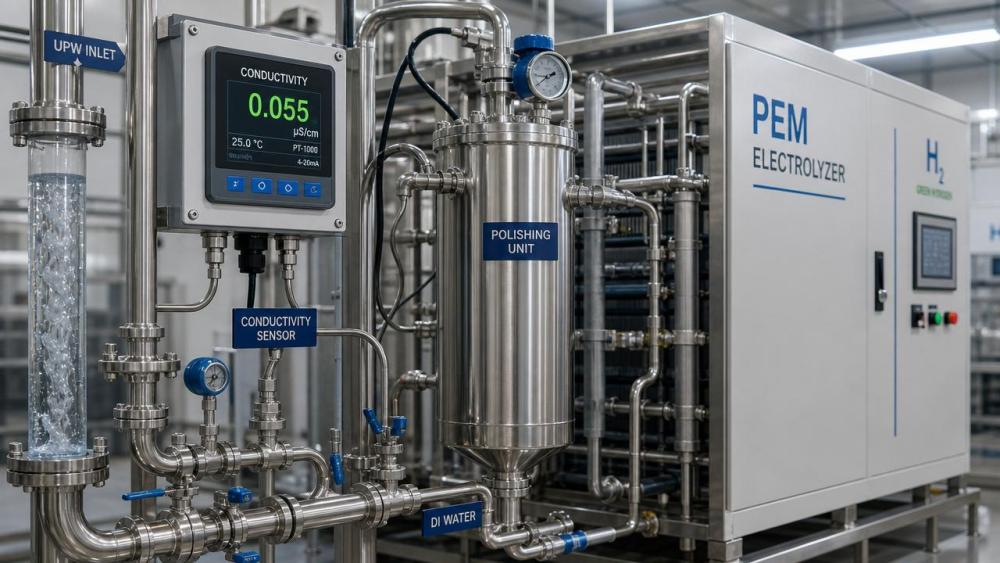
PEM electrolyzers depend on highly purified water because the membrane, catalyst layer, and titanium-based flow fields are sensitive to ionic contamination. Poor feedwater deionization conductivity quickly changes stack conditions.
Conductivity is not just a lab number. It is a field indicator of dissolved ions, resin performance, polishing loop health, and contamination ingress from tanks, piping, seals, or maintenance activity.
In stable PEM operation, lower conductivity generally means higher resistivity and fewer harmful ions. That reduces parasitic current paths, contamination of the membrane, and corrosion risks in auxiliary components.
For zero-carbon hydrogen infrastructure, water quality control also supports broader asset integrity goals. Stable conductivity helps preserve output predictability, stack warranty conditions, and long-cycle efficiency benchmarks across utility-scale electrolysis assets.
Use this practical checklist for feedwater deionization conductivity
The exact limit always follows OEM documentation, stack chemistry, and plant design. Still, the checklist below reflects widely used field practice for feedwater deionization conductivity in PEM systems.
- Verify the normal feedwater target stays below the OEM alarm threshold, with many PEM systems aiming for conductivity near or below 0.1-1.0 µS/cm at 25°C.
- Measure at a fixed temperature or use automatic temperature compensation, because conductivity shifts with temperature and can create false conclusions during troubleshooting.
- Check both inlet and recirculation points, since acceptable tank water does not guarantee acceptable water quality at the stack interface or polishing loop outlet.
- Trend conductivity continuously instead of relying on single readings, because gradual drift often appears days before a PEM alarm or output instability develops.
- Inspect mixed-bed resin, EDI modules, and polishing cartridges when conductivity rises, because treatment equipment exhaustion is a common root cause of unstable feedwater deionization conductivity.
- Confirm calibration of conductivity sensors using clean procedures, since contaminated probes, dried electrodes, or poor calibration fluid handling can distort readings.
- Review sodium, silica, chloride, and total organic carbon together with conductivity, because low conductivity alone may still hide contaminants harmful to PEM membranes.
- Isolate contamination sources after maintenance, especially from new hoses, gasket materials, improper chemical cleaning residues, or incomplete flushing of replacement parts.
- Compare conductivity excursions with stack voltage spread, gas purity alarms, and differential pressure changes to identify whether water quality is causing broader system instability.
- Document acceptance limits, alarm setpoints, hold points, and corrective actions so repeated water quality events are resolved consistently across shifts and service intervals.
What conductivity limits are practical in the field
Many operators use a three-band approach. First is the preferred operating band. Second is the caution band. Third is the stop-and-investigate band. This approach simplifies decisions during routine service.
Preferred operating band
For many PEM systems, feedwater deionization conductivity near ultrapure quality, often below 0.2-1.0 µS/cm, supports the most stable membrane performance. Lower values are commonly required for long stack life.
Caution band
When conductivity begins trending upward but remains below the shutdown point, investigate immediately. This often signals resin exhaustion, CO2 ingress, stagnant water zones, or early contamination from maintenance work.
Stop-and-investigate band
If conductivity exceeds the OEM limit or rises sharply within hours, treat it as a reliability event. Continuing operation can accelerate membrane contamination, increase cell voltage, and compromise hydrogen purity.
Because OEM thresholds vary, site procedures should always define actual trip values, sample points, compensation methods, and restart criteria. A generic number is never a substitute for validated equipment documentation.
Additional guidance for different operating scenarios
Commissioning and restart after outage
Conductivity often spikes during first fill or restart because preserved equipment, idle piping, and fresh replacement components release ions. Flush until readings stabilize, not just until water visually appears clear.
During recommissioning, compare conductivity at source water, RO outlet, deionized water tank, polishing skid, and stack inlet. This stepwise check quickly identifies where the contamination load enters.
High-load continuous production
At sustained high current density, stack sensitivity to water quality becomes more visible. Even moderate increases in feedwater deionization conductivity may correlate with higher cell voltages and reduced efficiency margins.
In this mode, continuous trending and alarm verification are more valuable than occasional grab samples. Fast load response can mask gradual water quality deterioration unless trend logic is reviewed daily.
Intermittent renewable-linked operation
Frequent start-stop cycles increase exposure to stagnant water, dissolved CO2 absorption, and variable polishing loop performance. Conductivity should be checked before startup, after ramping, and during idle recirculation periods.
Sites integrated with wind or solar should also verify whether storage tank venting, tank turnover, and intermittent treatment skid operation are affecting feedwater deionization conductivity between production windows.
Commonly overlooked risks
Ignoring sensor location. A low reading in the tank can hide a higher reading near the stack. Dead legs, warm piping, and local contamination can distort the real operating condition.
Focusing only on conductivity. Water may pass conductivity checks while still carrying silica, organics, or trace ions that harm PEM membranes and catalysts over time.
Missing post-maintenance contamination. Gloves, lubricants, cleaning agents, adhesive residues, and temporary hoses can all affect feedwater deionization conductivity after otherwise routine service work.
Delaying corrective action. Slow conductivity drift is often treated as noncritical until alarms appear. By then, the stack may already be operating outside its best efficiency window.
Simple execution steps that improve stability
- Set a site-specific target, caution limit, and shutdown limit for feedwater conductivity, then align them with OEM procedures and historian alarm tags.
- Sample at the same points every time and record temperature, operating load, and treatment skid status with each conductivity value.
- Replace or regenerate polishing media based on trend behavior, not only on calendar intervals, especially in variable-duty renewable applications.
- Flush thoroughly after component replacement and verify stable conductivity before returning the PEM stack to full current operation.
- Cross-check conductivity events against voltage spread, gas purity, and flow data to catch linked performance issues early.
Conclusion and next action
Stable PEM operation depends on disciplined water quality control, and feedwater deionization conductivity is one of the most useful daily indicators. It reflects treatment performance, contamination risk, and stack protection in one measurable signal.
The most effective next step is to build a simple conductivity response sheet: define target range, caution range, trip limit, sample points, temperature basis, and required corrective action for each deviation.
When conductivity data is trended consistently and acted on early, PEM assets remain more efficient, more reliable, and better aligned with long-term hydrogen infrastructure performance goals.
Related News
- Electricity Price Volatility Is Rewriting Hydrogen Cost ModelsApr 27, 2026Impact of electricity price on hydrogen cost is transforming industrial decarbonization and large-scale electrolysis. Explore LCOH trends, PPA strategies, and resilient hydrogen infrastructure planning.
- Energy Transition Plans Often Fail at the Grid Connection StageApr 27, 2026Sustainable energy and energy transition projects often fail at grid connection. Learn how hydrogen infrastructure, PEM electrolysis, and industrial decarbonization can avoid delays and protect investment value.
- What Is Slowing Industrial Decarbonization Projects in 2026?Apr 27, 2026Industrial decarbonization faces delays in 2026 as hydrogen infrastructure, sustainable energy access, grid limits, safety standards, and project bankability challenge the energy transition.
- How safety layers reduce risk in utility-scale hydrogen systemsOct 05, 2026Utility scale hydrogen systems safety: discover how layered prevention, detection, shutdown, venting, and inspection controls reduce operational risk.
Related News
- 00
0000-00
Hydrogen Energy Storage for Data Centers Gets Costly Fast - 00
0000-00
When 99.999% Hydrogen Purity Still Is Not Good Enough - 00
0000-00
When Does a Hydrogen-Ready Gas Turbine Pay Off? - 00
0000-00
Electricity Price Volatility Is Rewriting Hydrogen Cost Models - 00
0000-00
PSA Recovery Rate Drops for Reasons Operators Miss
Dr. Aris Aero
Weekly Insights
Stay ahead with our curated technology reports delivered every Monday.