Feedwater Deionization Conductivity: Early Warning Signs to Watch




For aftersales maintenance teams supporting hydrogen and zero-carbon infrastructure, feedwater deionization conductivity is more than a routine metric—it is an early indicator of system risk, efficiency loss, and material degradation. Spotting abnormal conductivity trends in time helps prevent unplanned downtime, protect critical components, and maintain stable performance across high-value water-treatment and energy systems.
When users search for feedwater deionization conductivity, they are usually not looking for a textbook definition. They want to know what a conductivity change means in practice, which warning signs matter first, how to distinguish sensor noise from real water-quality deterioration, and what actions should be taken before membranes, resins, pumps, heat exchangers, electrolyzers, or downstream balance-of-plant assets are affected.
For aftersales maintenance personnel, the most useful approach is not to treat conductivity as an isolated number. It should be read as a trend signal linked to resin health, leakage, contamination ingress, operating instability, and instrumentation reliability. In hydrogen-related water systems, especially those tied to electrolysis and other high-purity process loops, small conductivity deviations can point to larger issues developing upstream or downstream.
Why conductivity in deionized feedwater matters long before a failure happens
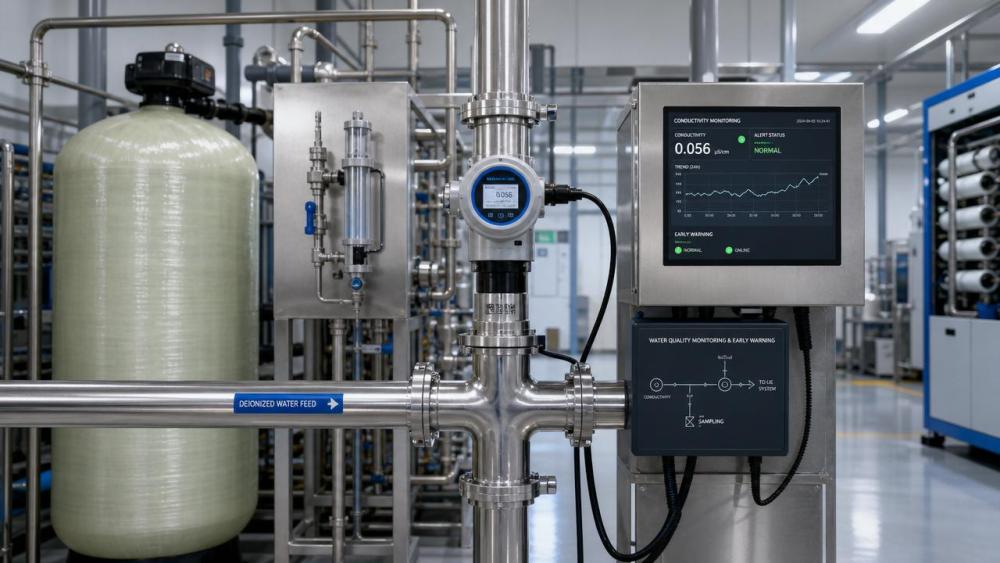
In high-value zero-carbon infrastructure, feedwater purity directly affects system efficiency, component life, and compliance with tight operating tolerances. Conductivity is one of the fastest practical indicators of ionic contamination. If conductivity rises, the system is often telling you that dissolved ions are breaking through, entering from an external source, or being released internally due to material or process changes.
For maintenance teams, the real value of conductivity monitoring lies in its role as an early warning metric. It can expose deionizer exhaustion, regeneration problems, valve leakage, membrane damage, CO₂ ingress, chemical carryover, or sample contamination before these conditions trigger more expensive consequences such as scale deposition, corrosion, stack performance loss, or repeated shutdowns.
This is especially important in hydrogen production environments using purified water for electrolyzer support systems. Even when the deionization unit is not part of the electrolyzer skid itself, unstable feedwater quality can cascade into lower efficiency, higher maintenance frequency, and uncertainty in troubleshooting. In short, conductivity often moves before the rest of the system starts to fail visibly.
What aftersales maintenance teams are really trying to identify
Most service teams are trying to answer five practical questions. First, is the conductivity increase real or is it an instrument issue? Second, is the problem temporary or progressive? Third, where is contamination entering the system? Fourth, how quickly must action be taken? Fifth, what components are at immediate risk if the trend continues?
These questions matter because not every conductivity excursion has the same cause or urgency. A brief spike after startup may be manageable if it clears quickly and matches known operating behavior. A slow but steady increase over several shifts is more concerning, because it often indicates resin exhaustion, process leakage, or chronic contamination that will not self-correct.
The core task is therefore not just measurement, but interpretation. Good maintenance teams combine conductivity readings with flow, temperature, pressure differential, regeneration history, sample location, and equipment operating mode. That broader view is what turns a conductivity number into a reliable maintenance decision.
The earliest warning signs to watch in feedwater deionization conductivity
The first warning sign is a gradual upward trend from the system’s established baseline. Even if the absolute value still appears acceptable, a stable system should not drift without reason. A rising baseline usually means ion exchange performance is weakening, contamination loading is increasing, or an operating condition has changed enough to affect water quality.
The second warning sign is repeated conductivity spikes during startup, shutdown, or load changes that become larger over time. This pattern can indicate poor rinse quality after regeneration, channeling in resin beds, valve sequencing issues, or a control problem that allows untreated or partially treated water to pass during transitions.
The third warning sign is a mismatch between inlet water quality and outlet conductivity performance. If influent conditions remain stable but deionized water conductivity worsens, the issue is likely inside the treatment train. That points attention toward exhausted resin, fouling, bed compaction, internal bypassing, or damaged internals rather than source water variability.
The fourth warning sign is conductivity instability without any clear process explanation. Sudden jumps, oscillations, or noise-like readings may indicate sensor fouling, poor calibration, grounding issues, air bubbles in the sample line, or low sample flow. Teams should be careful not to mistake bad data for bad water, but they should also not dismiss instability too quickly without verifying instrumentation health.
The fifth warning sign is localized conductivity deterioration at a specific monitoring point. If one loop or skid shows worsening conductivity while parallel units remain normal, the problem may be tied to a single polishing bed, branch line, storage tank, heat exchanger leak path, or maintenance-related contamination event.
Common root causes behind abnormal conductivity readings
Resin exhaustion remains one of the most common causes. As ion exchange capacity is consumed, ions begin to break through and conductivity rises. If regeneration intervals have been extended, source water chemistry has shifted, or throughput has increased beyond design assumptions, exhaustion may occur earlier than expected.
Regeneration problems are another frequent issue. Incorrect chemical concentration, poor contact time, inadequate rinse, or sequencing faults can leave the bed partially restored. In these cases, conductivity may improve temporarily after regeneration but degrade faster than normal, often confusing teams into suspecting multiple unrelated faults.
CO₂ ingress can also elevate conductivity, particularly in systems exposed to air through storage tanks, vents, or poorly sealed sample points. Carbon dioxide dissolves in water and forms ionic species that raise conductivity. This is important because a conductivity increase caused by CO₂ may not indicate the same contamination profile as a rise caused by hardness, chlorides, or sodium leakage.
Leakage from heat exchangers, valves, seals, or cross-connections can introduce ions into high-purity water loops. In integrated plants, maintenance teams should not assume that water-treatment skids are isolated from the rest of the asset base. A small internal leak in adjacent equipment can gradually compromise deionized water quality and appear first as a conductivity anomaly.
Instrumentation issues must remain on the shortlist. Conductivity probes can drift, foul, or read inaccurately if temperature compensation is wrong. Sample line dead legs, low flow, air entrainment, or residual cleaning chemicals can distort the reading. A disciplined troubleshooting process always verifies the measurement chain before major corrective action is taken.
How to separate a true water-quality problem from a sensor or sampling problem
Start by checking whether the abnormal reading matches process behavior. If conductivity rises while differential pressure, throughput, or regeneration performance also changes, the reading is more likely to be real. If conductivity alone behaves erratically while all other variables stay normal, focus first on sensor and sampling verification.
Next, confirm calibration status and inspect the sensor physically if access allows. Fouling films, damaged electrodes, incorrect cell constants, and outdated calibration can all create misleading values. In critical facilities, using a portable meter or a secondary analyzer to cross-check the installed instrument is often the fastest way to distinguish process reality from instrument error.
Then review sample line conditions. Low flow, stagnant water, trapped gas, contamination at the sample point, or poor temperature control can all affect conductivity results. Many apparent water-quality incidents are actually sample-system design or handling problems, especially after maintenance interventions, piping changes, or analyzer replacement.
Finally, compare readings across locations. If upstream and downstream values move together in a logical pattern, the issue is likely real. If one analyzer shows a severe excursion while adjacent measurement points remain flat, the probability of a local measurement problem increases. Cross-location comparison is one of the most practical tools available to aftersales teams.
A field-ready troubleshooting sequence for maintenance teams
First, define the event clearly. Note when the conductivity changed, how fast it changed, what operating mode the system was in, and whether the shift coincided with regeneration, startup, chemical cleaning, maintenance work, or source water changes. Timeline clarity prevents wasted effort later.
Second, verify the measurement. Check analyzer status, calibration records, temperature compensation, sample flow, sensor condition, and any available grab-sample confirmation. If the reading cannot be trusted, no root-cause conclusion should be treated as final.
Third, review recent process history. Look for resin age, throughput since last regeneration, chemical consumption, pressure drop changes, valve maintenance, and any deviations in pretreatment performance. A conductivity excursion often becomes easier to explain when viewed against recent operational shifts.
Fourth, isolate likely entry points for contamination. Inspect storage tanks, vents, cross-connections, heat exchangers, make-up water interfaces, and any maintenance access points recently opened. In complex hydrogen and zero-carbon facilities, contamination often enters through small, indirect paths rather than obvious failures.
Fifth, evaluate urgency based on downstream sensitivity. If the affected water supports electrolyzer feed preparation, precision cooling loops, or other purity-sensitive systems, intervention thresholds should be tighter than in less critical utility service. Aftersales teams need a response model tied to asset consequence, not just a generic alarm number.
What conductivity trends can tell you about asset condition and system risk
A slowly rising conductivity trend usually signals declining treatment effectiveness rather than a sudden mechanical failure. This gives maintenance teams a planning advantage: they can schedule inspection, regeneration, resin replacement, or leak testing before the problem escalates into a forced outage.
Sharp step changes, by contrast, often suggest a discrete event such as valve misalignment, breakthrough, sample contamination, incorrect regeneration, or a leak path opening. These events deserve immediate attention because they may indicate that the barrier between purified and contaminated water has already been compromised.
Cyclic conductivity patterns can point toward operating-sequence problems. If conductivity rises predictably after certain transitions, the system may have rinse inefficiency, standby stagnation, poor control logic, or mode-dependent bypassing. Repeating patterns are useful because they narrow the search from random fault to process-linked fault.
Reading these trends correctly helps protect expensive equipment. In hydrogen infrastructure, where uptime, purity, and material integrity are tightly linked, conductivity behavior can serve as an operational health indicator not just for the deionizer, but for the wider water-handling and process-support ecosystem.
Best practices to reduce repeat conductivity incidents
Establish a true baseline for each system rather than relying only on generic acceptance limits. Every facility has its own normal conductivity profile based on source water, treatment design, operating pattern, and measurement location. Teams are much more effective when they respond to deviations from known normal, not just to alarm thresholds.
Trend conductivity alongside temperature, flow, pressure differential, throughput, and regeneration history. A single data point can mislead; a trend with context is actionable. This is especially valuable for aftersales teams managing multiple sites or returning to customer facilities after initial commissioning.
Standardize post-maintenance verification. After sensor replacement, piping work, resin handling, or chemical cleaning, confirm conductivity stability before closing the job. Many recurring quality complaints come from incomplete handback checks rather than persistent hardware defects.
Maintain discipline in sample handling and analyzer upkeep. Clean sample systems, accurate temperature compensation, regular calibration, and documented verification routines reduce false alarms and improve confidence when a real event occurs. In high-consequence infrastructure, data quality is part of asset reliability.
Finally, connect conductivity response plans to asset criticality. A small rise in a low-risk utility loop may justify monitoring and scheduled correction. The same rise in a high-purity hydrogen support system may require immediate investigation. The response should match the consequence of contamination, not just the magnitude of the number.
Conclusion: treat feedwater deionization conductivity as an operational warning signal, not a routine checkbox
For aftersales maintenance teams, feedwater deionization conductivity is valuable because it reveals emerging problems early, often before major equipment shows obvious symptoms. The most important warning signs are rising baselines, repeated spikes, instability during transitions, unexplained analyzer behavior, and localized deterioration at specific monitoring points.
The right response is a disciplined one: verify the measurement, compare trends, check recent operating history, inspect likely contamination paths, and judge urgency based on downstream asset sensitivity. Teams that do this well can prevent avoidable outages, extend component life, and maintain stronger confidence in system performance.
In hydrogen and zero-carbon infrastructure, where purified water quality supports both efficiency and technical integrity, conductivity should never be treated as a passive number on a screen. Read correctly, it is one of the clearest early warning signs available to maintenance professionals.
Related News
- Electricity Price Volatility Is Rewriting Hydrogen Cost ModelsApr 27, 2026Impact of electricity price on hydrogen cost is transforming industrial decarbonization and large-scale electrolysis. Explore LCOH trends, PPA strategies, and resilient hydrogen infrastructure planning.
- Energy Transition Plans Often Fail at the Grid Connection StageApr 27, 2026Sustainable energy and energy transition projects often fail at grid connection. Learn how hydrogen infrastructure, PEM electrolysis, and industrial decarbonization can avoid delays and protect investment value.
- What Is Slowing Industrial Decarbonization Projects in 2026?Apr 27, 2026Industrial decarbonization faces delays in 2026 as hydrogen infrastructure, sustainable energy access, grid limits, safety standards, and project bankability challenge the energy transition.
- What drives electrolysis scaling cost in megawatt PEM projects?Sep 13, 2026Electrolysis scaling cost explained: uncover the CAPEX, power, balance-of-plant, and lifecycle risks shaping bankable megawatt PEM projects.
Related News
- 00
0000-00
Hydrogen Energy Storage for Data Centers Gets Costly Fast - 00
0000-00
When 99.999% Hydrogen Purity Still Is Not Good Enough - 00
0000-00
When Does a Hydrogen-Ready Gas Turbine Pay Off? - 00
0000-00
Electricity Price Volatility Is Rewriting Hydrogen Cost Models - 00
0000-00
PSA Recovery Rate Drops for Reasons Operators Miss
Dr. Aris Aero
Weekly Insights
Stay ahead with our curated technology reports delivered every Monday.