ISO 22734 Water Electrolyzers for Energy: What Compliance Really Covers




For quality and safety leaders navigating hydrogen projects, ISO 22734 water electrolyzers for energy is more than a technical label—it defines how design, operation, and risk control align in real-world deployment. Understanding what this standard truly covers helps teams strengthen compliance decisions, reduce safety gaps, and support reliable electrolyzer performance across large-scale zero-carbon energy infrastructure.
Why scenario differences matter before claiming compliance
In practice, ISO 22734 water electrolyzers for energy does not create value simply because it appears on a datasheet, tender response, or factory acceptance document. Its real value emerges when quality control teams and safety managers interpret the standard against the specific operating scenario of the electrolyzer system. A pilot skid in a research park, a utility-scale hydrogen plant connected to variable renewables, and an industrial decarbonization facility supplying hydrogen to downstream process users may all reference the same standard, but their compliance priorities are not identical.
This is exactly where many procurement and project risks begin. Teams often assume that ISO 22734 water electrolyzers for energy covers every legal, mechanical, electrical, process, and site safety obligation in a hydrogen project. It does not. The standard is highly relevant, but it sits within a wider compliance ecosystem that may include pressure equipment rules, hazardous area classification, hydrogen fueling standards, pipeline requirements, electrical safety codes, and owner-specific operating procedures. For safety leaders, the key question is not “Is the unit certified?” but “What risks and interfaces are actually covered, and what still requires separate verification?”
For organizations such as G-HEI that benchmark strategic hydrogen assets across sovereign-scale infrastructure, the difference between nominal compliance and application-fit compliance is critical. Water electrolysis systems used for energy applications are increasingly being integrated into national decarbonization programs, grid balancing schemes, ammonia and e-fuels production, and high-security energy reserves. Each scenario changes the meaning of acceptable risk, maintenance philosophy, redundancy planning, and evidence requirements for quality assurance.
Where ISO 22734 water electrolyzers for energy usually appears in real projects
For quality and safety personnel, it helps to start with the business contexts in which this standard is most often referenced. These include large-scale PEM and alkaline electrolysis systems producing hydrogen from water for energy storage, grid support, industrial fuel switching, mobility infrastructure supply, and integrated zero-carbon projects. In all of these cases, ISO 22734 water electrolyzers for energy is commonly used as a technical baseline for the design, construction, safety aspects, and operational expectations of the electrolyzer package itself.
However, the standard becomes especially important when a project has one or more of the following characteristics: hydrogen is produced at scale, oxygen and hydrogen separation integrity is critical, electrical loads are substantial, pressure-containing components are part of the system package, and operational control must address abnormal conditions such as water quality deviation, gas purity upset, overpressure, temperature excursions, or shutdown events. In these settings, the standard supports disciplined decision-making for acceptance criteria, supplier qualification, audit planning, and risk reviews.
What compliance really covers in the electrolyzer package
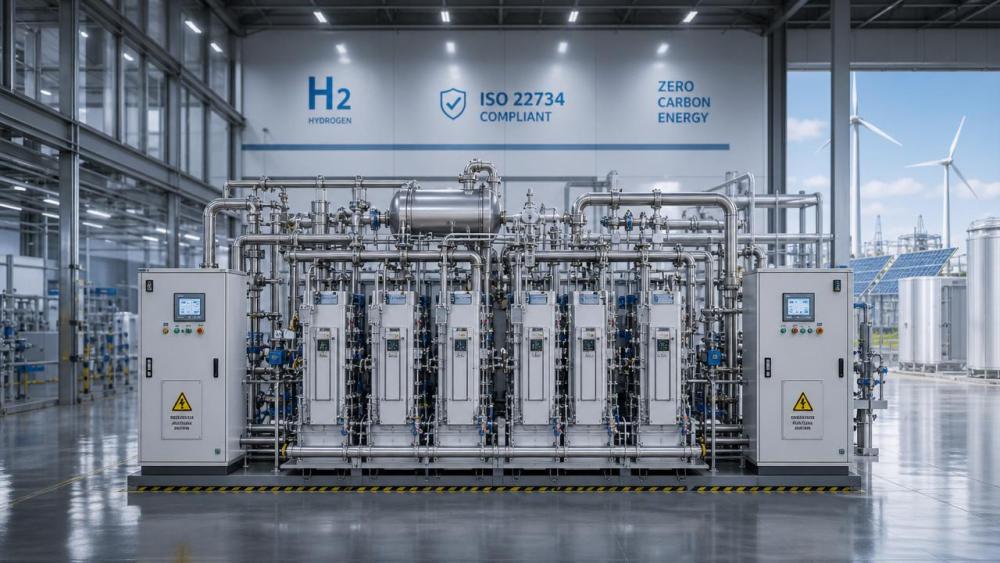
For most projects, ISO 22734 water electrolyzers for energy is best understood as a product and system safety framework focused on the electrolyzer assembly and its essential auxiliaries. It addresses how the equipment should be designed and evaluated so that hydrogen generation from water can occur under controlled and foreseeable conditions. This typically includes expectations around process safety, electrical safety considerations within the package, control functions, protective measures, documentation, and operating instructions.
From a quality assurance perspective, this means the standard has practical relevance in reviewing design dossiers, hazard controls, component suitability, alarms, interlocks, shutdown sequences, gas handling boundaries, and evidence that the manufacturer has considered credible failure modes. It also matters when assessing whether the supplier’s declared operating parameters match the application reality, including start-stop frequency, load variability, purity targets, water treatment quality, and environmental conditions.
Just as important is what it does not automatically cover in full. ISO 22734 water electrolyzers for energy is not a substitute for every local regulatory requirement, civil design rule, building code, explosion protection study, or downstream hydrogen distribution standard. Safety managers should treat it as a foundational layer rather than the entire compliance stack. That distinction is often what separates robust deployment from a project that passes supplier review but fails during integration, permitting, or commissioning.
Scenario-by-scenario: what quality and safety teams should examine first
1. Grid-connected renewable hydrogen plants
In renewable projects, especially those tied to solar and wind generation, the biggest issue is not only whether the electrolyzer complies on paper but whether ISO 22734 water electrolyzers for energy has been applied in a way that supports dynamic operation. Fluctuating power input can affect thermal balance, stack stress, gas separation performance, and shutdown frequency. Quality teams should verify the manufacturer’s evidence for transient performance, protective logic, and operating limits under partial load and cycling conditions. Safety teams should confirm whether design assumptions align with actual dispatch patterns instead of idealized steady-state operation.
2. Industrial feedstock replacement and process decarbonization
In refineries, steel plants, ammonia units, methanol synthesis, and similar industrial settings, the priority often shifts from dynamic flexibility to supply continuity and integration discipline. Here, ISO 22734 water electrolyzers for energy supports the safe production package, but the business consequence of downtime is much higher. QC personnel should focus on maintainability, spare parts philosophy, verification of material compatibility, and the reliability of sensors tied to purity and pressure control. Safety managers should also assess interface risks between the electrolyzer package and plant-wide systems such as flare, vent, compression, storage, and emergency shutdown architecture.
3. Hydrogen mobility and refueling supply chains
Where electrolyzers support transport fuel infrastructure, purity consistency becomes a commercial and safety issue, not only a process metric. ISO 22734 water electrolyzers for energy helps establish confidence in the generation side, yet mobility projects also depend on downstream standards and strict quality transfer across drying, compression, storage, and dispensing. In this scenario, teams should review package boundaries carefully. A supplier may provide a compliant electrolyzer, but if the integration with purification, storage, or refueling systems is weak, the project can still underperform or fail acceptance.
4. Demonstration projects and public-sector deployments
Smaller installations often create a dangerous misconception that compliance is simpler. In reality, public demonstrations, campuses, research sites, and municipal pilot projects frequently have limited operational maturity. In these cases, ISO 22734 water electrolyzers for energy should be read with extra attention to operating instructions, protective systems, signage, training assumptions, and routine inspection needs. A modest plant with inexperienced operators may present greater practical risk than a larger industrial unit with disciplined engineering controls.
Common gaps between standard coverage and project reality
Several recurring gaps appear across hydrogen projects. First, buyers may assume the standard confirms site readiness, when in fact it mainly addresses the electrolyzer equipment and defined scope. Second, teams may overlook the distinction between factory conformity and installed-system performance. Third, some projects fail to verify whether all auxiliary systems supplied by third parties maintain the same safety logic as the core electrolyzer package.
Another frequent issue concerns documentation depth. A declaration related to ISO 22734 water electrolyzers for energy is far more useful when supported by hazard analysis records, test reports, commissioning procedures, alarm matrices, maintenance instructions, and traceable component information. Without such evidence, quality audits become superficial and safety reviews lose predictive power. For strategic energy assets, especially those benchmarked at sovereign or utility scale, document quality is not administrative detail—it is operational risk control.
How to judge whether a solution fits your scenario
For quality control and safety management teams, a practical evaluation path is to ask five scenario-driven questions before approving a supplier or design package.
- Does the declared compliance scope clearly define what is inside the electrolyzer package and what remains outside owner or integrator responsibility?
- Do the tested operating conditions reflect the real duty cycle, including ramping, standby, shutdown frequency, and environmental exposure?
- Are gas purity, water quality, thermal control, venting, and protective logic suitable for the downstream use case?
- Have site-specific requirements been checked against additional standards, codes, and authority expectations beyond ISO 22734 water electrolyzers for energy?
- Can the supplier provide audit-ready evidence rather than marketing-level statements?
These questions are especially useful for multidisciplinary organizations like G-HEI, where benchmarking must compare not only equipment capability but also compliance maturity across PEM, alkaline, cryogenic logistics, turbine integration, CCUS-linked energy systems, and high-pressure hydrogen applications.
Typical misjudgments safety leaders should avoid
One common misjudgment is treating ISO 22734 water electrolyzers for energy as a universal project passport. Another is evaluating only stack technology while underweighting enclosure design, control architecture, gas management, maintenance access, and emergency response readiness. A third is assuming that large suppliers always deliver stronger compliance evidence; in reality, the quality of scenario-specific documentation varies significantly between vendors and project types.
Safety managers should also resist the temptation to judge suitability solely by production capacity. A high-capacity system may still be a weak fit if the site cannot support water quality stability, ventilation assumptions, electrical resilience, or competent operating routines. Conversely, a smaller unit with strong documentation, clear boundaries, and robust controls may be the safer and more bankable option for a given application.
Action steps for quality and safety teams in hydrogen projects
If your organization is selecting, auditing, or integrating electrolyzer assets, the best approach is to map ISO 22734 water electrolyzers for energy against your actual deployment scenario rather than against a generic checklist. Define the use case first: grid balancing, industrial hydrogen replacement, refueling supply, research deployment, or sovereign-scale strategic infrastructure. Then identify the operational realities that matter most: cycling intensity, uptime targets, purity sensitivity, staffing capability, maintenance model, and downstream interfaces.
From there, request evidence that directly supports those realities. Ask for design assumptions, test boundaries, alarm and shutdown philosophy, maintenance requirements, material compatibility information, and interface responsibilities. When needed, benchmark the electrolyzer package against adjacent standards and owner requirements so that no gap is hidden behind a single compliance claim. That is the practical meaning of mature compliance in the hydrogen economy.
For teams working in strategic zero-carbon infrastructure, especially across utility-scale electrolysis and integrated hydrogen assets, understanding what ISO 22734 water electrolyzers for energy really covers is not just a documentation exercise. It is a disciplined way to reduce uncertainty, improve procurement quality, and protect long-term asset performance. The strongest decisions come from aligning the standard with the scenario, the risk profile, and the operational mission of the project.
Related News
- Electricity Price Volatility Is Rewriting Hydrogen Cost ModelsApr 27, 2026Impact of electricity price on hydrogen cost is transforming industrial decarbonization and large-scale electrolysis. Explore LCOH trends, PPA strategies, and resilient hydrogen infrastructure planning.
- Energy Transition Plans Often Fail at the Grid Connection StageApr 27, 2026Sustainable energy and energy transition projects often fail at grid connection. Learn how hydrogen infrastructure, PEM electrolysis, and industrial decarbonization can avoid delays and protect investment value.
- What Is Slowing Industrial Decarbonization Projects in 2026?Apr 27, 2026Industrial decarbonization faces delays in 2026 as hydrogen infrastructure, sustainable energy access, grid limits, safety standards, and project bankability challenge the energy transition.
- AEM Stability Remains the Big Question for Scale-UpApr 27, 2026Anion exchange membrane stability is the key barrier to large-scale electrolysis. Discover how AEM impacts industrial decarbonization, hydrogen infrastructure, safety, and scale-up economics.
Related News
- 00
0000-00
Hydrogen Energy Storage for Data Centers Gets Costly Fast - 00
0000-00
When 99.999% Hydrogen Purity Still Is Not Good Enough - 00
0000-00
When Does a Hydrogen-Ready Gas Turbine Pay Off? - 00
0000-00
Electricity Price Volatility Is Rewriting Hydrogen Cost Models - 00
0000-00
PSA Recovery Rate Drops for Reasons Operators Miss
Dr. Aris Aero
Weekly Insights
Stay ahead with our curated technology reports delivered every Monday.