How does PEM electrolysis technology handle variable power?




Variable renewable power presents a critical challenge for hydrogen production: an electrolyzer must adjust its output without compromising safety, efficiency, or equipment life. PEM electrolysis technology is well suited to this task because its electrical load can be controlled dynamically as wind and solar generation fluctuate. However, response speed alone does not determine system performance. The useful operating range depends on the stack, power electronics, gas handling and control strategy working together.
For a technical evaluation, the question is not simply whether an electrolyzer can follow a renewable power profile. It is whether it can do so while meeting hydrogen quality, availability, lifetime and downstream delivery requirements under the conditions expected at the site.
From fluctuating electricity to controlled hydrogen production
A proton exchange membrane, or PEM, electrolyzer uses direct current to split water into hydrogen and oxygen. At the anode, water is oxidized to produce oxygen, protons and electrons. The membrane conducts protons to the cathode, while the electrons travel through the external circuit. At the cathode, protons and electrons combine to form hydrogen.
The electrical current is closely related to the rate of hydrogen production. Reducing current therefore reduces production, while increasing it raises production, subject to operating limits. Power consumption does not change in exactly the same proportion because cell voltage and auxiliary loads also vary with operating conditions.
In a commercial installation, the stack is only one part of the response. A power conversion system regulates the DC supply; a plant controller coordinates stack limits with water circulation, cooling, gas separation, drying and pressure control. When renewable output changes, these components must move together without allowing unsafe pressure differences, inadequate cooling or off-specification gas to reach downstream equipment.
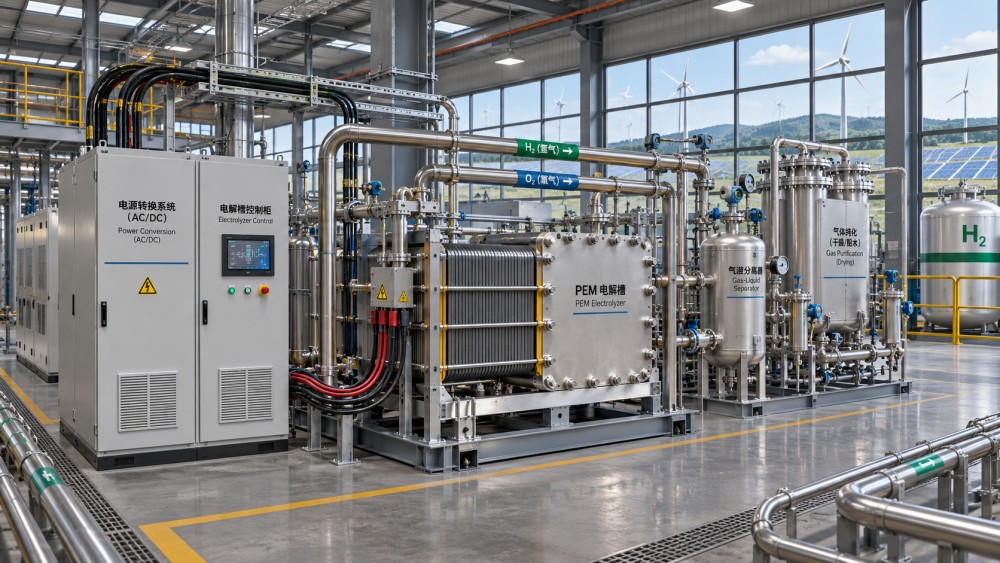
This distinction matters when reviewing a fast-response claim. A stack may accept a current change rapidly, but the time needed to deliver stable, specification-compliant hydrogen at the plant boundary can be longer. The answer depends on the starting state and on how response is defined.
Response time is not a single number
A supplier may quote response from one power setpoint to another while the system is already running. That is different from restarting in standby or starting after a prolonged shutdown. A cold start can require checks and conditioning of water, temperature, pressure and gas paths before hydrogen is accepted for delivery.
Ask which event starts the response timer: a grid signal, a controller command or a change in stack current. Also establish where the response is measured. A change at the DC terminals is not equivalent to a verified change in dry hydrogen flow at the outlet.
For a project exposed to frequent renewable ramps, the useful evidence is a set of operating curves rather than a single headline figure. These should identify permitted ramp rates, minimum and maximum loads, temperature and pressure conditions, and any restrictions on repeated transitions. The acceptance test should use a power profile representative of the intended duty, including short dips and recovery periods, rather than only a smooth step between two steady states.
The practical lower limit: crossover, purity and auxiliaries
PEM systems can operate below their rated output, but minimum stable load is a system-specific constraint. One reason is gas crossover: small quantities of hydrogen and oxygen can pass through the membrane. At lower production rates, crossover can become more significant relative to the gas being produced. This affects impurity concentrations and can constrain the safe operating envelope, particularly when pressure conditions or membrane condition change.
The relevant question is not merely whether the stack can remain energized at low current. Evaluators should establish how gas composition is monitored, which limits trigger a load increase or shutdown, where off-specification gas is directed, and how the system returns to normal operation. The answer should cover foreseeable sensor faults as well as normal process fluctuations.
Auxiliary consumption also changes the economics of turndown. Pumps, controls, cooling equipment and purification systems may continue to draw power even when hydrogen output is low. Consequently, a stack operating efficiently at a reduced current does not automatically mean that the whole plant is efficient at the same point. Compare specific electricity consumption at the plant boundary across the expected load range, including auxiliaries and the treatment needed to reach the specified hydrogen condition.
Hydrogen quality must be assessed at the delivery point. A downstream user may care about moisture, oxygen or other impurities, while a compressor, storage system or end-use process may have additional inlet limits. Dryers and purification equipment also have their own operating ranges. A plant that can follow a highly variable electrical profile may still need buffer storage or a controlled hydrogen outlet to protect the downstream process.
Flexibility has a durability cost to investigate
Dynamic operation introduces a different lifetime question from steady operation. Changes in current alter electrochemical and thermal conditions; starts, stops and pressure transients can add further stresses. Degradation mechanisms depend on the stack design and operating history, so it is not defensible to assign one universal penalty to every ramp or shutdown.
Instead, request the assumptions behind stack lifetime and replacement forecasts. Do they reflect continuous rated operation, a defined cycling profile or a renewable profile resembling the project? What limits apply to differential pressure, temperature excursions and time spent in standby? Are there restrictions on restart frequency, and what maintenance follows an abnormal trip?
The materials question extends beyond the membrane. PEM stacks use corrosion-resistant materials in demanding electrochemical environments; titanium components are common in relevant stack applications. Water quality, contamination control, coatings and component compatibility all deserve attention because material degradation can affect performance and service intervals. A lifetime estimate without its water-quality and maintenance assumptions is difficult to compare with another offer.
There is a genuine operating trade-off. Remaining in a warm standby state may reduce restart delay, but it can consume energy and may impose its own equipment-duty requirements. Shutting down can avoid some standby consumption, but it may increase restart time and expose the system to more start-stop events. The preferred strategy depends on the duration of power interruptions, electricity costs, hydrogen demand and the supplier’s validated operating limits.
Designing around the power profile, not the nameplate
A project with variable wind or solar generation should be evaluated against a time series, not only annual energy availability. Two sites with the same annual electricity supply can produce different operating outcomes if one has long outages and the other has frequent short fluctuations. Those profiles change the number of starts, the time spent near minimum load and the need for standby power.
System configuration can moderate these effects. Multiple electrolyzer modules may allow some units to operate while others remain off or in standby, although the benefit depends on shared equipment, dispatch logic and module-level limits. A grid connection or battery can smooth some electrical changes; hydrogen storage can separate variable production from a steadier delivery requirement. None is automatically justified: each introduces capital cost, losses or additional operating obligations.
Downstream pressure is another important interface. Compression, storage and delivery equipment must accommodate the expected flow range and the consequences of trips. If the receiving process requires continuous hydrogen, the design should specify how long storage must cover an interruption, what happens when storage is full, and whether the electrolyzer must reduce load even when renewable power is available.
For a fair technology comparison, assess PEM and alkaline systems against the same power profile, delivery specification and financial assumptions. PEM’s controllability is relevant, but project value also depends on installed cost, efficiency across the duty cycle, water treatment, maintenance, degradation and replacement schedules. Manufacturer-specific designs and operating envelopes matter more than a generic technology label.
Standards and evidence for a technical review
Standards should be mapped to the equipment and interfaces they actually govern. ISO 22734 addresses hydrogen generators using water electrolysis processes and is a relevant starting point for electrolyzer safety review. The applicable edition, scope, jurisdictional requirements and conformity assessment route should be confirmed for the project; referencing a standard does not by itself demonstrate that a particular plant complies.
Other requirements may arise downstream. ASME B31.12 concerns hydrogen piping and pipelines where applicable, while ISO 19880 addresses gaseous hydrogen fueling stations and SAE J2601 addresses fueling protocols for light-duty gaseous hydrogen surface vehicles. These references should not be treated as interchangeable electrolyzer performance standards. Their relevance depends on whether the project includes the corresponding piping or fueling interfaces and on local adoption.
A review should connect the standards register to tangible evidence: process and instrumentation diagrams, hazardous-area assessment, relief and venting philosophy, shutdown logic, materials specifications, inspection plans and factory or site acceptance procedures. For variable operation, ask how loss of power, communications failure, cooling failure and rapid pressure changes are handled. Confirm which systems require backup power to reach and maintain a safe state.
The Global Hydrogen-Economy & Zero-Carbon Infrastructure (G-HEI) frames this kind of assessment across electrolysis and connected hydrogen infrastructure. That broader view is useful because a technically responsive stack can still be limited by the piping, storage, compression or end-use equipment around it.
What to request before comparing bids
Start with a common project duty: the expected power time series, grid constraints, water conditions, required hydrogen quality, delivery pressure and availability target. Then ask each supplier to state its operating envelope and performance at the same measurement boundaries. The resulting comparison should make clear:
- Minimum load, permitted ramp rates and the conditions under which those limits apply.
- Response from operating, standby and shutdown states, including the time to deliver specification-compliant hydrogen.
- Plant-level electricity consumption across the load range, with auxiliary loads and gas treatment identified.
- Gas-quality monitoring, crossover-related protections and the handling of off-specification gas.
- Stack lifetime assumptions, cycling restrictions, water requirements and replacement scope.
- Applicable standards, verification documents and responsibilities at electrical, water and hydrogen interfaces.
The strongest assessment is a traceable match between a real operating profile and a documented plant response. If a proposed duty falls outside tested conditions, identify that gap before treating modelled flexibility, hydrogen output or stack life as a contractual expectation.
Related News
- Electricity Price Volatility Is Rewriting Hydrogen Cost ModelsApr 27, 2026Impact of electricity price on hydrogen cost is transforming industrial decarbonization and large-scale electrolysis. Explore LCOH trends, PPA strategies, and resilient hydrogen infrastructure planning.
- Energy Transition Plans Often Fail at the Grid Connection StageApr 27, 2026Sustainable energy and energy transition projects often fail at grid connection. Learn how hydrogen infrastructure, PEM electrolysis, and industrial decarbonization can avoid delays and protect investment value.
- What Is Slowing Industrial Decarbonization Projects in 2026?Apr 27, 2026Industrial decarbonization faces delays in 2026 as hydrogen infrastructure, sustainable energy access, grid limits, safety standards, and project bankability challenge the energy transition.
- How does PEM electrolysis technology handle variable power?Nov 14, 2026Discover how PEM electrolysis technology adapts to variable renewable power, and what to assess for safe, efficient hydrogen production.
Related News
- 00
0000-00
Hydrogen Energy Storage for Data Centers Gets Costly Fast - 00
0000-00
When 99.999% Hydrogen Purity Still Is Not Good Enough - 00
0000-00
When Does a Hydrogen-Ready Gas Turbine Pay Off? - 00
0000-00
Electricity Price Volatility Is Rewriting Hydrogen Cost Models - 00
0000-00
PSA Recovery Rate Drops for Reasons Operators Miss
Dr. Aris Aero
Weekly Insights
Stay ahead with our curated technology reports delivered every Monday.