Hydrogen Economy Transition: Where Megawatt PEM Fits First




The hydrogen economy transition is no longer a future concept but a board-level investment question.
For business evaluators, the first practical role of megawatt PEM lies where fast response, high-purity hydrogen, and grid-flexible operation create measurable value.
This article examines the earliest fit-for-purpose applications, helping decision-makers align technical readiness, infrastructure constraints, and capital priorities with sovereign decarbonization goals.
Where Megawatt PEM Fits First in the Hydrogen Economy Transition
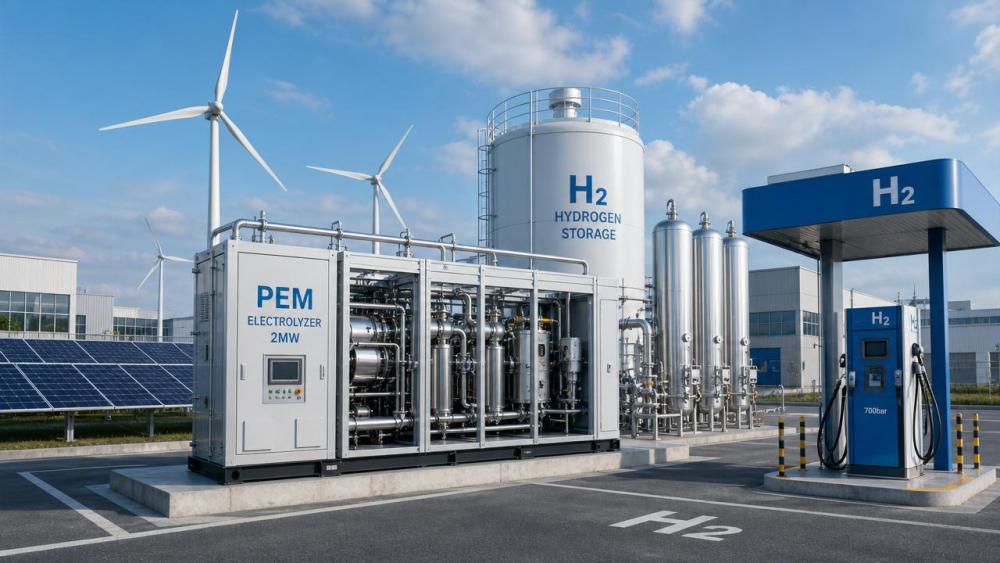
The core answer is straightforward: megawatt PEM fits first where hydrogen has premium operational value, not where commodity-scale production is the only objective.
For business evaluation teams, the best early markets are projects that monetize flexibility, purity, uptime, and rapid load-following rather than lowest-possible hydrogen cost alone.
That means the earliest viable deployment zones are industrial users needing reliable clean hydrogen, mobility hubs with strict fueling standards, and grid-coupled energy systems.
In the hydrogen economy transition, PEM is usually not the first-choice technology for every use case, but it is often the first bankable choice for specific ones.
Its advantage appears when developers must respond to variable renewable power, deliver high-purity output, operate in compact footprints, and scale from pilot to commercial assets.
Business evaluators searching this topic usually want a ranking of where PEM works now, what conditions make it investable, and where to remain cautious.
The practical judgment is that megawatt PEM should be prioritized in high-value, infrastructure-constrained, or flexibility-sensitive segments before broad commodity hydrogen substitution.
What Business Evaluators Actually Need to Know Before Approving PEM Investment
Target readers in commercial assessment roles are rarely asking whether hydrogen matters in principle; they are asking whether this project configuration can clear investment gates.
Their main concerns include revenue certainty, power-price exposure, stack replacement timing, utilization assumptions, compliance burden, and the availability of downstream offtake infrastructure.
They also need to know whether PEM creates strategic optionality, such as future integration into refueling, ammonia, e-fuels, industrial decarbonization, or balancing services.
In this context, technology selection is not just an engineering matter but a portfolio allocation decision across risk, timing, and sovereign industrial positioning.
PEM often enters the shortlist because it offers dynamic performance that aligns with intermittent renewable generation and because it can produce very pure hydrogen directly.
But that does not automatically make every PEM project attractive, especially when local power costs are high or demand is too uncertain to support acceptable utilization.
The key evaluation question is therefore not “Is PEM important?” but “Which early application captures enough value to justify PEM’s current capital and materials profile?”
First-Fit Application 1: Industrial Hydrogen Demand That Values Purity and Reliability
The strongest early fit is industrial consumption where hydrogen is already used and where decarbonized replacement can command operational or regulatory value.
Examples include electronics-related applications, specialty chemicals, selected metallurgy pathways, glass processing support, and facilities with strict gas quality requirements.
These environments often reward PEM because high-purity hydrogen reduces downstream purification needs and supports stable process integration with less ancillary complexity.
For evaluators, this matters because every avoided processing step can improve project economics, simplify plant design, and reduce execution risk during early deployment.
Reliability is equally important.
If the industrial buyer faces costly production interruptions, a hydrogen supply system with fast response and controllable output becomes more valuable than a simple lowest-cost model.
PEM is especially relevant where the buyer wants to pair electrolysis with renewable procurement while preserving process continuity across variable power conditions.
That said, not every industrial site is a PEM-first candidate.
Large facilities seeking constant, lowest-cost bulk hydrogen at very high scale may still favor alternatives depending on power, water, land, and system design.
PEM fits first where premium operational performance closes the commercial case.
First-Fit Application 2: High-Pressure Mobility and Refueling Infrastructure
The next strong early market is hydrogen mobility infrastructure, particularly high-pressure refueling systems where quality, compression integration, and duty-cycle responsiveness matter.
Heavy-duty transport corridors, bus depots, port logistics, and strategic fleet hubs are more realistic entry points than diffuse retail passenger fueling models.
For these projects, the hydrogen economy transition is tied to asset utilization, fleet conversion schedules, and compliance with stringent fueling protocols.
PEM supports this segment because it provides hydrogen purity suitable for demanding end uses and can respond dynamically to variable station demand profiles.
In commercial terms, that flexibility can reduce the mismatch between hydrogen production timing and dispensing peaks, especially when paired with storage and intelligent controls.
It can also improve resilience for fleet operators that prefer on-site or near-site generation rather than total dependence on delivered hydrogen logistics.
Business evaluators should still examine the full system, not only the electrolyzer.
Compression, storage, pre-cooling, dispenser throughput, and safety compliance often dominate both cost and operational complexity in refueling applications.
Still, among early markets, mobility hubs remain one of the clearest places where megawatt PEM can earn its position through quality and responsiveness rather than raw scale alone.
First-Fit Application 3: Renewable-Coupled Projects Requiring Fast Load Following
One of PEM’s defining strengths is dynamic operation.
That makes it well suited for renewable-coupled systems where wind or solar output changes rapidly and the hydrogen plant must follow power availability.
In the hydrogen economy transition, this is strategically important because early hydrogen assets are often developed where curtailment, congestion, or stranded renewable potential already exists.
PEM can convert intermittent electricity into a transportable molecule while preserving optionality across industry, mobility, power balancing, and synthetic fuels.
For evaluators, the value case improves when the project captures more than one revenue logic at the same site.
A plant may absorb low-cost renewable power, produce hydrogen for contracted industrial offtake, and support grid services or energy balancing under specific market rules.
This multi-value-stack structure is often where megawatt PEM becomes more compelling than a simplistic levelized hydrogen cost comparison suggests.
However, flexibility has value only if local market design, power procurement strategy, and offtake contracts allow the project to monetize it.
Without those commercial enablers, fast response remains technically impressive but financially underused.
First-Fit Application 4: Energy Security and Sovereign Resilience Projects
Another early role for megawatt PEM lies in strategic infrastructure projects where governments or critical industries prioritize resilience as much as direct cost competitiveness.
These may include island grids, defense-linked logistics, emergency energy reserves, remote industrial clusters, or national demonstration zones for hydrogen sovereignty.
In such cases, business evaluators must broaden the frame beyond immediate hydrogen price and include supply-chain security, domestic capability building, and geopolitical risk reduction.
PEM can be attractive here because modular megawatt systems enable phased deployment, faster project replication, and more flexible integration with local renewable assets.
They also support the creation of operational know-how that can later scale into larger national infrastructure programs.
This learning value matters in the hydrogen economy transition, where first-mover capability in safety, materials integrity, and system integration has long-term strategic benefits.
Not every evaluator will assign monetary value to sovereignty-related factors, but public-private projects increasingly do, especially in energy-import-dependent markets.
Where resilience is a formal project objective, PEM’s early role becomes easier to justify despite current cost sensitivities.
Where Megawatt PEM Is Less Likely to Fit First
Knowing where not to start is as important as identifying promising applications.
PEM is less likely to fit first in projects centered purely on bulk hydrogen commodity production with minimal value assigned to flexibility or purity.
It is also harder to justify where electricity prices remain persistently high, renewable access is weak, or utilization will stay too low for acceptable returns.
Another weak-fit situation is when developers underestimate downstream infrastructure requirements.
If storage, compression, transport, permitting, or offtake readiness lag behind production capability, the electrolyzer becomes a stranded or underused asset.
Business evaluators should be cautious with headline project announcements that focus on nameplate megawatts while leaving the hydrogen delivery chain underdefined.
Likewise, projects driven mainly by subsidy optics rather than durable demand can appear attractive in the short term but struggle after support windows narrow.
In the hydrogen economy transition, early winners will not be the loudest projects; they will be the ones with aligned infrastructure, bankable demand, and realistic operating assumptions.
How to Evaluate Early PEM Opportunities with a Business-First Lens
A practical framework begins with demand quality.
Ask whether hydrogen offtake is essential, contracted, premium-valued, and technically matched to PEM’s strengths in purity and dynamic control.
The second screen is electricity strategy.
Evaluate renewable sourcing, expected power-price volatility, curtailment access, and whether the project can operate profitably across real dispatch conditions rather than idealized assumptions.
Third, assess infrastructure completeness.
A strong electrolyzer proposal without bankable plans for water treatment, compression, storage, transport, and safety compliance is not a complete investment proposition.
Fourth, test utilization realism.
Many business cases weaken because they assume operating hours that conflict with actual renewable supply, market prices, maintenance windows, or demand behavior.
Fifth, review technology risk in lifecycle terms.
Stack durability, replacement intervals, materials exposure, service support, and OEM bankability can materially affect total cost and operational continuity.
Finally, measure strategic optionality.
The best early PEM assets often serve today’s use case while positioning the owner for future expansion into adjacent hydrogen value pools.
What Creates Measurable Value in the Earliest PEM Projects
For commercial decision-makers, measurable value usually comes from one or more specific advantages rather than from broad decarbonization narratives alone.
One value driver is avoided emissions cost, whether through internal carbon targets, regulatory compliance, customer requirements, or access to green-premium markets.
Another is operational efficiency at the system level, especially when PEM reduces purification steps or improves responsiveness in variable-load environments.
A third is energy arbitrage or renewable optimization, where hydrogen production absorbs otherwise underused low-carbon electricity under favorable procurement structures.
There is also resilience value.
Projects that reduce exposure to imported fuels, trucking disruptions, or unstable supply chains may justify investment even if headline hydrogen cost is not the lowest.
For national-scale stakeholders, demonstration value and capability accumulation can also matter, especially where policy seeks industrial leadership in zero-carbon infrastructure.
These benefits must be quantified carefully, but they are real and often explain why PEM fits first in targeted applications before mass-market scale arrives.
Conclusion: Start Where PEM Solves a Commercial Problem, Not Just a Technical One
The most useful conclusion for business evaluators is that megawatt PEM should enter the hydrogen economy transition through premium-value applications, not indiscriminate scale chasing.
Its first-fit markets are industrial users needing purity and reliability, mobility hubs requiring quality and responsiveness, renewable-coupled assets monetizing flexibility, and resilience-driven strategic projects.
These are the areas where PEM’s technical strengths translate most clearly into commercial logic, infrastructure alignment, and near-term bankability.
By contrast, projects based only on broad hydrogen optimism or incomplete downstream planning deserve far greater caution.
The right investment approach is disciplined: identify demand that values PEM’s advantages, secure credible power strategy, confirm infrastructure readiness, and price lifecycle risk honestly.
In short, the earliest role of megawatt PEM is not to dominate every hydrogen use case.
It is to win first where flexibility, purity, and strategic value are worth paying for.
That is the clearest path from pilot enthusiasm to investable hydrogen infrastructure.
Related News
- Electricity Price Volatility Is Rewriting Hydrogen Cost ModelsApr 27, 2026Impact of electricity price on hydrogen cost is transforming industrial decarbonization and large-scale electrolysis. Explore LCOH trends, PPA strategies, and resilient hydrogen infrastructure planning.
- Energy Transition Plans Often Fail at the Grid Connection StageApr 27, 2026Sustainable energy and energy transition projects often fail at grid connection. Learn how hydrogen infrastructure, PEM electrolysis, and industrial decarbonization can avoid delays and protect investment value.
- What Is Slowing Industrial Decarbonization Projects in 2026?Apr 27, 2026Industrial decarbonization faces delays in 2026 as hydrogen infrastructure, sustainable energy access, grid limits, safety standards, and project bankability challenge the energy transition.
- How safety layers reduce risk in utility-scale hydrogen systemsOct 05, 2026Utility scale hydrogen systems safety: discover how layered prevention, detection, shutdown, venting, and inspection controls reduce operational risk.
Related News
- 00
0000-00
Hydrogen Energy Storage for Data Centers Gets Costly Fast - 00
0000-00
When 99.999% Hydrogen Purity Still Is Not Good Enough - 00
0000-00
When Does a Hydrogen-Ready Gas Turbine Pay Off? - 00
0000-00
Electricity Price Volatility Is Rewriting Hydrogen Cost Models - 00
0000-00
PSA Recovery Rate Drops for Reasons Operators Miss
Dr. Aris Aero
Weekly Insights
Stay ahead with our curated technology reports delivered every Monday.