ISO 22734 Water Electrolyzers for Energy: What to Check Before Approval




For financial approvers evaluating hydrogen projects, ISO 22734 water electrolyzers for energy is more than a technical label—it is a key signal of safety, bankability, and long-term asset reliability. Before granting approval, decision-makers should verify whether the system meets core requirements on design integrity, operational safety, materials, and performance, ensuring capital is allocated to compliant, scalable infrastructure with lower regulatory and operational risk.
What does ISO 22734 water electrolyzers for energy actually mean in an approval context?
For engineers, ISO 22734 is a technical standard for hydrogen generators using water electrolysis. For financial approvers, however, ISO 22734 water electrolyzers for energy should be read as an approval filter. It helps determine whether a hydrogen production asset has been designed, assembled, tested, and documented according to recognized safety and operational principles rather than vendor claims alone.
This matters because electrolyzer investments sit at the intersection of technology risk, infrastructure risk, and regulatory risk. A project may look attractive on paper due to projected hydrogen demand, tax incentives, or decarbonization targets, but weak compliance discipline can create delays, insurance issues, retrofit costs, or shutdown exposure after commissioning. In large-scale energy portfolios, that translates into capital inefficiency.
In practical terms, ISO 22734 water electrolyzers for energy is relevant when reviewing PEM and alkaline systems intended for industrial hydrogen generation, renewable integration, utility-scale power balancing, mobility fueling, and zero-carbon industrial feedstock supply. The standard does not replace all other codes, but it creates a core baseline for evaluating whether the electrolyzer package is mature enough for serious project consideration.
Why do financial approvers pay so much attention to this standard?
Because approval is not only about capex; it is about downside control. A compliant electrolyzer package can improve lender confidence, insurer acceptance, permitting efficiency, and long-term serviceability. When a vendor demonstrates alignment with ISO 22734 water electrolyzers for energy, the conversation moves from “Does this technology work in theory?” to “How robust is this asset under real operating conditions?”
Financial stakeholders usually focus on five consequences of non-compliance:
- Unexpected redesign costs after detailed engineering review
- Permitting or certification delays that affect project schedule
- Higher HSE exposure tied to hydrogen handling and pressure systems
- Uncertain operating performance and stack replacement timing
- Reduced resale, refinancing, or expansion value of the asset
For institutions involved in sovereign-level decarbonization, energy security, or zero-carbon infrastructure benchmarking, these issues are not minor technical details. They influence the total investment case. That is why organizations such as G-HEI emphasize not only electrolysis capacity, but also alignment with wider safety, materials, and operational frameworks that support durable hydrogen infrastructure.
What should be checked first before approving an electrolyzer project?
The first review should not begin with the vendor brochure or the nameplate efficiency figure. It should begin with evidence. Financial approvers should ask for a structured compliance pack showing how the equipment has been designed, assessed, and validated against ISO 22734 water electrolyzers for energy and other relevant standards tied to the project boundary.
A useful first-pass checklist includes the following approval questions:
This first-pass review helps approval teams separate compliance-ready projects from those that merely sound advanced. It also makes technical diligence more efficient, because weak projects tend to reveal themselves quickly when asked for traceable records.
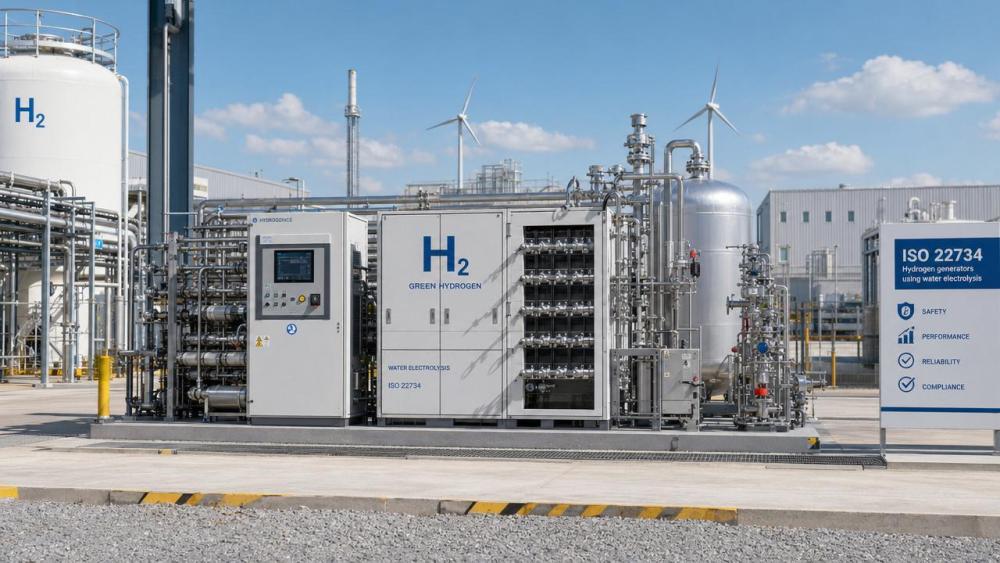
Which technical areas within ISO 22734 water electrolyzers for energy matter most to non-engineers?
Non-engineers do not need to review every clause in detail, but they do need to understand where commercial risk often hides. In approval practice, the most important areas are design integrity, electrical and process safety, gas purity management, pressure containment, controls, and maintenance philosophy.
Design integrity means the system has a coherent and documented engineering basis. This includes stack configuration, balance of plant, water treatment interfaces, ventilation concepts, pressure management, and hazardous area considerations. If the design basis is vague, future change orders become more likely.
Operational safety is equally critical. Hydrogen projects are judged not only by production output but by their ability to operate predictably under startup, turndown, shutdown, and emergency conditions. Approvers should ask whether the electrolyzer package includes clear logic for leak detection, gas separation, overpressure protection, emergency stop functions, and safe venting.
Materials review is another high-value checkpoint. Hydrogen environments can punish unsuitable materials over time, especially where pressure cycling, purity requirements, or humid process conditions are involved. For utility-scale projects, material shortcuts can become expensive through downtime, replacement campaigns, or warranty disputes.
Finally, performance must be assessed as a lifecycle variable, not a headline number. A system with attractive nominal efficiency but weak degradation performance may produce disappointing economics over ten years. ISO 22734 water electrolyzers for energy should therefore be linked to data on stack life, expected maintenance intervals, service support, and operational availability.
How can approvers tell whether compliance claims are real or just marketing?
This is one of the most important questions in hydrogen project finance. Many vendors use the language of compliance, but not all provide the same level of proof. A serious supplier can show documented conformity pathways, inspection records, testing evidence, risk assessments, and operating manuals that align with the delivered configuration.
Approvers should request specific documents rather than broad assurances. Useful examples include hazard analysis outputs, pressure test records, factory acceptance test protocols, material certificates, control narratives, alarm cause-and-effect matrices, and commissioning plans. If a vendor says the equipment is “built to ISO 22734 principles” but cannot produce traceable evidence, the compliance position may be immature.
It is also wise to test consistency across documents. For example, does the stated operating pressure match the process drawings? Do the gas purity assumptions align with the downstream storage or refueling application? Does the maintenance philosophy support the availability model used in the financial case? Real compliance tends to be internally coherent. Marketing compliance often breaks down when details are compared side by side.
What are the most common approval mistakes when reviewing electrolyzer investments?
The first mistake is treating ISO 22734 water electrolyzers for energy as a binary box-tick. In reality, approval quality depends on how deeply the compliance story is connected to the project’s actual operating environment. An electrolyzer may be acceptable in one application but under-specified in another, especially where dynamic renewable inputs, high-pressure hydrogen handling, or strict purity demands are present.
The second mistake is overvaluing efficiency while undervaluing availability and safety architecture. A low electricity consumption figure is attractive, but if the system requires frequent intervention, has unclear interlocks, or lacks robust service support, the financial model can degrade quickly.
The third mistake is ignoring integration risk. Electrolyzers do not operate in isolation. They depend on water quality systems, power electronics, compression, storage, controls, and site safety infrastructure. A compliant core electrolyzer package can still underperform if interfaces are weak. For approval teams, this means evaluating the whole hydrogen production chain rather than the stack package alone.
The fourth mistake is assuming all standards exposure is already covered by one label. In practice, large projects may also need review under pressure system, piping, fueling, electrical, or jurisdiction-specific codes. G-HEI’s benchmarking approach is valuable here because it frames electrolysis within the wider zero-carbon infrastructure environment instead of looking at one component in isolation.
How does ISO 22734 water electrolyzers for energy affect bankability, insurance, and long-term asset value?
Bankability improves when technical risk becomes more understandable. Lenders and investment committees do not need perfection, but they do need confidence that key hazards and failure modes have been addressed through accepted design practice. ISO 22734 water electrolyzers for energy supports that confidence by reducing ambiguity around how the equipment should be built and assessed.
Insurance conversations also become easier when there is evidence of recognized safety design and documented operating controls. Insurers tend to focus on foreseeable loss scenarios: explosion, fire, release, contamination, mechanical failure, and business interruption. Strong compliance documentation helps demonstrate that these risks have been systematically considered.
Long-term asset value is influenced by serviceability, expandability, and secondary market confidence. A project that follows robust standards is generally easier to refinance, repower, replicate, or integrate into larger hydrogen corridors. In a rapidly maturing hydrogen economy, assets that lack credible compliance grounding may face faster obsolescence or discounting.
What final questions should be asked before granting approval?
Before signing off, financial approvers should shift from broad confidence to decision-grade confirmation. The goal is to ensure that ISO 22734 water electrolyzers for energy is not just cited, but translated into a bankable project structure. The following questions are especially useful:
- What exact configuration is being supplied, and does the compliance evidence match that configuration?
- Which performance figures are guaranteed, under what operating conditions, and for how long?
- What exclusions, interface responsibilities, and owner obligations could create cost overruns later?
- How are stack degradation, replacement timing, and spare parts strategy reflected in the financial model?
- Which additional standards or local regulatory approvals apply beyond ISO 22734?
- What is the vendor’s track record in similar duty cycles, plant scales, and jurisdictions?
If the answers are specific, documented, and technically coherent, approval risk decreases significantly. If the answers remain general, incomplete, or inconsistent, the prudent step is to pause approval until evidence is strengthened.
Quick FAQ summary for decision-makers
For decision-makers who need a compact view, the role of ISO 22734 water electrolyzers for energy can be summarized simply: it is a practical screening tool for safer capital deployment in hydrogen infrastructure. It does not eliminate all risk, but it helps identify whether a project is being built on disciplined engineering and credible documentation.
If you need to move from internal review to procurement, diligence, or partnership discussions, the best next step is to clarify five topics early: compliance evidence, guaranteed performance, integration boundaries, lifecycle maintenance assumptions, and jurisdiction-specific approval requirements. Those questions will reveal whether the project is merely technically interesting or truly finance-ready.
Related News
- Electricity Price Volatility Is Rewriting Hydrogen Cost ModelsApr 27, 2026Impact of electricity price on hydrogen cost is transforming industrial decarbonization and large-scale electrolysis. Explore LCOH trends, PPA strategies, and resilient hydrogen infrastructure planning.
- Energy Transition Plans Often Fail at the Grid Connection StageApr 27, 2026Sustainable energy and energy transition projects often fail at grid connection. Learn how hydrogen infrastructure, PEM electrolysis, and industrial decarbonization can avoid delays and protect investment value.
- What Is Slowing Industrial Decarbonization Projects in 2026?Apr 27, 2026Industrial decarbonization faces delays in 2026 as hydrogen infrastructure, sustainable energy access, grid limits, safety standards, and project bankability challenge the energy transition.
- AEM Stability Remains the Big Question for Scale-UpApr 27, 2026Anion exchange membrane stability is the key barrier to large-scale electrolysis. Discover how AEM impacts industrial decarbonization, hydrogen infrastructure, safety, and scale-up economics.
Related News
- 00
0000-00
Hydrogen Energy Storage for Data Centers Gets Costly Fast - 00
0000-00
When 99.999% Hydrogen Purity Still Is Not Good Enough - 00
0000-00
When Does a Hydrogen-Ready Gas Turbine Pay Off? - 00
0000-00
Electricity Price Volatility Is Rewriting Hydrogen Cost Models - 00
0000-00
PSA Recovery Rate Drops for Reasons Operators Miss
Dr. Aris Aero
Weekly Insights
Stay ahead with our curated technology reports delivered every Monday.