PPA for Hydrogen Projects: How Power Contracts Change LCOH




For business evaluators, a PPA (Power Purchase Agreement) for hydrogen is more than an electricity sourcing tool—it is a core lever that can materially reshape LCOH, project bankability, and long-term risk exposure. As hydrogen projects scale from pilot assets to sovereign-grade infrastructure, understanding how power contract structures influence cost stability, financing confidence, and competitive positioning becomes essential to sound investment assessment.
Power pricing has moved from background variable to front-line LCOH driver
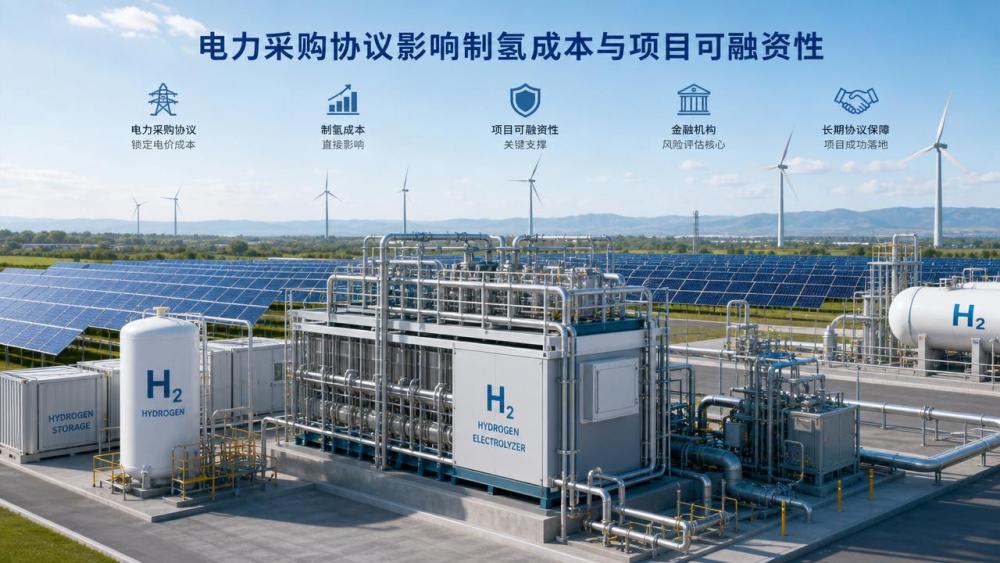
In the current hydrogen market, electricity is no longer a supporting input; it is the dominant cost determinant for many electrolysis projects. That shift is why the conversation around a PPA (Power Purchase Agreement) for hydrogen now sits at the center of feasibility reviews. When grid prices remain volatile, renewable capture rates fluctuate, and curtailment economics become more relevant, project value depends heavily on how power is contracted rather than simply how much power is consumed.
This is especially true for utility-scale hydrogen developments tied to PEM and alkaline electrolysis. In many business cases, power can account for 50% to 75% of green hydrogen production cost. As a result, even small adjustments in contract tenor, price floors, indexation, shaping terms, balancing obligations, or guarantees of origin can materially alter the levelized cost of hydrogen. A poorly structured PPA (Power Purchase Agreement) for hydrogen can erase the value of a strong electrolyzer efficiency profile, while a well-structured one can improve cost certainty enough to unlock financing.
The broader industry signal is clear: investors are now evaluating hydrogen assets through an integrated power-and-molecules lens. LCOH is no longer judged only by electrolyzer CAPEX, water use, or plant utilization. It is increasingly judged by the sophistication of the power strategy behind the hydrogen output.
Why the market is rethinking PPA design for hydrogen projects
Several structural forces are pushing the market to treat the PPA (Power Purchase Agreement) for hydrogen as a strategic asset rather than a standard utility contract. Unlike conventional industrial loads, hydrogen plants can be dispatchable, semi-flexible, or tightly linked to renewable generation profiles. That operational flexibility creates opportunities, but it also creates contract complexity. Projects must align electricity delivery terms with electrolyzer ramp rates, stack degradation behavior, storage design, and offtake commitments.
Another reason for this rethink is that hydrogen is increasingly expected to meet strict carbon-intensity thresholds. In many jurisdictions, policy support, tax credits, and premium offtake pricing depend on provable emissions performance. That means a PPA (Power Purchase Agreement) for hydrogen may need to do more than secure low-cost power; it may also need to demonstrate temporal matching, regional deliverability, and renewable additionality.
Main forces changing contract expectations
How a PPA (Power Purchase Agreement) for hydrogen changes LCOH in practice
A PPA (Power Purchase Agreement) for hydrogen affects LCOH through several direct and indirect channels. The most obvious channel is the delivered power price. Lower energy cost generally reduces hydrogen cost per kilogram. However, headline price alone is a weak decision metric. The more meaningful question is how contract design interacts with operating profile, load factor, emissions compliance, and financing assumptions.
For example, an attractively priced as-generated renewable PPA may reduce nominal energy cost but also lower electrolyzer utilization if generation is highly intermittent. That can increase unit hydrogen cost by spreading fixed plant costs across fewer kilograms. By contrast, a slightly more expensive but better-shaped supply contract may improve annual run hours, reduce start-stop stress, and create a lower true LCOH outcome.
Key LCOH levers influenced by power contract structure
- Energy price certainty: Fixed or partially hedged pricing improves forecast accuracy and protects downside scenarios.
- Electrolyzer utilization: Better alignment between power delivery and plant operation supports higher output and lower unit cost.
- Stack life and maintenance: Contract-induced cycling can accelerate degradation, adding hidden cost to hydrogen production.
- Balancing and curtailment exposure: Imbalance penalties and uncompensated curtailment can materially change operating economics.
- Carbon-intensity qualification: Compliance-ready power sourcing can preserve subsidy value and improve marketability of output.
- Debt terms: A bankable PPA (Power Purchase Agreement) for hydrogen may reduce financing cost, indirectly lowering LCOH.
The best way to assess value is therefore not “cheapest electricity wins,” but “which contract structure produces the lowest risk-adjusted LCOH over the full operating horizon.” That distinction matters greatly in sovereign-scale infrastructure planning, where technical resilience and policy alignment are as important as near-term cost optics.
The impact reaches beyond power sourcing into financing, compliance, and market access
The influence of a PPA (Power Purchase Agreement) for hydrogen extends well beyond the utility bill. In project finance settings, lenders and equity partners look closely at whether the power contract provides predictable operating assumptions. If electricity cost, delivery shape, curtailment rights, or counterparty performance remain uncertain, financing models become fragile. That often translates into higher cost of capital, stricter reserve requirements, or delayed investment decisions.
Compliance is another major area of impact. Hydrogen intended for premium industrial use, export corridors, refining substitution, or low-carbon mobility often faces documentary scrutiny. In that context, the PPA (Power Purchase Agreement) for hydrogen becomes part of the evidence chain proving emissions integrity. Contract design can therefore influence whether output qualifies for incentive schemes or preferred offtake arrangements.
Finally, commercial positioning is affected. Projects with robust power contracts can offer more credible long-term hydrogen pricing to downstream users in steel, ammonia, synthetic fuels, heavy transport, and dispatchable power. That visibility can strengthen offtake negotiations and reduce the discount that counterparties apply to uncertain supply models.
Where the effects show up across the value chain
- Project development: better site screening and renewable pairing strategy
- Engineering design: optimized storage, compression, and dispatch assumptions
- Finance: improved debt sizing and lower perceived merchant risk
- Operations: more stable run profile and clearer maintenance planning
- Commercial strategy: stronger offtake confidence and pricing transparency
What deserves close attention before selecting a contract model
Because no single PPA (Power Purchase Agreement) for hydrogen fits every asset, evaluation should focus on interaction effects rather than isolated clauses. A hydrogen project attached to dedicated renewables will have different priorities from one relying on portfolio supply, merchant grid supplementation, or hybrid procurement. The following points deserve particular attention:
- Shape versus price: Determine whether lower-priced intermittent power actually supports targeted hydrogen output and delivery obligations.
- Temporal matching rules: Review whether hourly, monthly, or annual matching assumptions affect incentive eligibility.
- Curtailment allocation: Clarify who bears volume loss, imbalance risk, and compensation mechanics.
- Contract tenor: Align PPA duration with electrolyzer life, financing horizon, and expected technology refresh cycles.
- Counterparty strength: Credit quality matters because a weak seller can undermine long-term cost assumptions.
- Certificate architecture: Ensure renewable attributes and carbon claims are legally transferrable and auditable.
- Operational flexibility: Check whether the contract supports load-following, minimum take, or grid-service participation.
A practical framework for judging the next generation of hydrogen PPAs
The emerging lesson is that the strongest PPA (Power Purchase Agreement) for hydrogen is not necessarily the most standardized one. It is the one that integrates energy market exposure, electrolyzer performance, carbon rules, and financing expectations into a coherent commercial architecture.
The next step is to model PPAs as strategic infrastructure decisions
Hydrogen decision-making is moving into a more disciplined era. In that environment, a PPA (Power Purchase Agreement) for hydrogen should be treated as a strategic infrastructure decision with direct consequences for LCOH, bankability, and long-term competitiveness. It shapes not only the cost of electrons, but also the credibility of the molecule produced from them.
A practical next move is to compare at least three contract pathways—such as fixed renewable supply, portfolio-shaped renewable supply, and hybrid renewable-plus-grid procurement—against one common LCOH model. Include stack degradation, utilization, curtailment, balancing, certification, and financing variables in the same analysis. This approach reveals whether a proposed PPA (Power Purchase Agreement) for hydrogen truly strengthens project resilience or simply shifts risk into less visible parts of the business case.
For organizations tracking sovereign-scale hydrogen infrastructure, the winning position will come from seeing power contracting, technical integrity, and market qualification as one connected system. That is where durable cost advantage is most likely to emerge.
Related News
- Electricity Price Volatility Is Rewriting Hydrogen Cost ModelsApr 27, 2026Impact of electricity price on hydrogen cost is transforming industrial decarbonization and large-scale electrolysis. Explore LCOH trends, PPA strategies, and resilient hydrogen infrastructure planning.
- Energy Transition Plans Often Fail at the Grid Connection StageApr 27, 2026Sustainable energy and energy transition projects often fail at grid connection. Learn how hydrogen infrastructure, PEM electrolysis, and industrial decarbonization can avoid delays and protect investment value.
- What Is Slowing Industrial Decarbonization Projects in 2026?Apr 27, 2026Industrial decarbonization faces delays in 2026 as hydrogen infrastructure, sustainable energy access, grid limits, safety standards, and project bankability challenge the energy transition.
- AEM Stability Remains the Big Question for Scale-UpApr 27, 2026Anion exchange membrane stability is the key barrier to large-scale electrolysis. Discover how AEM impacts industrial decarbonization, hydrogen infrastructure, safety, and scale-up economics.
Related News
- 00
0000-00
Hydrogen Energy Storage for Data Centers Gets Costly Fast - 00
0000-00
When 99.999% Hydrogen Purity Still Is Not Good Enough - 00
0000-00
When Does a Hydrogen-Ready Gas Turbine Pay Off? - 00
0000-00
Electricity Price Volatility Is Rewriting Hydrogen Cost Models - 00
0000-00
PSA Recovery Rate Drops for Reasons Operators Miss
Dr. Aris Aero
Weekly Insights
Stay ahead with our curated technology reports delivered every Monday.