
Titanium Bipolar Plate Coating: Durability vs Cost




For procurement teams evaluating PEM stack materials, titanium bipolar plate coating sits at the center of a critical trade-off: long-term durability versus upfront cost. In hydrogen infrastructure, the right coating affects corrosion resistance, conductivity, maintenance cycles, and total asset value. This article examines how buyers can balance technical performance, lifecycle economics, and supply risk when selecting coating solutions.
Why titanium bipolar plate coating is moving from niche choice to strategic benchmark
PEM electrolyzer deployment is scaling fast across sovereign energy programs, utility projects, and heavy industrial decarbonization plans.
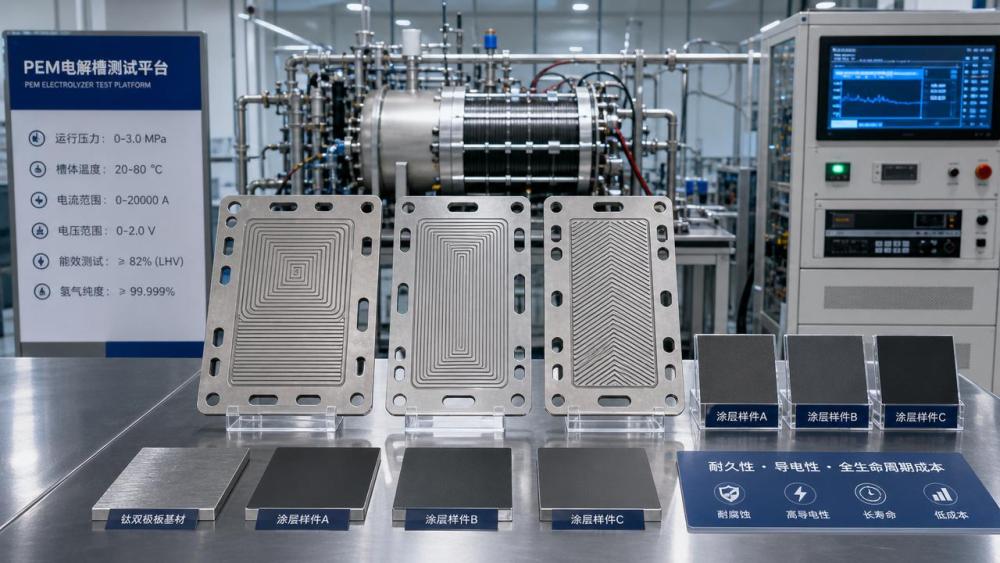
That expansion changes material selection. Components once judged on purchase price alone now face stricter uptime, efficiency, and compliance expectations.
In this environment, titanium bipolar plate coating has become a strategic decision point rather than a simple materials specification.
The reason is straightforward. Bare titanium offers corrosion resistance, but its native oxide layer raises interfacial contact resistance.
Coatings help solve that contradiction. They preserve durability while improving conductivity under aggressive PEM operating conditions.
As electrolyzer systems move toward larger stacks and higher current densities, coating quality increasingly determines stack efficiency and replacement intervals.
For institutions benchmarking zero-carbon assets, titanium bipolar plate coating now influences not only stack output but also broader infrastructure bankability.
The strongest trend signal: lifetime economics now outweigh simple component price
A clear market signal is emerging. Buyers are shifting from unit-cost comparison to lifetime cost modeling for stack-critical materials.
This shift is especially visible in PEM plants linked to grid balancing, ammonia, e-fuels, and hydrogen transport corridors.
When duty cycles intensify, coating failure becomes expensive. Losses appear through voltage drift, shutdowns, maintenance labor, and shortened stack life.
As a result, titanium bipolar plate coating is increasingly evaluated through total cost of ownership instead of initial invoice value.
This trend favors coatings with stable conductivity, chemical resistance, and reproducible deposition quality across large production volumes.
What is driving the shift
Durability is no longer abstract; it directly shapes output, risk, and maintenance timing
Durability in titanium bipolar plate coating means more than surviving a laboratory corrosion test.
It includes stable interfacial resistance, adhesion under pressure cycling, tolerance to acidic environments, and low contamination release.
In PEM systems, small degradation effects compound over time. Minor conductivity losses can raise operating voltage across many cells.
That translates into higher energy consumption, reduced efficiency, and pressure on project economics.
Durable titanium bipolar plate coating also protects membrane-adjacent environments from corrosion byproducts that may harm stack performance.
For large installations, service timing matters. Planned maintenance is manageable, but unplanned stack interruptions disrupt hydrogen delivery commitments.
Therefore, durability is best viewed as an operating-risk control measure, not merely a material property.
Key technical signals of durable coating performance
- Low and stable interfacial contact resistance over extended testing.
- Strong adhesion after thermal, pressure, and electrochemical cycling.
- Minimal pinholes, cracks, or thickness variation across flow-field geometry.
- Low ion release and strong corrosion resistance in PEM-relevant conditions.
- Repeatable deposition quality at pilot and industrial production scale.
Cost pressure remains real, but the cheapest titanium bipolar plate coating can become the most expensive option
Upfront cost still matters, especially in early-stage projects where capital discipline is intense.
However, low-cost coating options often rely on less mature processes, thinner functional layers, or weaker quality control windows.
That does not guarantee failure, but it increases uncertainty. Uncertainty is expensive in utility-scale hydrogen infrastructure.
The cost discussion should include coating method, deposition uniformity, scrap rates, validation depth, and supply continuity.
A higher-priced titanium bipolar plate coating may still reduce total plant cost if it extends service intervals and maintains lower voltage loss.
This is particularly relevant where electricity cost dominates hydrogen production economics. Small efficiency gains become financially meaningful.
Common hidden costs behind low-price decisions
- Higher stack replacement frequency.
- Lower energy efficiency over operating life.
- Increased testing burden during qualification.
- More field failures and warranty exposure.
- Greater supply disruption risk from single-process dependence.
Material choice now affects multiple business links beyond the stack itself
The implications of titanium bipolar plate coating extend across engineering, finance, operations, and compliance functions.
On the engineering side, coating performance influences stack architecture, thermal behavior, and degradation modeling assumptions.
On the operations side, it shapes maintenance planning, spare strategy, and expected availability.
On the finance side, it affects depreciation logic, performance guarantees, and lender confidence in projected uptime.
In regulated hydrogen ecosystems, material traceability and test documentation also support broader asset integrity narratives.
Where the impact is most visible
- Megawatt-scale PEM electrolyzer design and stack validation.
- Hydrogen production plants with variable renewable power input.
- Projects requiring long-term service contracts and uptime guarantees.
- Cross-border infrastructure investments under strict technical due diligence.
What deserves closer attention when comparing titanium bipolar plate coating options
A robust comparison should move beyond brochure claims and single-point conductivity values.
The better question is whether a coating remains functional under realistic operating stress over time.
- Check accelerated durability data, not just initial resistance measurements.
- Review coating-process maturity and statistical quality control capability.
- Compare adhesion, porosity, thickness uniformity, and corrosion metrics together.
- Verify scalability from prototype lots to full industrial production.
- Assess supplier resilience, dual-source potential, and documentation depth.
- Model total ownership cost using energy, maintenance, and replacement assumptions.
These checks make titanium bipolar plate coating decisions more resilient under real project conditions.
A practical decision framework for balancing durability, cost, and supply risk
This framework helps compare titanium bipolar plate coating options without reducing the decision to a price-only contest.
The next phase will reward validated coating performance, not optimistic assumptions
The hydrogen economy is entering a phase where bankable performance matters more than conceptual promise.
In that context, titanium bipolar plate coating is becoming a visible marker of technical seriousness and project discipline.
The best path is to pair accelerated testing evidence with realistic lifecycle modeling and supply-chain verification.
Shortlist coating systems that show stable resistance, strong corrosion protection, and scalable production control.
Then test assumptions against real duty cycles, expected maintenance windows, and energy-cost sensitivity.
For strategic hydrogen assets, the right titanium bipolar plate coating is rarely the cheapest line item. It is often the smarter long-term hedge.
A practical next step is to build a comparison matrix covering durability data, conductivity retention, process repeatability, and full lifecycle economics before final specification.
Related News
- Electricity Price Volatility Is Rewriting Hydrogen Cost ModelsApr 27, 2026Impact of electricity price on hydrogen cost is transforming industrial decarbonization and large-scale electrolysis. Explore LCOH trends, PPA strategies, and resilient hydrogen infrastructure planning.
- Energy Transition Plans Often Fail at the Grid Connection StageApr 27, 2026Sustainable energy and energy transition projects often fail at grid connection. Learn how hydrogen infrastructure, PEM electrolysis, and industrial decarbonization can avoid delays and protect investment value.
- What Is Slowing Industrial Decarbonization Projects in 2026?Apr 27, 2026Industrial decarbonization faces delays in 2026 as hydrogen infrastructure, sustainable energy access, grid limits, safety standards, and project bankability challenge the energy transition.
- When do industrial parks need megawatt-scale hydrogen production?Sep 28, 2026Hydrogen for industrial projects: discover when industrial parks need megawatt-scale production, from firm demand and power supply to storage, safety, and phased hub design.
Related News
- 00
0000-00
Hydrogen Energy Storage for Data Centers Gets Costly Fast - 00
0000-00
When 99.999% Hydrogen Purity Still Is Not Good Enough - 00
0000-00
When Does a Hydrogen-Ready Gas Turbine Pay Off? - 00
0000-00
Electricity Price Volatility Is Rewriting Hydrogen Cost Models - 00
0000-00
PSA Recovery Rate Drops for Reasons Operators Miss
Dr. Aris Aero
Weekly Insights
Stay ahead with our curated technology reports delivered every Monday.