
MEA Lifetime Benchmarks for Megawatt PEM Systems




For business evaluators assessing megawatt PEM projects, membrane electrode assembly (MEA) lifetime is not a laboratory detail. It is a leading indicator of stack replacement timing, electricity-normalized hydrogen cost, warranty credibility, financing confidence, and long-term operational risk.
In practice, the most useful benchmark is not the highest hour claim on a datasheet. It is the lifetime that remains after normalizing for current density, start-stop behavior, water quality, pressure regime, thermal cycling, and the exact end-of-life definition used by the supplier.
For investment and procurement teams, the core question is straightforward: which MEA lifetime figures are comparable enough to support a bankable decision? The answer depends on disciplined benchmarking across test methods, degradation rates, replacement assumptions, and alignment with recognized reliability and safety frameworks.
Why MEA lifetime is the commercial benchmark that matters most in megawatt PEM systems
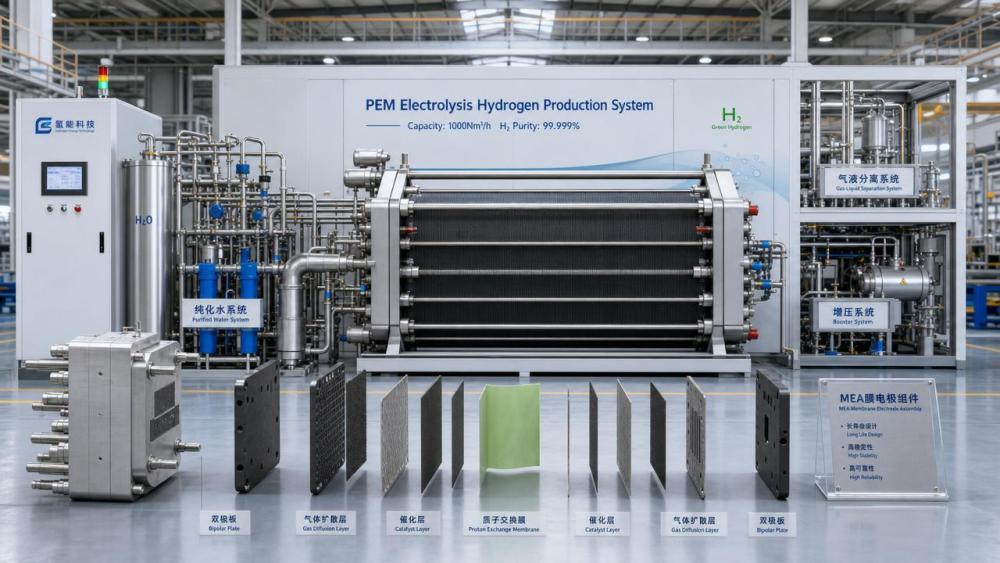
The membrane electrode assembly is the electrochemical core of a PEM electrolyzer stack. Its condition directly influences voltage efficiency, hydrogen output stability, maintenance intervals, and the moment when stack performance falls below the project’s economic threshold.
For business evaluators, membrane electrode assembly (MEA) lifetime matters because stack replacement is one of the largest medium-term capital events in a megawatt PEM asset. A small change in degradation rate can materially alter net present value and levelized hydrogen cost.
An MEA that lasts longer under relevant duty cycles reduces planned outages, lowers spare stack inventory pressure, and improves debt-service resilience. By contrast, an overstated lifetime claim can distort the entire business case, especially when electricity costs and utilization assumptions are already tight.
This is why MEA lifetime should be treated as a board-level benchmark rather than a narrow engineering metric. It affects procurement strategy, warranty negotiations, reserve planning, and portfolio risk ranking across electrolyzer vendors.
What business evaluators are really trying to learn from an MEA lifetime claim
When decision-makers search for MEA lifetime benchmarks, they are usually not looking for a single universal number. They want to understand what performance range is credible for megawatt PEM systems and what conditions make one figure better or worse than another.
The first concern is comparability. A supplier may cite a long lifetime obtained under steady operation at moderate current density, while another may report a shorter figure under dynamic renewable-following conditions. Those two numbers cannot be used interchangeably in commercial evaluation.
The second concern is replacement economics. Evaluators need to know when the stack is likely to require refurbishment or replacement, what degradation slope is expected before that point, and how much project cash flow can absorb that event.
The third concern is bankability. Lenders and investment committees want evidence that lifetime claims are supported by transparent test protocols, field references, and a clear end-of-life criterion rather than aspirational internal modeling.
The fourth concern is risk transfer. Buyers need to know how much of the MEA lifetime risk remains with the owner and how much is covered through warranty structures, availability guarantees, and performance correction mechanisms.
How to compare MEA lifetime across vendors without making false equivalencies
The most common mistake in benchmarking membrane electrode assembly (MEA) lifetime is comparing absolute operating hours without checking the underlying test regime. A lifetime figure is meaningful only when paired with the conditions that produced it.
Start with current density. Higher current density generally increases hydrogen output per stack area, but it can also accelerate degradation through harsher electrochemical and thermal conditions. A 60,000-hour claim at lower current density may not outperform a 40,000-hour claim at a commercially relevant higher load point.
Next, review dynamic operation. Megawatt PEM assets often support variable renewable power, ancillary services, or flexible dispatch. Frequent ramping, start-stop events, and partial-load operation can stress the MEA differently from stable baseload operation.
Pressure conditions also matter. Pressurized hydrogen production may reduce downstream compression needs, but it can affect membrane stress and crossover behavior. Lifetime figures should be tied to the actual outlet pressure range expected in the project design.
Water quality, temperature control, and gas purity requirements are equally important. An MEA tested under tightly controlled laboratory conditions may not reflect site realities where feedwater excursions, balance-of-plant transients, or contamination risks are higher.
Finally, confirm the end-of-life definition. Some vendors define lifetime by a specified voltage rise, some by efficiency loss, some by hydrogen purity drift, and others by a threshold that triggers uneconomic operation. Without a common end-of-life basis, benchmarking is weak.
What counts as a credible lifetime benchmark in 2026 market conditions
By 2026, credible benchmarking no longer relies on optimistic headline hours alone. Mature evaluation requires a combination of accelerated testing data, long-duration stack operation, field evidence at relevant scale, and transparent degradation modeling.
Business evaluators should expect suppliers to present lifetime as a range, not a single number. That range should reflect different duty profiles such as steady industrial production, renewable-linked cycling, and mixed operating modes with variable utilization.
A credible benchmark should also distinguish between stack lifetime and full-system life. The MEA may be the critical wear component, but balance-of-plant reliability, control strategy, water treatment stability, and thermal management strongly affect realized lifetime in service.
Another sign of credibility is consistency between technical claims and commercial commitments. If a vendor advertises an aggressive MEA lifetime but offers only a narrow warranty window or a restrictive operating envelope, the practical benchmark may be much lower than the marketing claim.
For sovereign-scale or utility-scale projects, evaluators should prefer benchmark packages that include field hours on comparable megawatt installations, documented maintenance history, and evidence of degradation under realistic dispatch patterns rather than isolated pilot data.
Which degradation mechanisms most affect business risk
Understanding failure and degradation modes helps evaluators ask better commercial questions. In PEM systems, MEA lifetime can be shortened by membrane thinning, catalyst dissolution, catalyst support corrosion, interfacial delamination, contamination, and uneven local operating conditions.
For commercial purposes, these mechanisms matter because they do not all produce the same financial outcome. Some create gradual efficiency loss, while others increase the probability of abrupt stack underperformance, purity issues, or forced shutdowns.
Voltage degradation is often the most visible signal, but it should not be assessed alone. Gas crossover, differential pressure tolerance, and purity stability can become decisive in applications where downstream safety, compression design, or product certification are tightly specified.
Dynamic cycling deserves particular attention. Projects linked to intermittent renewables may experience more frequent transients than originally modeled. If the supplier’s data does not reflect similar cycling severity, the effective MEA lifetime may be overstated for that asset class.
Contamination risk is another commercial blind spot. Trace impurities from water systems, materials incompatibility, or maintenance events can shorten stack life. Evaluators should test whether the vendor’s lifetime assumptions depend on water treatment performance that is unusually difficult to maintain at site level.
How MEA lifetime changes total cost of ownership and levelized hydrogen cost
For business evaluators, the practical value of membrane electrode assembly (MEA) lifetime is its effect on cost over time. Longer life improves economics not only by delaying replacement capex but also by protecting conversion efficiency during the operating years that matter most.
A faster degradation rate means more electricity is required per kilogram of hydrogen as the stack ages. In power-intensive hydrogen production, that efficiency loss can outweigh maintenance savings and reshape the entire cost curve of the project.
Replacement timing is equally important. If a stack replacement is required earlier than expected, the project may face a negative overlap of outage costs, procurement lead times, labor mobilization, and financing pressure. That is especially critical for large industrial offtake contracts.
Evaluators should therefore model at least three scenarios: base-case lifetime, conservative lifetime, and downside lifetime under harsher cycling or operating variability. The spread between those scenarios is often more informative than the vendor’s headline benchmark.
It is also useful to convert lifetime assumptions into decision metrics familiar to finance teams: cost per operating hour, replacement reserve requirement, sensitivity of project IRR, and effect on debt covenants under lower-than-expected system efficiency.
What procurement teams should ask suppliers before accepting a lifetime number
A strong benchmarking process depends on disciplined questioning. Ask suppliers for the exact test protocol behind the MEA lifetime claim, including current density, temperature range, pressure, water specification, cycling profile, shutdown frequency, and duration of operation.
Request the degradation curve, not just the end number. A smooth and well-characterized trend is more useful than a single lifetime endpoint because it supports maintenance planning and economic forecasting across the asset’s operating life.
Ask whether the data comes from short-stack tests, full stack tests, or field systems. Performance proven in a controlled test environment may not translate directly to megawatt-scale operations with real balance-of-plant interactions.
Procurement teams should also ask what operating behaviors void or narrow the lifetime expectation. If routine grid disturbances, rapid ramps, or water quality excursions materially alter expected life, that limitation must be reflected in project design and commercial terms.
Finally, clarify spare strategy and service capability. Even with a strong MEA lifetime benchmark, value is lost if replacement modules have long lead times, service coverage is thin, or warranty claim procedures create extended downtime.
How standards and reliability frameworks support better lifetime benchmarking
In large hydrogen infrastructure programs, MEA lifetime should not be reviewed in isolation from broader reliability and compliance frameworks. Evaluators need a line of sight from stack performance to system safety, materials integrity, and operating assurance.
That is why recognized standards and technical frameworks matter. While no single standard alone defines MEA lifetime, alignment with established hydrogen system requirements helps verify that the operating envelope, test discipline, and design assumptions are commercially robust.
For example, infrastructure governed by frameworks such as ISO 19880, ASME B31.12, and related hydrogen handling requirements places practical constraints on purity, pressure management, materials compatibility, and operational safety. These constraints influence how lifetime should be interpreted.
From a benchmarking perspective, the most valuable suppliers connect stack durability evidence to the wider plant architecture. They show how control logic, thermal balance, water purification, shutdown sequencing, and gas handling design protect the MEA in real operating conditions.
This system-level view is essential for sovereign or utility-scale buyers. A technically impressive MEA claim has limited value if the surrounding plant design introduces avoidable degradation stress or creates compliance gaps during long-term operation.
A practical evaluation framework for business decision-makers
For commercial screening, a useful framework has five layers. First, identify the supplier’s stated MEA lifetime and exact end-of-life definition. Second, normalize the claim for current density, pressure, and duty cycle. Third, compare it with field evidence at relevant scale.
Fourth, translate the normalized lifetime into project economics. Estimate efficiency decline, replacement timing, reserve requirements, outage exposure, and the effect on levelized hydrogen cost. Fifth, test the strength of contractual protection through warranties and performance guarantees.
This process helps separate technically credible assets from commercially fragile ones. It also improves cross-vendor comparison by forcing each claim into a common decision structure rather than relying on datasheet narratives.
For portfolio-level evaluators, the same framework can be turned into a weighted scorecard. Typical weightings include durability evidence, degradation transparency, replacement logistics, operating flexibility, standards alignment, and downside-case economics.
The result is a benchmark that supports procurement, investment committee review, and strategic planning at the same time. That is the level of rigor required when megawatt PEM systems are being positioned as long-life zero-carbon infrastructure.
Conclusion: what a strong MEA lifetime benchmark should tell you
For megawatt PEM systems, membrane electrode assembly (MEA) lifetime is not simply a technical specification. It is a decision-grade indicator of operating resilience, replacement burden, efficiency stability, and investment quality across the life of the asset.
The best benchmark is one that survives normalization. If the lifetime figure remains credible after adjusting for current density, cycling intensity, pressure, water quality, and end-of-life definition, it becomes useful for procurement and bankability analysis.
Business evaluators should therefore prioritize transparency over headline claims. A shorter but well-substantiated lifetime can be more valuable than an impressive but weakly documented number, because it produces a more reliable cost model and a better risk allocation strategy.
In 2026 market conditions, confident decision-making depends on viewing MEA lifetime through a full commercial lens: degradation behavior, field relevance, replacement economics, standards alignment, and contractual protection. That is the benchmark that supports durable hydrogen infrastructure investment.
Related News
- Electricity Price Volatility Is Rewriting Hydrogen Cost ModelsApr 27, 2026Impact of electricity price on hydrogen cost is transforming industrial decarbonization and large-scale electrolysis. Explore LCOH trends, PPA strategies, and resilient hydrogen infrastructure planning.
- Energy Transition Plans Often Fail at the Grid Connection StageApr 27, 2026Sustainable energy and energy transition projects often fail at grid connection. Learn how hydrogen infrastructure, PEM electrolysis, and industrial decarbonization can avoid delays and protect investment value.
- What Is Slowing Industrial Decarbonization Projects in 2026?Apr 27, 2026Industrial decarbonization faces delays in 2026 as hydrogen infrastructure, sustainable energy access, grid limits, safety standards, and project bankability challenge the energy transition.
- When do industrial parks need megawatt-scale hydrogen production?Sep 28, 2026Hydrogen for industrial projects: discover when industrial parks need megawatt-scale production, from firm demand and power supply to storage, safety, and phased hub design.
Related News
- 00
0000-00
Hydrogen Energy Storage for Data Centers Gets Costly Fast - 00
0000-00
When 99.999% Hydrogen Purity Still Is Not Good Enough - 00
0000-00
When Does a Hydrogen-Ready Gas Turbine Pay Off? - 00
0000-00
Electricity Price Volatility Is Rewriting Hydrogen Cost Models - 00
0000-00
PSA Recovery Rate Drops for Reasons Operators Miss
Dr. Aris Aero
Weekly Insights
Stay ahead with our curated technology reports delivered every Monday.