Feedwater Conductivity Limits That Protect PEM Stacks




In PEM electrolysis, feedwater deionization conductivity is not a routine utility metric—it is a frontline control parameter for stack life, process safety, and output stability. For quality-control and safety teams, understanding the conductivity limits that protect PEM stacks is essential to preventing membrane degradation, catalyst contamination, and unplanned downtime in high-value hydrogen infrastructure.
In utility-scale hydrogen projects, a small drift in water quality can trigger outsized consequences. A feedwater deionization conductivity excursion of only a few microsiemens per centimeter can accelerate ionic carryover, disturb cell voltage balance, and shorten maintenance intervals across megawatt-class PEM systems.
For quality-control managers and safety officers, the issue is not simply how pure the water looks on a lab report. The practical question is how to define stack-protective conductivity limits, how to monitor them in real time, and how to act before contamination becomes an asset-integrity event.
Why feedwater deionization conductivity is a stack protection variable
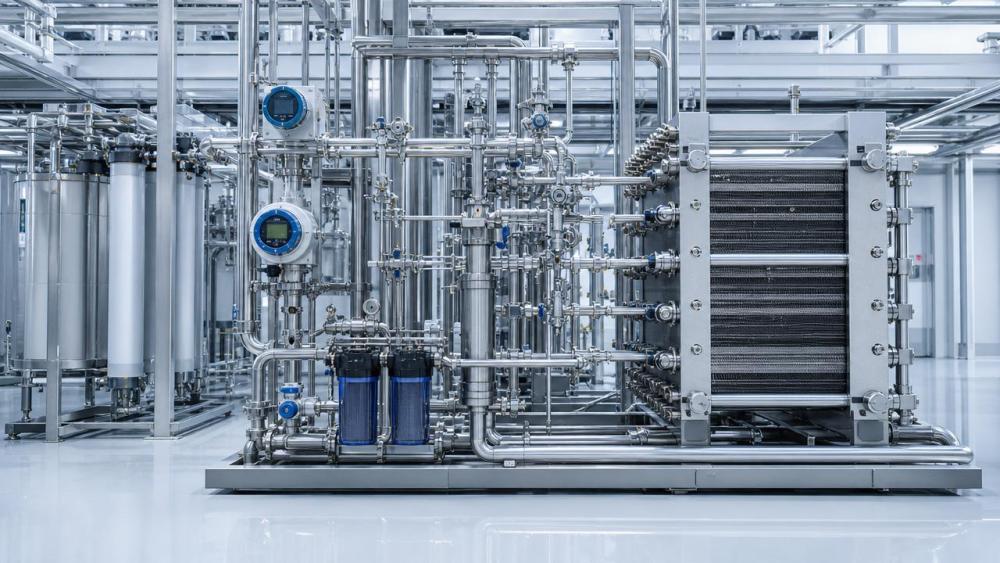
PEM electrolysis relies on a proton-conducting membrane, precious-metal catalysts, and tightly managed water chemistry. Unlike many balance-of-plant utilities, feedwater directly interacts with the electrochemical environment. That is why feedwater deionization conductivity must be treated as a controlled operating parameter, not a background housekeeping number.
In most industrial settings, conductivity is used as a fast indirect indicator of dissolved ionic content. Higher conductivity generally means more mobile ions such as sodium, chloride, calcium, silica-associated species, or residual treatment chemicals. In a PEM stack, those impurities can migrate into the membrane-electrode assembly and create performance and safety consequences within days or weeks, not only over annual operating cycles.
How conductivity affects membrane, catalyst, and system stability
When feedwater conductivity rises beyond acceptable limits, three risk pathways usually appear. First, ionic contamination can reduce membrane selectivity and promote localized degradation. Second, catalyst surfaces can become poisoned or masked, increasing cell voltage. Third, the water management loop can accumulate contaminants that disturb differential pressure, recirculation quality, and product hydrogen purity.
A conductivity change from below 0.1 µS/cm to 1.0 µS/cm may seem small in a general utilities context. In PEM service, however, that 10-fold increase can be operationally significant because stack components are designed around ultra-pure water conditions, often with narrow tolerance bands and high sensitivity to trace ionic ingress.
Typical control philosophy used by quality and safety teams
Most high-reliability projects manage feedwater deionization conductivity using a three-layer approach: design limit, alarm limit, and trip or intervention limit. This structure allows operators to react before stack damage occurs, while giving quality-control teams a documented basis for release, hold, or escalation decisions.
- Design target: commonly below 0.1–0.2 µS/cm at the stack inlet
- Early warning alarm: often set around 0.2–0.5 µS/cm depending on OEM guidance
- Corrective action threshold: frequently above 0.5–1.0 µS/cm or based on time-at-excursion
These ranges are not substitutes for stack supplier requirements. They are practical benchmarking bands used by many project teams to structure water-quality governance, especially where multiple skids, polishing loops, and storage tanks are involved.
Why conductivity alone is necessary but not sufficient
Conductivity is a leading indicator, but it should be paired with resistivity, total organic carbon where relevant, silica checks, sodium trending, and differential analysis between RO outlet, mixed-bed outlet, and stack inlet. A single acceptable conductivity reading does not always prove that the entire water train is under control.
The table below shows a practical risk interpretation framework that quality and safety teams can use when reviewing feedwater deionization conductivity values during commissioning and routine operation.
The key takeaway is that protective limits should be tied to action logic, not only numerical acceptance. A plant that measures conductivity but lacks defined response times, escalation owners, and restart criteria still carries significant hidden risk.
Setting practical conductivity limits for megawatt-scale PEM operations
Conductivity limits should reflect the full operating context: stack vendor guidance, water source variability, pretreatment design, storage residence time, and the consequences of contamination on hydrogen delivery commitments. A 5 MW installation with one centralized polishing loop may tolerate different alarm architecture than a 100 MW campus with multiple trains and distributed tanks.
Define the limit at the right measurement point
One common mistake is relying on conductivity data from the deionization skid outlet while ignoring the stack inlet. Between those points, water can pick up contaminants from storage tanks, vent filters, elastomers, dead legs, or improperly passivated piping. For stack protection, the most meaningful number is typically the final value just before feed enters the electrolyzer loop.
A robust monitoring layout often includes 4 checkpoints: raw water after pretreatment, reverse osmosis outlet, deionization outlet, and stack inlet. Trend comparison across those 4 points helps isolate whether the problem is resin exhaustion, membrane breakthrough, recirculation contamination, or downstream asset cleanliness.
Build limits around duration as well as magnitude
Not every excursion requires a full shutdown, but duration matters. For example, a spike to 0.6 µS/cm lasting 2 minutes during sensor stabilization may not carry the same risk as a sustained 0.4 µS/cm condition over 8 hours. Quality procedures should therefore include both instantaneous thresholds and time-integrated exposure rules.
- Set a normal operating target.
- Set a warning limit with a response window, such as 15–30 minutes.
- Set a high limit that requires investigation or controlled stop within 1 shift.
- Set a critical limit requiring immediate isolation and management signoff before restart.
Account for temperature compensation and instrument drift
Conductivity is temperature sensitive. If temperature compensation is inconsistent, two analyzers can show materially different values for the same water. In high-value hydrogen infrastructure, calibration verification intervals of 7, 14, or 30 days should be defined according to operating criticality, analyzer technology, and site quality system requirements.
The matrix below can help teams convert feedwater deionization conductivity into an implementable control strategy for procurement, commissioning, and operations.
For buyers and project developers, this means conductivity performance should be specified in water-treatment scope, instrumentation scope, and acceptance testing scope. If the EPC package addresses only nominal water production capacity but not stack-inlet purity verification, the risk is merely shifted downstream.
Failure modes, warning signs, and root-cause pathways
When feedwater deionization conductivity rises, the root cause is not always obvious. Effective troubleshooting depends on identifying where contaminants entered the system and whether the issue is chemical, mechanical, or procedural. For safety managers, this also matters because repeated water-quality instability can indicate broader weaknesses in maintenance discipline and management of change.
The most frequent sources of conductivity excursions
- Mixed-bed resin exhaustion after higher-than-expected ionic load
- Reverse osmosis membrane performance decline over 6–24 months
- Contamination from storage tanks, venting systems, or poorly cleaned pipework
- Improper chemical cleaning residuals after maintenance or commissioning
- Analyzer fouling, calibration drift, or sample-line stagnation
- Intermittent ingress from make-up water bypasses or valve leakage
Each of these pathways requires a different corrective action. Replacing resin will not solve contamination introduced by a corroding storage-tank fitting, and recalibrating a sensor will not fix a genuine sodium breakthrough event.
Operational signals that often appear before serious stack impact
Water-quality deterioration often shows secondary indicators before major damage develops. These can include a gradual rise in cell voltage, more frequent conductivity alarms, unstable hydrogen purity readings, increased differential pressure across polishing components, or a mismatch between online analyzer data and lab samples.
A practical rule for QC teams is to investigate if two or more indicators move together within the same 24–72 hour period. A single isolated fluctuation may be instrumentation noise. Multiple correlated changes are more likely to represent a real process shift requiring containment action.
Why start-up and restart periods are high risk
Many conductivity events occur not at steady state but during commissioning, post-maintenance restart, or low-load cycling. During those windows, stagnant water, cleaning residues, air ingress, or incomplete flushing can produce transient contamination. That is why acceptance protocols should include defined rinse volumes, stabilization times, and release criteria before full-current operation.
Implementation roadmap for quality-control and safety teams
For organizations scaling sovereign hydrogen infrastructure, the target is not simply low conductivity on paper. The target is a repeatable governance system that keeps feedwater deionization conductivity within protective limits across design, procurement, commissioning, and operations.
A five-step control model
- Specify stack-inlet conductivity targets and alarm bands in procurement documents.
- Require analyzer locations, redundancy philosophy, and calibration intervals in design review.
- Validate water-train cleanliness through commissioning flush, baseline sampling, and trend capture.
- Run a documented excursion procedure with named decision owners from operations, QC, and safety.
- Review monthly trends against stack performance, maintenance history, and water-treatment consumption.
This five-step model is especially useful for sites operating 24/7, where even a 6-hour quality-related outage can affect hydrogen supply commitments, trailer loading plans, or downstream ammonia, refining, and mobility applications.
Procurement and audit questions that reduce long-term risk
Before approving a water-treatment package or stack-support utility design, decision-makers should ask a focused set of questions. These questions improve comparability between vendors and reduce the chance of under-specified controls.
- What conductivity range is guaranteed at the electrolyzer inlet, not only at the DI skid outlet?
- How many online analyzers are included, and what is the calibration method?
- What are the recommended resin changeout triggers and expected service intervals?
- How is post-maintenance flushing verified before restart authorization?
- What data logging resolution is available: 1 minute, 5 minutes, or 15 minutes?
- Which materials of construction are used in the final ultrapure water loop?
These are not minor technical details. In large PEM deployments, they shape stack longevity, warranty defensibility, and the site’s ability to prove disciplined control to internal risk committees, insurers, and public-sector stakeholders.
Protecting PEM stacks starts with disciplined control of feedwater deionization conductivity at the point that matters most: the actual stack inlet. For quality-control and safety teams, the strongest practice is to combine strict numeric limits, time-based response logic, multi-point monitoring, and restart governance that prevents contaminated water from ever reaching the membrane-electrode assembly.
Within the hydrogen economy, water quality is not a peripheral utility issue. It is a core reliability and asset-protection discipline for megawatt-scale electrolysis, especially where uptime, safety, and sovereign infrastructure performance must be defended under rigorous operating conditions.
If your team is evaluating PEM water-treatment strategy, reviewing stack-protection limits, or building a QC framework for new hydrogen assets, G-HEI can help benchmark technical requirements against practical operating realities. Contact us to get a tailored assessment, discuss conductivity control architecture, or explore broader zero-carbon infrastructure solutions.
Related News
- Electricity Price Volatility Is Rewriting Hydrogen Cost ModelsApr 27, 2026Impact of electricity price on hydrogen cost is transforming industrial decarbonization and large-scale electrolysis. Explore LCOH trends, PPA strategies, and resilient hydrogen infrastructure planning.
- Energy Transition Plans Often Fail at the Grid Connection StageApr 27, 2026Sustainable energy and energy transition projects often fail at grid connection. Learn how hydrogen infrastructure, PEM electrolysis, and industrial decarbonization can avoid delays and protect investment value.
- What Is Slowing Industrial Decarbonization Projects in 2026?Apr 27, 2026Industrial decarbonization faces delays in 2026 as hydrogen infrastructure, sustainable energy access, grid limits, safety standards, and project bankability challenge the energy transition.
- When do industrial parks need megawatt-scale hydrogen production?Sep 28, 2026Hydrogen for industrial projects: discover when industrial parks need megawatt-scale production, from firm demand and power supply to storage, safety, and phased hub design.
Related News
- 00
0000-00
Hydrogen Energy Storage for Data Centers Gets Costly Fast - 00
0000-00
When 99.999% Hydrogen Purity Still Is Not Good Enough - 00
0000-00
When Does a Hydrogen-Ready Gas Turbine Pay Off? - 00
0000-00
Electricity Price Volatility Is Rewriting Hydrogen Cost Models - 00
0000-00
PSA Recovery Rate Drops for Reasons Operators Miss
Dr. Aris Aero
Weekly Insights
Stay ahead with our curated technology reports delivered every Monday.