Hidden Operating Risks in Truck Hydrogen Dispensing Systems




Why hidden risk matters before a station ever shows a major fault
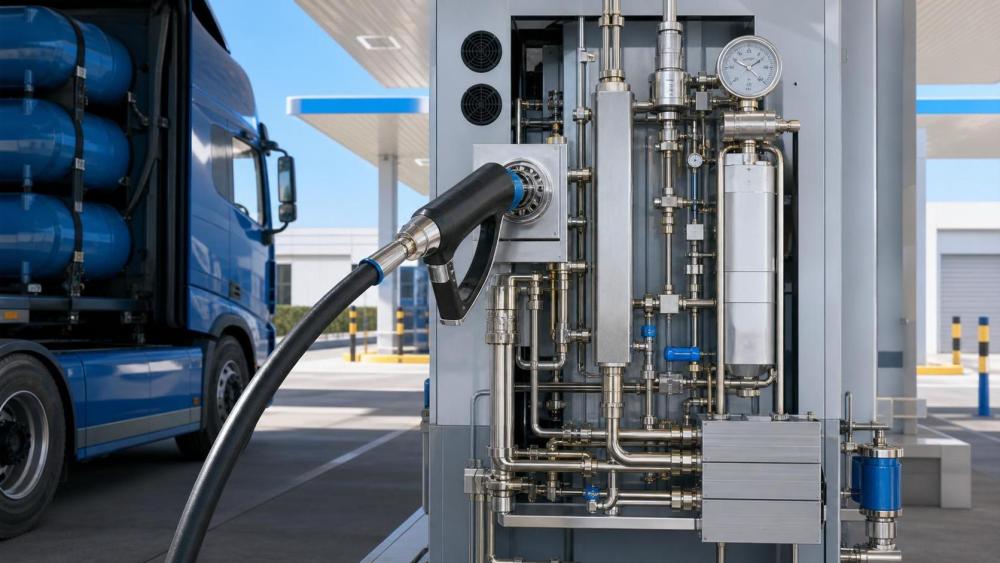
Truck fleets depend on fast, repeatable fueling. That makes Hydrogen dispensing systems for trucks a critical operational layer, not just a refueling accessory.
In practice, the most expensive failures rarely begin with a visible release. They start as small deviations inside pressure control, temperature compensation, sealing surfaces, or communication logic.
Those deviations can stay below alarm thresholds for weeks. Meanwhile, fill accuracy drifts, component fatigue accelerates, and maintenance records begin to look inconsistent.
For large hydrogen programs, that is more than a maintenance issue. It affects asset confidence, station throughput, compliance evidence, and long-term infrastructure credibility.
This is why G-HEI treats high-pressure refueling as part of sovereign-grade infrastructure benchmarking. In a hydrogen economy, reliability is judged at the nozzle as much as at the electrolyzer.
Actual operating conditions change what needs attention
Hydrogen dispensing systems for trucks do not fail in the same way everywhere. The risk profile changes with vehicle class, daily fueling rhythm, ambient climate, and upstream gas condition.
A depot serving a fixed route often values repeatability over peak speed. A public heavy-duty corridor station usually pushes throughput, back-to-back fills, and faster hose handling.
The equipment may look similar on a datasheet. The operating stress is not. Pressure ramp behavior, pre-cooling performance, and dispenser recovery time can diverge sharply.
Another variable is protocol discipline. A technically compliant dispenser can still underperform if vehicle communication, pressure targeting, or station sequencing is poorly aligned with SAE J2601 logic.
That is why risk review should begin with the real duty cycle. Hidden issues in Hydrogen dispensing systems for trucks often come from mismatched assumptions, not defective hardware alone.
Fleet depot use exposes slow drift more than dramatic breakdowns
In a closed depot, fueling windows are predictable. That usually reduces queue pressure, but it also allows gradual errors to become normalized.
If delivered mass trends slightly low, operators may attribute it to tank variation. If nozzle temperature reads a little high, fills may still complete, just less efficiently.
The warning sign is often pattern stability. When every fill looks acceptable, teams can miss the fact that acceptable has slowly moved away from calibrated performance.
For this setting, Hydrogen dispensing systems for trucks need stronger verification of meter accuracy, sensor drift, and seal condition over time, not only event-based fault response.
A useful approach is to compare fill duration, final pressure, gas temperature, and delivered mass across similar trucks over a rolling interval. Stable outliers deserve investigation.
High-throughput corridor stations face a different failure pattern
On freight corridors, the strain moves from slow drift to thermal and sequencing stress. Hydrogen dispensing systems for trucks must recover quickly between consecutive fills.
Here, pre-cooling margin matters more than many station models assume. If recovery lags, the second or third truck in sequence can see underfilled tanks or aborted sessions.
This kind of problem is easy to misread. Teams may blame vehicle receptacles or driver handling, when the deeper issue is inadequate thermal stabilization inside the station loop.
Pressure control valves also see harsher cycling in these environments. Even small response delays can create overshoot risk, especially when ambient temperatures are already elevated.
Where throughput is the business driver, maintenance intervals should be based on cycle count and heat load, not calendar time alone.
Cold climate, hot climate, and mixed supply quality do not create the same priorities
Environmental conditions reshape the operating envelope. Hydrogen dispensing systems for trucks in cold regions may face brittle sealing behavior and condensation-related instrumentation issues.
In hot climates, temperature compensation becomes less forgiving. Thermal buildup can distort fill calculations and shorten component life if the cooling strategy was sized too narrowly.
Supply quality introduces another layer. Hydrogen from different production and logistics chains may meet formal purity requirements yet still create different material or filtration burdens over time.
That matters for stations linked to broader zero-carbon infrastructure. G-HEI’s cross-pillar view is useful here because production, storage, transport, and dispensing integrity are connected in practice.
The same dispenser can perform very differently when fed by varying compression regimes, trailer delivery conditions, or cryogenic-to-gaseous conversion steps upstream.
Where scenario differences usually show up first
What gets misjudged when teams rely on nameplate data
One common mistake is treating 70 MPa capability as proof of field readiness. Nameplate pressure says little about consistency across seasons, fill sequences, and vehicle combinations.
Another mistake is focusing on leak prevention while overlooking measurement integrity. A station can remain mechanically tight and still deliver poor operational quality.
Protocol mismatch is also underestimated. Hydrogen dispensing systems for trucks may pass bench checks yet create repeated field anomalies when software logic and truck-side expectations diverge.
Cost evaluations often narrow the issue further. Low purchase cost can be attractive, but replacement seals, recalibration downtime, and aborted fills create a larger lifecycle burden.
- Do not assume similar truck routes create identical fueling stress.
- Do not judge dispenser quality by peak flow rate alone.
- Do not separate station data review from upstream hydrogen conditioning.
- Do not defer calibration checks until alarms appear.
A practical way to match Hydrogen dispensing systems for trucks to site conditions
A better starting point is to define the site by operating behavior. Count consecutive fills, average dwell time, ambient extremes, truck tank diversity, and gas supply variability.
Then test the dispenser against those conditions, not just against a generic commissioning checklist. This is where standards such as ISO 19880, ASME B31.12, and SAE J2601 become operational tools.
For depot stations, prioritize trend analytics, calibration intervals, and nozzle wear inspection. For corridor sites, prioritize thermal recovery, rapid-cycle valve health, and queue resilience.
If hydrogen supply sources may change, add material review and filtration checkpoints. Compatibility should be revisited when upstream compression or logistics strategy changes.
This kind of scenario-based review fits the broader G-HEI framework. Hydrogen infrastructure performs best when dispensing is assessed as part of the full energy transport chain.
Suggested verification actions before risk accumulates
- Build a fill-performance baseline for each truck class and fueling pattern.
- Track pressure, temperature, and delivered mass as a combined signal.
- Review seal, hose, and valve replacement intervals against actual cycle intensity.
- Compare software protocol settings with vehicle-side behavior after updates.
- Recheck station assumptions when climate or hydrogen source conditions shift.
The next useful step is not more alarms, but better operating evidence
Hidden risk in Hydrogen dispensing systems for trucks is usually a pattern problem before it becomes a safety event. That is why operating evidence matters more than isolated incident reports.
The strongest programs separate site types, define expected fill behavior, and review deviations early. They also connect dispenser performance to upstream hydrogen handling and standards compliance.
A sensible next move is to map each station by duty cycle, climate, truck mix, and supply path. Then compare those conditions against calibration practice, component life, and protocol alignment.
That process usually reveals where Hydrogen dispensing systems for trucks need tighter controls, different maintenance triggers, or a more realistic operating envelope.
Related News
- How ISO 19880 shapes safety requirements for hydrogen refueling systemsSep 22, 2026Hydrogen refueling systems ISO 19880 guides safer station design, pressure control, venting, emergency shutdowns, and verification. Explore essential safeguards.
- What makes a reliable hydrogen dispenser unit exporter for your project?Sep 16, 2026Hydrogen dispenser unit exporter guide: assess standards, integration, testing, logistics, and lifecycle support to choose a reliable project partner.
- What determines the cost of hydrogen dispenser units for a station?Sep 01, 2026Hydrogen dispenser units cost depends on pressure rating, protocols, safety, metering, integration, and lifecycle support. Explore smarter station procurement choices.
- EU Mandates ISO 19880-5 Type Approval for 70 MPa Hydrogen DispensersAug 15, 2026EU mandates ISO 19880-5 type approval for 70 MPa hydrogen dispensers from 2027, reshaping certification, compliance, and market access for exporters.
Related News
- 00
0000-00
Hydrogen Energy Storage for Data Centers Gets Costly Fast - 00
0000-00
When 99.999% Hydrogen Purity Still Is Not Good Enough - 00
0000-00
When Does a Hydrogen-Ready Gas Turbine Pay Off? - 00
0000-00
Electricity Price Volatility Is Rewriting Hydrogen Cost Models - 00
0000-00
PSA Recovery Rate Drops for Reasons Operators Miss
Dr. Victor Gear
Weekly Insights
Stay ahead with our curated technology reports delivered every Monday.