Hydrogen Energy Storage for Data Centers: Backup Power Limits and Benefits




As data centers face higher uptime exposure, grid congestion, and stricter carbon targets, hydrogen energy storage for data centers is moving from concept to strategic evaluation.
Its appeal is clear: long-duration backup, reduced local emissions, and stronger resilience against fuel supply interruptions and grid instability.
Yet adoption depends on a realistic view of limits.
Cost, safety engineering, space requirements, refueling logistics, and system maturity all shape whether hydrogen energy storage for data centers is technically and commercially justified.
For infrastructure planners, the priority is not replacing every backup technology at once.
It is identifying where hydrogen can outperform diesel generators, batteries, or gas-based systems under real operating constraints.
What Hydrogen Energy Storage for Data Centers Means in Practice
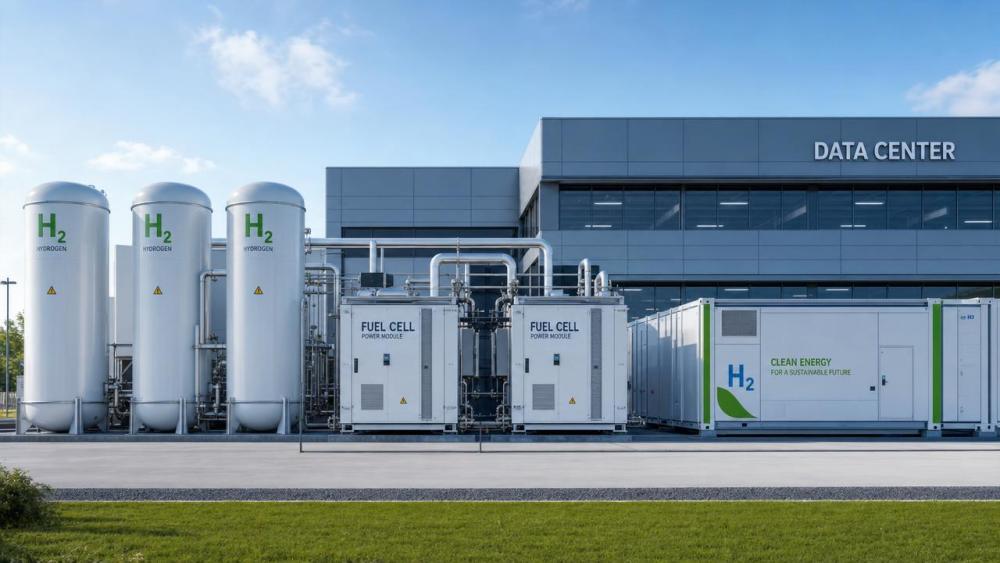
Hydrogen energy storage for data centers usually combines stored hydrogen, conversion equipment, power electronics, and control systems.
The most common pathway stores hydrogen in tanks and converts it to electricity through fuel cells.
Some designs also consider hydrogen-ready turbines or engines, especially for larger campuses needing very high power output.
In a backup configuration, the system sits idle or semi-ready during normal operation.
When the grid fails, stored hydrogen feeds the generation unit and supports critical loads.
Compared with lithium battery systems, hydrogen is generally better suited to longer discharge durations.
Compared with diesel, it can reduce on-site carbon emissions and local air pollutants if low-carbon hydrogen is available.
However, hydrogen energy storage for data centers is not one single product category.
It spans compressed gas storage, liquid hydrogen logistics, fuel cell architectures, and different redundancy strategies.
This means project feasibility depends heavily on site conditions, uptime requirements, and fuel supply design.
Why the Data Center Industry Is Paying Closer Attention
Several market signals are pushing hydrogen energy storage for data centers into serious planning discussions.
- Grid interconnection delays are slowing new capacity deployment.
- High-density computing increases the cost of downtime.
- Corporate decarbonization targets are tightening backup power expectations.
- Diesel permitting is becoming harder in some jurisdictions.
- Long-duration resilience is gaining value during extreme weather events.
The result is a broader view of resilience.
Backup power is no longer judged only by starting speed and capital cost.
It is also judged by emissions exposure, fuel security, runtime flexibility, and future compatibility with zero-carbon infrastructure.
Core Benefits and Strategic Business Value
The main strength of hydrogen energy storage for data centers is duration.
Batteries perform well for seconds-to-hours balancing, but extended backup often becomes expensive and space-intensive.
Hydrogen shifts the economics by separating power capacity from stored energy volume.
That feature matters where contingency planning calls for long runtimes or uncertain restoration windows.
Operational advantages
- Long-duration backup without proportionally expanding battery packs
- Lower local tailpipe emissions in fuel cell configurations
- Potential compatibility with microgrids and renewable integration
- Fuel inventory can support staged resilience planning
- Reduced dependency on diesel deliveries during disruptions
Strategic advantages
Hydrogen energy storage for data centers can also support broader infrastructure positioning.
Sites near hydrogen corridors, industrial clusters, or port logistics may gain better fuel access over time.
This creates optionality as zero-carbon energy systems mature.
For organizations with visible sustainability commitments, the technology also offers a credible path beyond incremental diesel offsets.
Backup Power Limits That Must Be Understood Early
Despite its promise, hydrogen energy storage for data centers still faces practical boundaries.
Ignoring them can produce expensive pilot projects with limited operational value.
1. Cost remains a major barrier
System costs include storage vessels, fuel cells, compressors, controls, balance-of-plant equipment, and safety systems.
Fuel cost also varies sharply depending on hydrogen source, transport mode, and contract structure.
2. Footprint and siting are not trivial
Compressed hydrogen storage requires dedicated space, setbacks, ventilation design, and emergency access planning.
Dense urban data center sites may struggle to accommodate these requirements.
3. Fuel availability is highly regional
Hydrogen energy storage for data centers depends on reliable fuel replenishment.
In regions without mature supply chains, resilience may be theoretical rather than practical.
4. Efficiency is lower than direct battery discharge
If hydrogen is produced from electricity, stored, then reconverted, round-trip efficiency is lower than battery systems.
That does not remove value, but it changes the use case.
5. Codes, standards, and safety discipline are essential
Hydrogen deployment requires serious engineering governance.
Material integrity, leak detection, pressure handling, separation distances, and emergency response must be built into project design.
Frameworks such as ISO 19880 and ASME B31.12 are highly relevant to planning quality.
Typical Deployment Scenarios and Fit Profiles
Hydrogen energy storage for data centers is not equally suitable for every facility.
The strongest fit usually appears where runtime demands, carbon targets, and infrastructure context align.
In many cases, the best model is hybrid rather than exclusive.
Batteries can manage instant ride-through, while hydrogen covers extended outages.
This layered approach often improves resilience design and capital allocation.
Implementation Priorities and Risk Controls
Any evaluation of hydrogen energy storage for data centers should begin with quantified operating assumptions.
The key question is not whether hydrogen is promising.
It is whether it performs better than alternatives for a defined resilience objective.
- Model critical load, runtime target, and restart sequence in detail.
- Assess local hydrogen supply, storage regulations, and permit pathways.
- Compare fuel cells, turbines, and hybrid architectures against uptime requirements.
- Validate safety design against recognized international standards.
- Stress-test total cost using outage frequency and carbon policy scenarios.
- Plan maintenance, training, and emergency procedures before commissioning.
This is where technically rigorous references become valuable.
Benchmarking equipment, storage methods, and integrity standards reduces strategic uncertainty.
For complex energy transition projects, alignment across safety, materials, and infrastructure is critical.
A Practical Next Step for Evaluation
Hydrogen energy storage for data centers offers real benefits, especially for long-duration backup and decarbonized resilience.
But its success depends on disciplined matching between technology, site conditions, and supply infrastructure.
A sensible next step is a site-specific feasibility study.
That review should quantify runtime needs, available footprint, fuel sourcing, code compliance, and lifecycle economics.
Where hydrogen corridors, electrolysis capacity, or zero-carbon infrastructure are advancing, the business case may strengthen quickly.
Using a technical benchmark resource such as G-HEI can support better screening of storage pathways, safety frameworks, and asset readiness.
In a market where uptime and decarbonization increasingly intersect, early evaluation of hydrogen energy storage for data centers can create a more resilient decision base.
Related News
- Hydrogen Energy Storage for Data Centers Gets Costly FastApr 27, 2026Hydrogen energy storage for data centers gets costly fast as hydrogen storage, cryogenic liquid hydrogen, safety standards, and utility-scale power needs reshape the energy transition case. Learn the real trade-offs.
- Hydrogen Energy Storage for Data Centers: Backup Power vs Battery SystemsMay 19, 2026Hydrogen energy storage for data centers vs battery systems: compare backup duration, safety, costs, and zero-carbon resilience to choose the right power strategy.
- Solar-Hydrogen Hybrid Microgrids: When Fuel Cells Beat Battery-Only DesignsMay 18, 2026Solar-hydrogen hybrid microgrids outperform battery-only designs when long-duration resilience, lower lifecycle cost, and diesel-free backup matter most. See where fuel cells win.
- Hydrogen Energy Storage for Data Centers: Backup Power or Cost Burden?May 18, 2026Hydrogen energy storage for data centers: smart long-duration backup or rising cost burden? Explore resilience, safety, carbon benefits, and ROI before you invest.
Related News
- 00
0000-00
Hydrogen Energy Storage for Data Centers Gets Costly Fast - 00
0000-00
When 99.999% Hydrogen Purity Still Is Not Good Enough - 00
0000-00
When Does a Hydrogen-Ready Gas Turbine Pay Off? - 00
0000-00
Electricity Price Volatility Is Rewriting Hydrogen Cost Models - 00
0000-00
PSA Recovery Rate Drops for Reasons Operators Miss
Dr. Hideo Torque
Weekly Insights
Stay ahead with our curated technology reports delivered every Monday.