Hydrogen Energy Storage for Data Centers: Backup Power vs Battery Systems




As data centers face rising uptime demands and decarbonization pressure, hydrogen energy storage for data centers is emerging as a strategic alternative to conventional battery backup. For enterprise decision-makers, the real question is not only resilience, but how backup power architecture can align with long-duration storage, safety standards, and future zero-carbon infrastructure goals.
For operators managing hyperscale campuses, colocation facilities, and sovereign digital infrastructure, backup design is no longer a narrow engineering issue. It now influences carbon reporting, grid interconnection strategy, land use, fuel logistics, and board-level risk exposure over 10 to 20 years.
In that context, hydrogen energy storage for data centers deserves a practical comparison with battery systems. Batteries remain strong for seconds-to-hours support, while hydrogen can address multi-hour to multi-day resilience when paired with fuel cells, turbines, or hybrid architectures.
Why the Backup Power Debate Is Changing
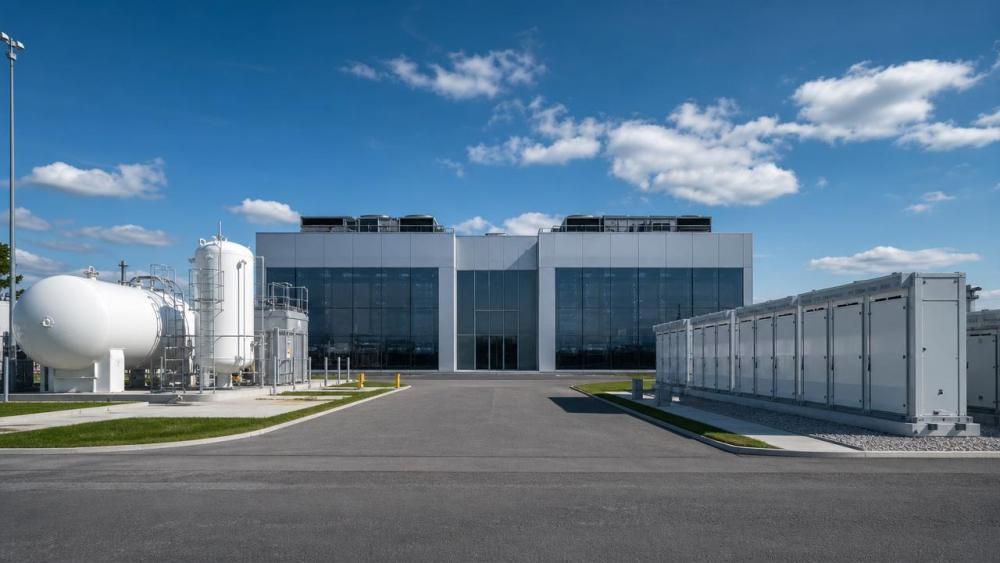
Data center uptime expectations have tightened as AI workloads, financial transactions, and public digital services become less tolerant of interruption. In many enterprise environments, backup systems are now evaluated not only against Tier objectives, but also against site autonomy targets such as 8 hours, 24 hours, or 72 hours.
Traditional battery energy storage systems, usually based on lithium-ion chemistry, are efficient and fast. They can deliver sub-second response, stabilize transfers, and support uninterruptible power supply functions. However, scaling batteries for long-duration backup often increases footprint, thermal management complexity, and replacement planning.
Hydrogen shifts the design logic. Instead of storing all resilience in electrochemical cells, a site can separate power capacity from energy duration. Fuel cells or hydrogen-ready turbines define output in kW or MW, while storage tanks define runtime in hours or days.
What enterprise buyers are really comparing
Most executive teams are not choosing between two isolated technologies. They are comparing 4 architecture questions: ride-through speed, duration of backup, refueling or recharge logistics, and alignment with decarbonization commitments. This is why hydrogen energy storage for data centers is increasingly assessed as part of an integrated resilience stack.
- Seconds to 15 minutes: UPS continuity and power quality
- 15 minutes to 4 hours: bridge power during transfer or grid instability
- 4 to 72 hours: sustained outage coverage and black-start support
- Beyond 72 hours: fuel supply chain resilience and sovereign energy strategy
Battery strengths and battery constraints
Battery systems are mature, modular, and relatively easy to integrate near critical loads. They usually offer round-trip efficiencies in the 85% to 95% range and fast automated control. For short-duration events, this makes them hard to displace.
Yet enterprise decision-makers also face trade-offs. Long-duration battery backup can require larger electrical rooms, fire protection zoning, thermal conditioning, and end-of-life replacement cycles commonly planned around 8 to 15 years, depending on duty profile and ambient conditions.
Where hydrogen changes the value proposition
Hydrogen storage is attractive when resilience duration matters more than instantaneous energy efficiency. If a facility needs 24-hour or 48-hour autonomy without relying solely on diesel, compressed or liquid hydrogen can provide a lower-frequency, longer-duration reserve that is refueled rather than fully recharged.
This is particularly relevant for campuses planning renewable power integration, microgrids, or sovereign energy strategies. Organizations following technical benchmarks from bodies such as ISO 19880, ASME B31.12, and related hydrogen handling standards can evaluate hydrogen energy storage for data centers with clearer safety and material-integrity frameworks.
Hydrogen Backup Power vs Battery Systems: Technical Comparison
The most effective comparison is not “which technology is better,” but “which duty cycle fits which system.” The table below summarizes how hydrogen energy storage for data centers compares with battery-based backup across key procurement and engineering dimensions.
The key takeaway is clear: batteries dominate for immediate response, while hydrogen becomes increasingly competitive as duration requirements move beyond a few hours. Many resilient designs therefore combine both rather than forcing a single-technology decision.
Efficiency should not be the only metric
A common mistake is to compare systems using energy efficiency alone. Battery round-trip efficiency may be higher, but enterprise infrastructure decisions also depend on fuel availability, outage frequency, restart readiness, critical load segmentation, and whether the organization can tolerate repeated recharge delays during prolonged grid stress.
For example, a 20 MW site with a 24-hour resilience target implies a far different storage strategy than a 2 MW edge facility designed only for 15-minute transfer support. Hydrogen energy storage for data centers becomes more compelling as load size and required autonomy increase together.
Typical hybrid architecture
- UPS or short-duration batteries carry the first seconds or minutes.
- Fuel cells or hydrogen-ready turbines assume sustained critical load.
- Stored hydrogen provides 8 to 72 hours of autonomy, with refueling plans for longer events.
- Microgrid controls optimize transitions, islanding, and renewable integration.
Safety, Standards, and Operational Risk
Safety is often the decisive factor in board approval. Hydrogen is not simply another fuel, and batteries are not risk-free. Each technology introduces different hazard profiles, permitting pathways, and emergency planning requirements.
For hydrogen energy storage for data centers, the evaluation must include pressure class, leak detection, ventilation design, material compatibility, fueling interfaces, and site separation distances. For batteries, thermal runaway mitigation, room zoning, suppression systems, and de-energization procedures remain central.
Critical hydrogen risk controls
- Continuous gas detection in enclosed and semi-enclosed areas
- Ventilation engineered for credible leak scenarios
- Materials selection aligned with hydrogen embrittlement considerations
- Pressure system design reviewed against applicable piping and vessel standards
- Operator drills conducted at defined intervals, often every 6 to 12 months
Organizations such as G-HEI add value by benchmarking infrastructure choices against high-performance assets and practical safety frameworks. That is especially important when projects involve cryogenic liquid hydrogen logistics, PEM or alkaline electrolyzer integration, or hydrogen-ready turbine pathways.
A practical decision matrix for enterprise buyers
The next table can help CTOs, infrastructure directors, and investment teams organize site-level decision criteria before moving into FEED studies or EPC procurement.
This matrix shows why no serious buyer should evaluate backup only on equipment price. Siting, permitting, long-duration availability, and operational readiness often have equal or greater impact on the final business case.
How to Select the Right Architecture for a Data Center Portfolio
Portfolio strategy matters more than single-site preference. An edge node, a 5 MW enterprise facility, and a 100 MW hyperscale campus should not automatically use the same resilience model. Hydrogen energy storage for data centers may be ideal for some locations and unnecessary for others.
When batteries are usually the better choice
Battery-centric backup remains attractive when outages are short, land is constrained, and the main requirement is seamless ride-through. This is often the case for urban colocation sites, latency-sensitive enterprise rooms, and facilities that already have dependable secondary generation or robust grid redundancy.
When hydrogen deserves serious consideration
Hydrogen should move onto the shortlist when a facility needs 8 hours or more of low-carbon resilience, when diesel restrictions are tightening, or when the operator wants to align backup assets with broader zero-carbon infrastructure development. It is also relevant where grid congestion increases the value of on-site energy sovereignty.
For governments, utilities, and strategic digital campuses, hydrogen can support a wider ecosystem: large-scale electrolysis, cryogenic transport, hydrogen-ready gas turbines, and future cross-sector fuel use. That makes the backup system part of an industrial transition, not just an isolated emergency asset.
Five-step evaluation process
- Define critical load blocks and required autonomy in hours.
- Screen site constraints including setbacks, ventilation, and utility interfaces.
- Model capex and opex across 10 to 15 years.
- Stress-test fuel logistics under regional disruption scenarios.
- Validate compliance roadmap, emergency response, and commissioning plan.
Common implementation mistakes
- Assuming hydrogen can replace UPS without a bridging layer
- Underestimating permitting time for storage and hazardous systems
- Comparing only efficiency while ignoring outage duration economics
- Failing to match fuel strategy with actual regional supply reliability
- Designing for nominal load rather than tested critical load tiers
Procurement, Delivery, and Long-Term Value
From a procurement standpoint, the winning solution is usually the one that reduces enterprise risk across the full asset life. That includes procurement lead times, integration complexity, compliance burden, maintenance planning, and the ability to adapt as power density and sustainability requirements evolve.
Battery projects may move faster at smaller scales, especially where containerized systems are already approved. Hydrogen projects often require more front-end design discipline, but they can deliver stronger strategic value where long-duration resilience, decarbonization, and national energy security intersect.
What sophisticated buyers should request from suppliers
- Single-line architecture showing transition logic from UPS to sustained backup
- Runtime assumptions tied to actual MW load and storage conditions
- Standards mapping for piping, storage, fueling, and safety systems
- Inspection and maintenance intervals with spares strategy
- Scenario analysis for 24-hour, 48-hour, and 72-hour outage events
This is where a technical benchmarking platform such as G-HEI becomes useful to senior decision-makers. By linking electrolysis, logistics, hydrogen-ready power systems, and internationally recognized safety practices, it helps buyers evaluate hydrogen energy storage for data centers on engineering merit rather than marketing claims.
For most enterprises, the future is not a simple battery-versus-hydrogen contest. It is a staged resilience strategy in which batteries secure immediate continuity and hydrogen provides scalable, long-duration backup aligned with zero-carbon infrastructure. The right choice depends on runtime target, site constraints, safety readiness, and long-term energy strategy.
If your organization is assessing hydrogen energy storage for data centers, now is the time to compare architectures using real duty cycles, compliance pathways, and lifecycle economics. Contact us to discuss a tailored resilience roadmap, request a technical benchmark review, or explore a custom solution for your data center portfolio.
Related News
- Hydrogen Energy Storage for Data Centers Gets Costly FastApr 27, 2026Hydrogen energy storage for data centers gets costly fast as hydrogen storage, cryogenic liquid hydrogen, safety standards, and utility-scale power needs reshape the energy transition case. Learn the real trade-offs.
- Hydrogen Energy Storage for Data Centers: Backup Power Options ComparedJun 14, 2026Hydrogen energy storage for data centers compared: see how hydrogen, diesel, batteries, and hybrids perform on uptime, emissions, safety, and long-duration backup.
- Energy Storage Battery Sizing: Key Specs That Affect Runtime and CostJun 14, 2026Energy storage battery sizing affects far more than kWh. Learn how DoD, C-rate, efficiency, temperature, and degradation shape runtime, lifecycle cost, and smarter project decisions.
- Industrial Energy Efficiency Upgrades With the Fastest PaybackJun 07, 2026Industrial energy efficiency upgrades with the fastest payback: discover proven ways to cut power loss, reduce downtime, and improve ROI in hydrogen, CCUS, turbines, and cryogenic systems.
Related News
- 00
0000-00
Hydrogen Energy Storage for Data Centers Gets Costly Fast - 00
0000-00
When 99.999% Hydrogen Purity Still Is Not Good Enough - 00
0000-00
When Does a Hydrogen-Ready Gas Turbine Pay Off? - 00
0000-00
Electricity Price Volatility Is Rewriting Hydrogen Cost Models - 00
0000-00
PSA Recovery Rate Drops for Reasons Operators Miss
Dr. Hideo Torque
Weekly Insights
Stay ahead with our curated technology reports delivered every Monday.