Hydrogen Energy Storage for Data Centers: Backup Power or Peak Shaving?




As data centers face rising power density, grid volatility, and decarbonization pressure, hydrogen energy storage for data centers is emerging as a strategic option beyond conventional batteries and diesel backup. But should operators prioritize it for resilient emergency power, or for peak shaving and energy cost optimization? This article examines the technical, economic, and infrastructure factors shaping that decision for enterprise leaders.
For most enterprise operators, the short answer is this: hydrogen is usually more compelling first as long-duration backup power than as a pure peak-shaving tool. Peak shaving can create value, but only under specific electricity pricing, renewable integration, and utilization conditions.
That distinction matters because executive teams are not evaluating a technology in isolation. They are deciding how to protect uptime, manage energy cost exposure, satisfy carbon targets, and avoid stranded infrastructure in facilities where downtime is financially unacceptable.
The search intent behind hydrogen energy storage for data centers is therefore not academic. Decision-makers want to know where hydrogen actually fits, what business case is strongest, what deployment risks are real, and how it compares with batteries, diesel generators, and other resilient power options.
Should data centers use hydrogen for backup power or peak shaving?
The most practical answer is to begin with backup resilience, then evaluate peak shaving as a secondary value stream. Hydrogen systems are strongest when long discharge duration, fuel flexibility, emissions reduction, and grid independence matter more than fast daily cycling at the lowest short-term cost.
Batteries remain highly effective for short-duration ride-through, power quality support, and rapid-response load management. Diesel still dominates emergency generation because of cost familiarity and established operating procedures. Hydrogen enters the conversation when operators need cleaner long-duration coverage without relying entirely on large battery banks or fossil backup.
For peak shaving alone, hydrogen often faces a tougher economic comparison. Round-trip efficiency is lower than batteries, and system complexity is higher. If an operator only needs to shave a few hours of peak demand every day, lithium-ion or other electrical storage usually presents a more direct and efficient answer.
However, that conclusion changes when the site also values resilient backup, on-site renewable integration, reduced diesel dependence, or future participation in low-carbon energy programs. In those cases, hydrogen energy storage for data centers can support more than one board-level objective at the same time.
Why enterprise leaders are now seriously evaluating hydrogen energy storage for data centers
Three pressures are driving serious interest. First, data center loads are growing rapidly, especially with AI clusters, high-density racks, and liquid cooling systems. Second, utility interconnection delays and local grid congestion are making reliable expansion harder. Third, sustainability expectations are moving from reporting language to infrastructure decisions.
Large operators can no longer assume that diesel plus UPS batteries will remain the undisputed default. In many jurisdictions, air permitting is getting harder, testing restrictions are tighter, and carbon accounting is becoming material for investors, hyperscale customers, and public-sector procurement.
Hydrogen offers an alternative pathway because it can store energy over longer periods than typical batteries and can be converted back to power through fuel cells or hydrogen-ready turbines. That makes it relevant where outage duration risk, renewable intermittency, or fuel decarbonization strategy is central.
For enterprise decision-makers, the question is less “Is hydrogen interesting?” and more “Under what conditions does hydrogen outperform conventional options enough to justify capital, operational, and safety complexity?” That is the lens through which any serious evaluation should proceed.
Where hydrogen is stronger than batteries and diesel
Hydrogen’s clearest advantage is long-duration storage. Extending battery systems from minutes to many hours or even multiple days can become expensive, space-intensive, and operationally limiting. Hydrogen can decouple storage duration from power capacity more flexibly, especially at larger scales.
This matters in data center environments where outage risk is not only about short disturbances. Severe weather events, transmission bottlenecks, and constrained utility restoration can push operators to think beyond traditional backup assumptions. A longer-duration energy reserve can become a strategic resilience asset rather than a compliance feature.
Hydrogen also supports emissions reduction more credibly than diesel when the supply chain is low-carbon and the power conversion technology is configured correctly. Fuel cells can produce electricity with zero local combustion emissions, which may help in regions with strict air quality rules or sustainability commitments.
Another strength is multi-function potential. A hydrogen platform can be designed to serve emergency backup, microgrid support, renewable balancing, and in some cases market-facing energy optimization. Batteries can do some of these jobs well, but hydrogen may scale duration more effectively where enterprise resilience is the primary constraint.
Why peak shaving is usually a harder first-use case
Peak shaving sounds attractive because data centers consume large amounts of electricity and often face high demand charges or time-of-use tariffs. The challenge is that hydrogen systems generally involve electrolysis, compression or storage, and reconversion to power, each with efficiency losses and capital costs.
That means a pure arbitrage model often struggles unless power price spreads are unusually wide, renewable curtailment is available, or policy incentives improve project economics. In contrast, batteries can respond instantly and efficiently to daily peaks without requiring fuel handling infrastructure.
There is also the utilization problem. Peak shaving works best with assets that cycle often. Backup systems, by nature, may sit idle for long periods. Hydrogen can bridge those roles, but the commercial case improves only if the system is dispatched enough to justify its installed cost without compromising emergency readiness.
For that reason, executives should be cautious about approving hydrogen projects based solely on expected demand-charge savings. The better framing is whether peak shaving can be layered onto a resilience-first asset, thereby improving utilization and shortening payback rather than carrying the entire business case alone.
What a realistic hydrogen architecture looks like in a data center
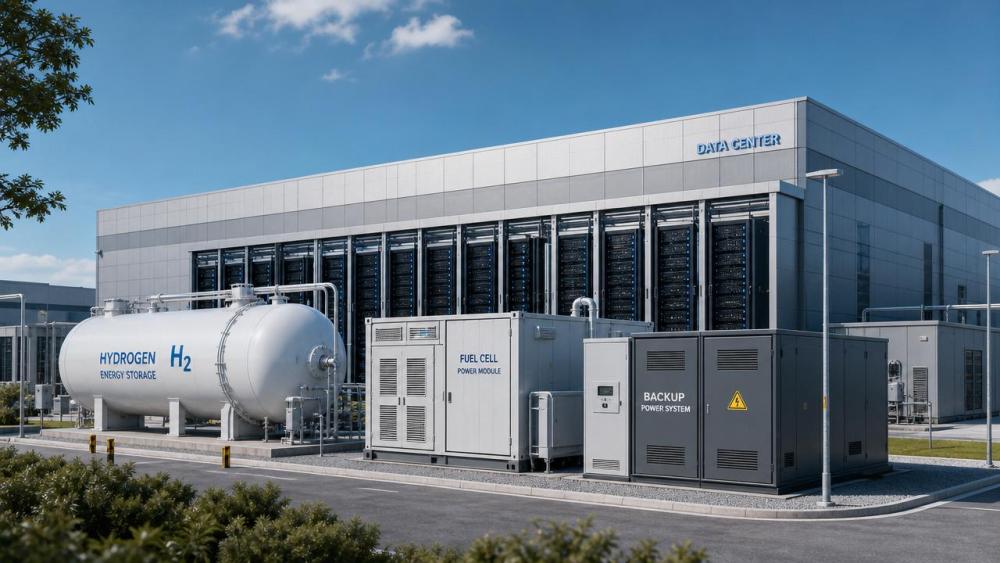
Hydrogen energy storage for data centers is not a single product. It is a system architecture. A typical configuration may include grid or renewable power input, an electrolyzer if on-site production is planned, hydrogen compression, storage vessels, power conversion equipment, control systems, and integration with existing UPS and standby power layers.
Some sites may prefer delivered hydrogen rather than on-site electrolysis, especially where space, water availability, permitting, or electricity pricing make local production less attractive. Others may use a hybrid model, combining contracted hydrogen supply with limited on-site generation tied to renewable energy procurement.
On the power output side, proton exchange membrane fuel cells are often discussed because they offer low local emissions, modularity, and high-quality electrical output. Hydrogen-capable turbines may become relevant at larger scales, particularly where operators want to integrate with campus-level thermal or power infrastructure.
In practice, most enterprise deployments will not replace the entire existing backup chain immediately. They will layer hydrogen into a hybrid resilience stack that includes UPS batteries for instantaneous response and either fuel cells or turbines for sustained backup duration.
How to judge the economics without oversimplifying them
Executives should avoid evaluating hydrogen only through levelized storage cost headlines. The correct analysis must account for uptime value, avoided diesel exposure, carbon compliance, fuel logistics, power market conditions, and the strategic option value of energy independence.
Capital expenditure typically includes storage systems, power conversion units, safety equipment, controls, and potentially electrolysis. Operating expenditure depends on hydrogen sourcing method, maintenance, testing, efficiency losses, site staffing, and regulatory obligations. These categories can vary widely by geography and project design.
A useful business case model starts with four scenarios: backup-only, backup plus peak shaving, backup plus renewable firming, and full microgrid participation. This reveals whether hydrogen creates value primarily through resilience, through energy optimization, or through stacking multiple services over time.
It is also important to price the cost of downtime honestly. In many data centers, even a rare power disruption can have consequences that dwarf fuel cost differences. If hydrogen materially improves long-duration resilience while reducing emissions liabilities, its economics may be stronger than simple efficiency comparisons suggest.
What risks and objections usually stop projects
The first concern is safety. Hydrogen requires disciplined handling because of its flammability, storage pressure, leak behavior, and material compatibility requirements. That said, the right question is not whether hydrogen has risks, but whether those risks can be engineered and governed to recognized standards.
For enterprise adoption, safety credibility depends on system design, separation distances, ventilation, leak detection, shutdown logic, and compliance with relevant engineering codes and fueling or storage standards. Leadership teams should demand evidence of mature hazard analysis, not generic assurances.
The second concern is infrastructure readiness. Not every site has room for storage vessels, easy equipment access, or a permitting path for hydrogen facilities. Water supply, electrical connection quality, and logistics for delivered hydrogen may all influence feasibility far more than conceptual enthusiasm.
The third concern is technology maturity at the exact scale and duty cycle required. Decision-makers should distinguish between proven components and proven integrated systems. A bankable project needs confidence not just in electrolysis or fuel cells individually, but in the full operational chain under data center reliability expectations.
Which data center profiles are the best fit
Hydrogen is most likely to make sense where long-duration resilience has high strategic value, diesel restrictions are tightening, and sustainability targets carry financial or customer consequences. Hyperscale campuses, remote or weak-grid sites, and facilities planning large AI load expansions are among the strongest candidates.
Sites with abundant low-carbon electricity, curtailed renewable energy, or supportive policy incentives may also have an advantage. In such environments, operators can turn hydrogen from a backup expense into a broader energy platform with decarbonization and grid-interactive value.
By contrast, urban colocation sites with limited space, modest outage-duration concerns, and relatively predictable tariff structures may find batteries and grid contracts more practical in the near term. Hydrogen is not automatically the best answer simply because a facility has a large load.
The most important screening principle is this: if the organization values duration, fuel decarbonization, and infrastructure optionality, hydrogen deserves serious evaluation. If it values low complexity and high-frequency daily cycling above all else, batteries usually remain the stronger first choice.
A practical decision framework for enterprise leaders
First, define the primary mission. Is the project meant to reduce downtime risk, lower demand charges, meet carbon commitments, defer grid upgrades, or support an on-site microgrid strategy? If leadership cannot rank these priorities, technology evaluation will become confused and politically driven.
Second, assess the outage and tariff profile. How long do critical loads need support? How expensive are demand peaks? How constrained is the local grid? What are the likely future permitting rules for diesel operation? Hydrogen only makes sense when matched to actual site risk and cost structures.
Third, compare architectures rather than technologies in isolation. A battery-only model, diesel-plus-battery model, hydrogen-plus-battery model, and hybrid microgrid model should each be tested. The goal is not to choose the most novel system, but the one that best satisfies resilience, cost, and decarbonization requirements.
Fourth, plan for phased adoption. A pilot covering one resilience block or one campus segment may be more valuable than a full-site commitment. Phasing reduces technical risk, builds operational competence, and creates real data for future investment decisions.
Conclusion: backup first, then value stacking
For most organizations, hydrogen energy storage for data centers should be approached first as a resilience and decarbonized backup solution, not as a standalone peak-shaving asset. Its strategic value is strongest where long-duration power assurance and reduced diesel dependence matter most.
Peak shaving can still play an important role, but usually as a secondary benefit layered onto a backup-oriented system. When executives evaluate hydrogen through that lens, the business case becomes more realistic and the deployment pathway clearer.
In other words, the right question is not whether hydrogen replaces batteries or diesel everywhere. It is where hydrogen solves a more valuable problem than they do. For enterprise leaders managing uptime, carbon exposure, and energy uncertainty, that is the decision framework that matters.
Related News
- Hydrogen Energy Storage for Data Centers Gets Costly FastApr 27, 2026Hydrogen energy storage for data centers gets costly fast as hydrogen storage, cryogenic liquid hydrogen, safety standards, and utility-scale power needs reshape the energy transition case. Learn the real trade-offs.
- Energy Efficiency Solutions That Cut Operating Costs in Hydrogen SystemsJun 23, 2026Energy efficiency solutions for hydrogen systems that reduce operating costs, improve uptime, and strengthen ROI. Discover practical ways to cut energy use and boost asset value.
- Ammonia Price Shock Speeds Fuel Cell Backup AdoptionJun 22, 2026Ammonia price shock is accelerating stationary fuel cell backup adoption in green ammonia projects. Learn how ASME B31.12 and ISO 19880-3 are reshaping procurement, compliance, and delivery.
- Energy Market Analysis Tools: How to Compare Cost, Data Depth, and Forecast AccuracyJun 22, 2026Energy market analysis tools compared: learn how to evaluate cost, data depth, and forecast accuracy for hydrogen, CCUS, and zero-carbon projects with confidence.
Related News
- 00
0000-00
Hydrogen Energy Storage for Data Centers Gets Costly Fast - 00
0000-00
When 99.999% Hydrogen Purity Still Is Not Good Enough - 00
0000-00
When Does a Hydrogen-Ready Gas Turbine Pay Off? - 00
0000-00
Electricity Price Volatility Is Rewriting Hydrogen Cost Models - 00
0000-00
PSA Recovery Rate Drops for Reasons Operators Miss
Dr. Hideo Torque
Weekly Insights
Stay ahead with our curated technology reports delivered every Monday.