Sustainable Iridium Sourcing: Supply Risk Behind PEM Expansion




As PEM electrolysis scales from pilot projects to sovereign-grade infrastructure, sustainable iridium sourcing is becoming a decisive procurement challenge rather than a niche materials issue. For buyers responsible for long-term supply security, cost stability, and compliance, understanding iridium availability, sourcing ethics, and technology risk is essential to avoiding bottlenecks that could slow hydrogen expansion and weaken zero-carbon investment performance.
For procurement teams serving utility-scale hydrogen projects, iridium is no longer a background material hidden inside stack specifications. It is now a strategic input tied to project bankability, localization strategy, technology selection, and long-range spare parts planning. In the G-HEI landscape, where sovereign decarbonization programs must align with safety codes, asset integrity, and industrial resilience, sustainable iridium sourcing deserves the same level of scrutiny as power availability, water treatment, compression, and cryogenic logistics.
This matters most in PEM deployments above the megawatt scale, where procurement timelines often extend 12–36 months and supply agreements can outlast a single project phase. A weak sourcing strategy may not show up during pilot procurement, but it can become a binding constraint when national hydrogen plans move from 10 MW demonstrations to 100 MW or gigawatt-class buildouts. For buyers, the question is not simply whether iridium is available today, but whether sustainable iridium sourcing can remain viable across multiple procurement cycles.
Why Iridium Has Become a Strategic Risk in PEM Electrolysis
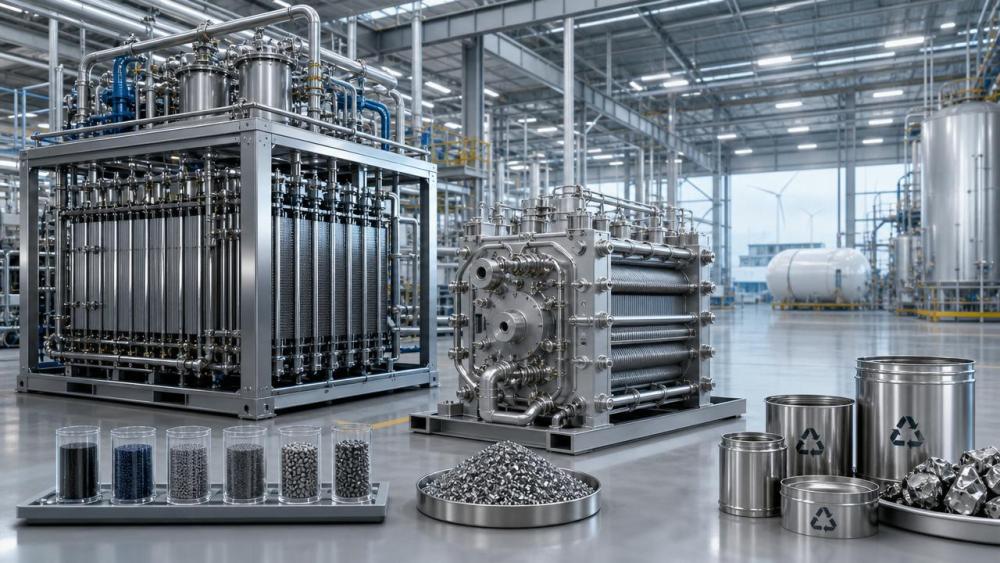
PEM electrolysers depend on iridium-based catalyst layers at the anode because the oxygen evolution reaction in acidic conditions is highly demanding. Compared with alkaline systems, PEM technology offers faster ramp rates, high current density, compact footprint, and better integration with variable renewable power. Those advantages have made PEM attractive for grid-balancing hydrogen plants, offshore wind coupling, and high-purity hydrogen applications. However, they also increase exposure to a metal with limited primary production and concentrated supply channels.
Iridium is typically obtained as a by-product of platinum group metal refining rather than from standalone mines. That means output does not respond quickly to PEM demand signals. Even if hydrogen project pipelines grow by 2x or 3x over a 24-month period, iridium availability may remain constrained because upstream mining and refining economics are driven by broader PGM markets. For procurement managers, this creates a mismatch between electrolyser deployment speed and catalyst material scalability.
Three procurement implications buyers should not ignore
- Lead-time risk: stack deliveries quoted at 26–40 weeks can stretch further if catalyst supply tightens.
- Price volatility: even modest changes in iridium availability can affect catalyst cost assumptions for projects above 20 MW.
- Allocation risk: priority may shift to strategic customers with multi-year framework agreements rather than spot buyers.
Procurement teams should also distinguish between short-term component supply and long-term replacement demand. PEM stacks are not purchased once and forgotten. Depending on duty cycle, operating conditions, and stack design, catalyst loading, refurbishment planning, and replacement intervals can affect total material exposure over 7–15 years. Sustainable iridium sourcing therefore belongs in lifecycle cost reviews, not only in initial capex evaluation.
How concentration risk enters sovereign hydrogen planning
A sovereign-grade hydrogen program must secure more than equipment names on a bidder list. It must assess geopolitical concentration, refining bottlenecks, ESG traceability, and recyclability. If a national project relies on imported PEM systems without a transparent catalyst chain, the resulting asset base may be technically installed but strategically vulnerable. In practical terms, this means a 100 MW program can face delays not because transformers or balance-of-plant items are missing, but because a few grams per square meter of catalyst become hard to source at scale.
The table below outlines how iridium-related risks show up across the procurement cycle for PEM infrastructure.
The key conclusion is that sustainable iridium sourcing should be evaluated as a full-cycle procurement issue. Buyers who focus only on initial stack efficiency may overlook material dependencies that later affect uptime, expansion schedules, and capital discipline.
What Sustainable Iridium Sourcing Actually Means for Buyers
In procurement practice, sustainable iridium sourcing is broader than buying from a supplier with a general ESG statement. It combines four measurable dimensions: supply continuity, source transparency, material efficiency, and circular recovery. Each dimension matters because PEM projects are expected to serve critical infrastructure roles, often under public scrutiny and multi-stakeholder financing conditions.
1. Supply continuity
Buyers should confirm whether an OEM has multi-source refining relationships, forward purchase arrangements, or allocation mechanisms for strategic accounts. A supplier that can ship one 5 MW system this year may not be able to support three additional expansion phases over the next 18–30 months. Continuity should be tested against scale-up scenarios, not only against current nameplate demand.
2. Source transparency and ethics
Procurement teams increasingly need chain-of-custody visibility, conflict-risk screening, and responsible sourcing documentation. This is especially relevant where national utilities, export credit agencies, or institutional investors impose stricter disclosure standards. If source disclosure stops at the stack integrator level, buyers should ask how far upstream the audit trail extends: catalyst coater, refiner, or mine-linked PGM channel.
3. Material efficiency
Not all PEM platforms use iridium with the same intensity. Catalyst loading reduction, current density optimization, and stack architecture can lower grams per kilowatt without compromising durability if validated properly. For buyers, this means the lowest purchase price is not always the least risky option. A system with better material efficiency may reduce exposure to future sourcing shocks even if the initial equipment quote is 5%–12% higher.
4. Circular recovery and end-of-life planning
Sustainable iridium sourcing should include a recovery path for spent stacks, scrap catalyst-coated materials, and manufacturing off-cuts. Recovery rates vary by process and chain design, but even partial reclamation can improve long-term material resilience. This is particularly relevant for projects with 8–15 year asset horizons and planned capacity additions, where recycled material may support replacement cycles or future module builds.
Core due-diligence questions for procurement teams
- What is the indicative iridium loading range per kW or per stack generation?
- How many upstream supply tiers can the OEM document?
- What is the standard lead time under base demand and under surge demand?
- Is there a recovery or buy-back program for end-of-life catalyst-bearing components?
- Which contract terms address price review, substitution limits, and allocation priority?
How to Evaluate PEM Suppliers When Iridium Availability Is Tight
A practical sourcing strategy should compare suppliers beyond stack efficiency and rated hydrogen output. In constrained markets, procurement needs a weighted framework that connects technical design with material resilience. This is especially important for public tenders, utility-scale procurement boards, and cross-border hydrogen infrastructure programs where one weak vendor assumption can affect schedule, financing, and compliance.
Recommended supplier evaluation criteria
The table below provides a useful decision structure for buyers screening PEM suppliers under sustainable iridium sourcing constraints.
This framework helps buyers move from generic vendor comparison to material-risk comparison. In many cases, two PEM suppliers may offer similar electrical performance while having very different exposure to iridium bottlenecks.
Contract levers that reduce sourcing exposure
Well-structured contracts can reduce procurement uncertainty even when the upstream market remains tight. Buyers should consider phased volume reservations, indexed price review mechanisms, documented substitution controls, and agreed escalation paths if catalyst lead times exceed defined thresholds such as 4 weeks, 8 weeks, or 12 weeks beyond baseline. For larger programs, a dual-track award strategy may also reduce dependency on a single technology route.
Common contract points worth negotiating
- Volume call-off windows for stage 1, stage 2, and expansion modules
- Notification periods for material shortages or allocation changes
- Traceability documentation deliverables at factory acceptance stage
- Scrap recovery ownership and value-sharing provisions
- Replacement stack pricing logic for years 3, 5, and 8
Procurement Strategies for Sovereign-Grade Hydrogen Infrastructure
For national programs and large industrial buyers, sustainable iridium sourcing should be embedded into front-end planning rather than treated as a late-stage purchasing detail. This is consistent with the G-HEI approach to benchmark infrastructure against material integrity, operational security, and internationally aligned performance frameworks. A sovereign hydrogen asset must remain scalable under real market stress, not just under ideal tender assumptions.
Build a 3-layer sourcing plan
First, establish a base-case procurement plan covering awarded PEM capacity, standard lead times, and approved catalyst sourcing disclosures. Second, prepare a surge case for 1.5x–2x expansion, including optional slots and revised delivery windows. Third, create a resilience case that addresses substitution paths, stack refurbishment access, and recycling arrangements if upstream iridium markets tighten sharply during the program cycle.
Balance technology portfolio exposure
Not every hydrogen application requires the same electrolyser technology mix. Buyers can reduce concentration risk by aligning PEM deployment with the use cases that most benefit from dynamic response, compactness, or high-pressure integration, while evaluating alkaline systems for other duty profiles. This does not eliminate the need for sustainable iridium sourcing, but it can reduce unnecessary material intensity across a portfolio of projects.
Treat recycling as part of supply, not waste
In procurement terms, a spent stack is not merely a disposal item. It is a future source of strategic material value. Buyers should therefore ask whether the supplier has a documented chain for collecting, processing, and crediting catalyst-bearing returns. Even where exact recovery economics are case-specific, early contractual clarity can improve reporting, budgeting, and long-term replacement planning.
Typical implementation sequence
- Map total PEM demand by phase, usually across 3–5 year windows.
- Request material-risk disclosures during prequalification, not after award.
- Score suppliers on catalyst efficiency, traceability, and recovery readiness.
- Negotiate framework terms before final capacity expansion decisions.
- Review stack replacement and recycling assumptions annually.
Common Buyer Mistakes and Practical Questions to Ask
One common mistake is assuming that a reputable OEM automatically has a resilient iridium chain. Another is comparing PEM bids only on hydrogen efficiency, footprint, and capex per MW while ignoring catalyst dependency. A third is leaving replacement economics outside the procurement scope. In reality, sustainable iridium sourcing touches initial award, service planning, compliance reporting, and future expansion rights.
Questions that strengthen negotiation quality
- Can the supplier support repeat orders within 6–12 months without re-entering allocation queues?
- What portion of catalyst-bearing material can be tracked to a documented refining route?
- How does the supplier manage production if iridium price or availability shifts materially?
- Are there validated stack generations with lower catalyst intensity and equivalent duty life?
- What recovery obligations apply at end of life, and who bears logistics cost?
These questions improve internal procurement governance as well. They help buyers align engineering, legal, finance, and sustainability functions around a shared risk picture. For utility-scale and public infrastructure projects, that cross-functional alignment is often the difference between a smooth award process and a delayed approval cycle.
Sustainable iridium sourcing is now central to PEM procurement strategy because it links material scarcity, ethical sourcing, lifecycle economics, and energy security in a single decision set. Buyers who evaluate source transparency, catalyst efficiency, recovery pathways, and contract resilience will be better positioned to protect project schedules and long-term hydrogen capacity buildout. For organizations using G-HEI benchmarks to guide zero-carbon infrastructure planning, this is the right moment to review PEM sourcing assumptions before they become deployment constraints. Contact us to discuss a tailored procurement framework, request a benchmark-based assessment, or explore broader hydrogen infrastructure solutions aligned with sovereign-grade performance requirements.
Related News
- Electricity Price Volatility Is Rewriting Hydrogen Cost ModelsApr 27, 2026Impact of electricity price on hydrogen cost is transforming industrial decarbonization and large-scale electrolysis. Explore LCOH trends, PPA strategies, and resilient hydrogen infrastructure planning.
- Energy Transition Plans Often Fail at the Grid Connection StageApr 27, 2026Sustainable energy and energy transition projects often fail at grid connection. Learn how hydrogen infrastructure, PEM electrolysis, and industrial decarbonization can avoid delays and protect investment value.
- What Is Slowing Industrial Decarbonization Projects in 2026?Apr 27, 2026Industrial decarbonization faces delays in 2026 as hydrogen infrastructure, sustainable energy access, grid limits, safety standards, and project bankability challenge the energy transition.
- How electricity use determines green hydrogen systems efficiencySep 20, 2026Green hydrogen systems efficiency starts with electricity use. Explore how system boundaries, auxiliary loads, renewable matching, and degradation shape hydrogen cost and carbon performance.
Related News
- 00
0000-00
Hydrogen Energy Storage for Data Centers Gets Costly Fast - 00
0000-00
When 99.999% Hydrogen Purity Still Is Not Good Enough - 00
0000-00
When Does a Hydrogen-Ready Gas Turbine Pay Off? - 00
0000-00
Electricity Price Volatility Is Rewriting Hydrogen Cost Models - 00
0000-00
PSA Recovery Rate Drops for Reasons Operators Miss
Dr. Aris Aero
Weekly Insights
Stay ahead with our curated technology reports delivered every Monday.