
Hydrogen Energy Storage for Data Centers: Backup Power Cost vs Diesel




As data centers face rising uptime demands, fuel volatility, and stricter decarbonization targets, hydrogen energy storage for data centers is moving from pilot concept to board-level infrastructure option.
The core comparison is no longer simple fuel price versus fuel price.
It is total backup readiness, lifecycle cost, emissions exposure, site resilience, safety compliance, and long-term asset value versus conventional diesel standby systems.
For critical facilities, hydrogen energy storage for data centers can offer longer-duration clean backup, lower local emissions, and stronger alignment with future zero-carbon power strategies.
Yet diesel still leads on installed familiarity, fast procurement, and proven emergency operating history.
A structured review helps separate strategic fit from hype and reveals where hydrogen outperforms, where diesel remains practical, and where hybrid architectures create the best answer.
Why a structured evaluation matters
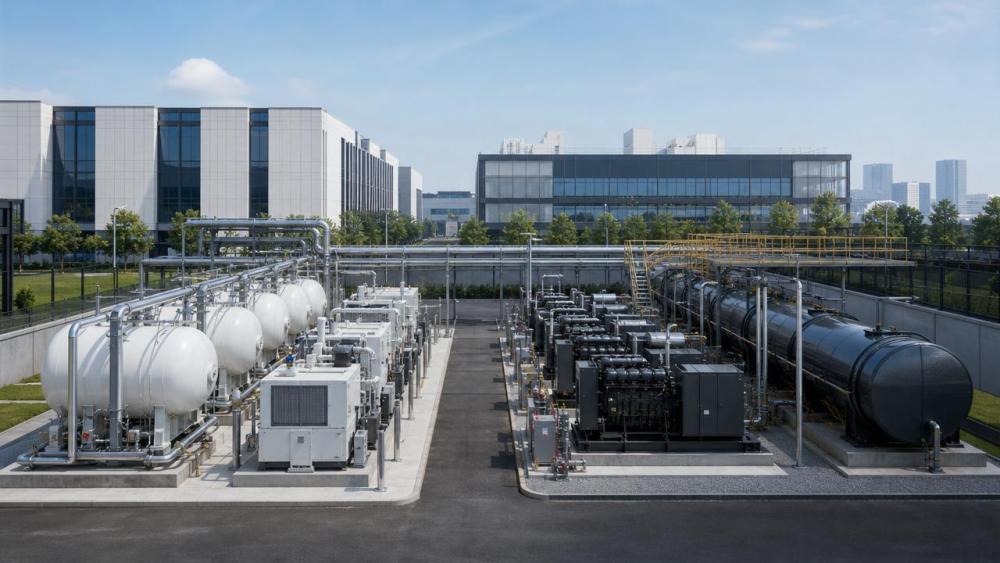
Backup power decisions influence uptime, permits, insurance, carbon reporting, land planning, and utility interconnection for years.
That makes hydrogen energy storage for data centers a systems decision, not only a generator replacement decision.
Diesel costs look straightforward at first.
However, delivery logistics, tank maintenance, emissions controls, testing fuel burn, local air restrictions, and future carbon costs often distort the real total cost of ownership.
Hydrogen systems require more front-end engineering.
But they may unlock lower operational emissions, quieter operation, modular storage scaling, and stronger compatibility with renewable electricity and zero-carbon infrastructure plans.
A checklist approach keeps technical, financial, and regulatory variables visible before capital is committed.
Key points to compare before choosing backup power
- Measure full lifecycle cost, including storage equipment, fuel contracts, delivery risk, preventive maintenance, testing cycles, emissions fees, insurance impact, and end-of-life replacement timing.
- Verify required runtime under actual critical load, not nameplate assumptions, and test whether hydrogen storage or diesel reserves can sustain multi-hour or multi-day outage scenarios.
- Check site constraints carefully, including land use, tank spacing, ventilation, hazardous area zoning, truck access, blast separation, and future expansion options.
- Review response performance, including cold start, transfer speed, black-start capability, power quality stability, and integration with UPS and switchgear architecture.
- Compare fuel supply resilience by examining local diesel delivery reliability versus hydrogen production, storage replenishment, pipeline access, or onsite electrolysis feasibility.
- Quantify carbon and air-quality exposure, including Scope implications, NOx and particulate restrictions, local permitting risk, and future sustainability reporting requirements.
- Confirm safety engineering against recognized frameworks, including hydrogen leak detection, ventilation design, pressure management, and standards such as ASME B31.12 and ISO 19880.
- Model utilization value beyond emergencies, because hydrogen assets may support demand response, microgrids, renewable balancing, or future fuel-cell power applications.
- Assess maintenance realities, including technician availability, spare parts, stack replacement intervals, fuel polishing for diesel, and routine inspection obligations.
- Stress-test total project bankability by reviewing warranty strength, technology maturity, EPC capability, insurer acceptance, and long-term infrastructure adaptability.
Backup power cost: hydrogen versus diesel
Hydrogen energy storage for data centers usually carries higher initial capital cost than diesel.
Storage vessels, compression, fuel cells or hydrogen-ready turbines, controls, and safety systems drive early spending upward.
Diesel often wins on first-cost simplicity.
Engines, tanks, and established service networks are widely available, reducing engineering time and procurement complexity.
But first cost should not be mistaken for lowest long-term cost.
Hydrogen can improve the business case where carbon costs rise, air permits tighten, long-duration storage is needed, or renewable power can feed onsite electrolysis.
The economics improve further when backup assets deliver secondary value.
Examples include microgrid support, peak shaving coordination, campus decarbonization, or integration with broader hydrogen transport and storage networks.
Cost factors that frequently change the result
How the answer changes by deployment scenario
Urban data center campuses
Urban sites often face strict noise and air-permit pressure.
Here, hydrogen energy storage for data centers may gain an advantage if diesel testing emissions or delivery access create operational risk.
The key checks are zoning distance, ventilation design, emergency response coordination, and whether fuel-cell systems meet critical transfer expectations.
Hyperscale greenfield facilities
Greenfield projects can optimize layout from the start.
That improves the case for hydrogen energy storage for data centers because storage, power conversion, and future expansion can be planned as one integrated backbone.
Important checks include renewable power availability, phased capacity buildout, and whether a hybrid design lowers cost while preserving uptime margins.
Remote or grid-weak locations
Remote sites expose delivery chains.
Diesel may appear simple, but flood, conflict, or transport disruption can block replenishment exactly when backup duration matters most.
Hydrogen can become attractive when paired with onsite production, long-duration storage, and renewable generation that cuts dependence on fuel trucking.
Retrofit facilities
Retrofits are usually constrained by footprint and legacy switchgear.
In these cases, hydrogen energy storage for data centers should be screened for enclosure fit, ventilation upgrades, fire code alignment, and outage windows for installation.
Often, a phased hybrid deployment works better than full immediate replacement.
Commonly overlooked issues
Fuel availability is not the same as fuel resilience
A local supplier list does not prove emergency reliability.
Compare contracted priority access, refill time, transport routes, and duration during regional disruptions for both fuels.
Testing regimes can distort annual operating cost
Diesel systems require routine test runs that consume fuel and create emissions.
Hydrogen systems have different verification needs, including leak detection, pressure integrity, and stack condition monitoring.
Safety planning must match hydrogen physics
Hydrogen disperses differently from liquid fuels.
Effective sensor placement, vent paths, material compatibility, and shutdown logic are essential to safe deployment.
Short procurement cycles can create long operational penalties
A faster diesel purchase may solve immediate schedule pressure.
Yet it can lock the site into future permit, carbon, and upgrade costs that outweigh early savings.
Practical execution steps
- Define critical load, target autonomy, and acceptable transfer performance before discussing fuel technology.
- Build a 10-to-20-year total cost model that includes fuel volatility, maintenance, emissions compliance, and retrofit expenses.
- Map site constraints early, especially storage footprint, ventilation, access roads, and authority approvals.
- Evaluate diesel, hydrogen, and hybrid architectures using the same uptime and safety assumptions.
- Require standards-based engineering documentation, including safety cases aligned with recognized hydrogen frameworks.
- Pilot critical subsystems where needed, then scale with phased milestones tied to performance validation.
Frequently asked questions
Is hydrogen energy storage for data centers already practical?
Yes, especially for long-duration backup, low-emission operation, and sites pursuing integrated zero-carbon infrastructure.
Is diesel always cheaper?
Not always.
Diesel is often cheaper upfront, but hydrogen may become more competitive when full lifecycle and strategic value are included.
Should backup systems be fully replaced at once?
Not necessarily.
Many sites benefit from a hybrid path that preserves resilience while validating hydrogen performance and operating procedures.
Conclusion and next actions
Hydrogen energy storage for data centers should be judged against diesel through a full resilience and infrastructure lens.
When only upfront cost is measured, diesel usually leads.
When emissions limits, fuel security, long-duration backup, and decarbonization value are included, hydrogen can become the stronger long-term choice.
The smartest next step is a side-by-side technical and financial assessment using real site loads, real safety constraints, and realistic outage scenarios.
That process reveals whether diesel, hydrogen, or a hybrid architecture delivers the most durable backup strategy.
Related News
- Hydrogen Energy Storage for Data Centers Gets Costly FastApr 27, 2026Hydrogen energy storage for data centers gets costly fast as hydrogen storage, cryogenic liquid hydrogen, safety standards, and utility-scale power needs reshape the energy transition case. Learn the real trade-offs.
- Hydrogen Energy Storage for Data Centers: Backup Power Options ComparedJun 14, 2026Hydrogen energy storage for data centers compared: see how hydrogen, diesel, batteries, and hybrids perform on uptime, emissions, safety, and long-duration backup.
- Energy Storage Battery Sizing: Key Specs That Affect Runtime and CostJun 14, 2026Energy storage battery sizing affects far more than kWh. Learn how DoD, C-rate, efficiency, temperature, and degradation shape runtime, lifecycle cost, and smarter project decisions.
- Industrial Energy Efficiency Upgrades With the Fastest PaybackJun 07, 2026Industrial energy efficiency upgrades with the fastest payback: discover proven ways to cut power loss, reduce downtime, and improve ROI in hydrogen, CCUS, turbines, and cryogenic systems.
Related News
- 00
0000-00
Hydrogen Energy Storage for Data Centers Gets Costly Fast - 00
0000-00
When 99.999% Hydrogen Purity Still Is Not Good Enough - 00
0000-00
When Does a Hydrogen-Ready Gas Turbine Pay Off? - 00
0000-00
Electricity Price Volatility Is Rewriting Hydrogen Cost Models - 00
0000-00
PSA Recovery Rate Drops for Reasons Operators Miss
Dr. Hideo Torque
Weekly Insights
Stay ahead with our curated technology reports delivered every Monday.