Refinery Decarbonization Strategies That Put Hydrogen to Work First




For enterprise decision-makers, refinery decarbonization strategies are no longer optional—they are central to energy security, asset resilience, and long-term competitiveness. This article examines why hydrogen should be deployed first across refining operations, where it delivers the fastest emissions impact, strongest infrastructure synergies, and clearest pathway to sovereign-scale industrial transition.
Why are refinery decarbonization strategies receiving so much attention now?
Refineries sit at the intersection of industrial emissions, fuel security, and national competitiveness. They are already large hydrogen consumers, major heat users, and critical nodes in transport fuel supply chains. That is exactly why refinery decarbonization strategies have moved from a compliance topic to a board-level capital allocation issue. Unlike many sectors that must build a hydrogen demand case from scratch, refining already has embedded use cases in hydrotreating, hydrocracking, sulfur removal, and product upgrading.
For decision-makers, the urgency comes from several converging pressures: tighter carbon policy, rising investor scrutiny, aging process assets, volatile natural gas markets, and customer demand for lower-carbon fuels. At the same time, the hydrogen economy is maturing. Large-scale electrolysis, hydrogen storage, CCUS, and hydrogen-ready turbines are no longer theoretical options; they are becoming integrated infrastructure choices. This makes refineries one of the first industrial environments where hydrogen can be put to work with practical speed and measurable impact.
Another reason these strategies matter is that refineries cannot decarbonize through a single lever. Efficiency projects help, electrification helps in selected units, and carbon capture can reduce major point-source emissions. But hydrogen often delivers the most immediate operational relevance because it fits existing process chemistry. In other words, refining is one of the few sectors where hydrogen-first planning can align emissions reduction with production continuity rather than disrupt it.
What does “put hydrogen to work first” actually mean in a refinery?
In practical terms, a hydrogen-first approach does not mean replacing every refinery energy input with hydrogen overnight. It means prioritizing the decarbonization levers where hydrogen already has process value, infrastructure compatibility, and strategic multiplier effects. Most refineries consume hydrogen produced from steam methane reforming or other carbon-intensive pathways. Replacing that supply with low-carbon hydrogen—whether from electrolysis, paired renewables, or reforming with CCUS—can cut emissions without redesigning the core business model.
This approach typically begins with three priorities. First, decarbonize existing captive hydrogen production. Second, optimize hydrogen networks, recovery, purification, compression, and storage across refinery units. Third, connect hydrogen planning with broader infrastructure decisions such as low-carbon power procurement, oxygen utilization, process heat modernization, and export-ready logistics. These moves turn hydrogen from a single utility stream into a platform for future flexibility.
That distinction matters. Many refinery decarbonization strategies fail to create momentum because they treat hydrogen as one isolated project among many. The stronger model is to view hydrogen as a systems asset. Once low-carbon hydrogen is available at scale, it can support cleaner fuels, enable refinery-petrochemical integration, strengthen compliance positioning, and improve readiness for future market shifts such as sustainable aviation fuel and e-fuels.
Which refinery applications should be prioritized first for the best emissions and business impact?
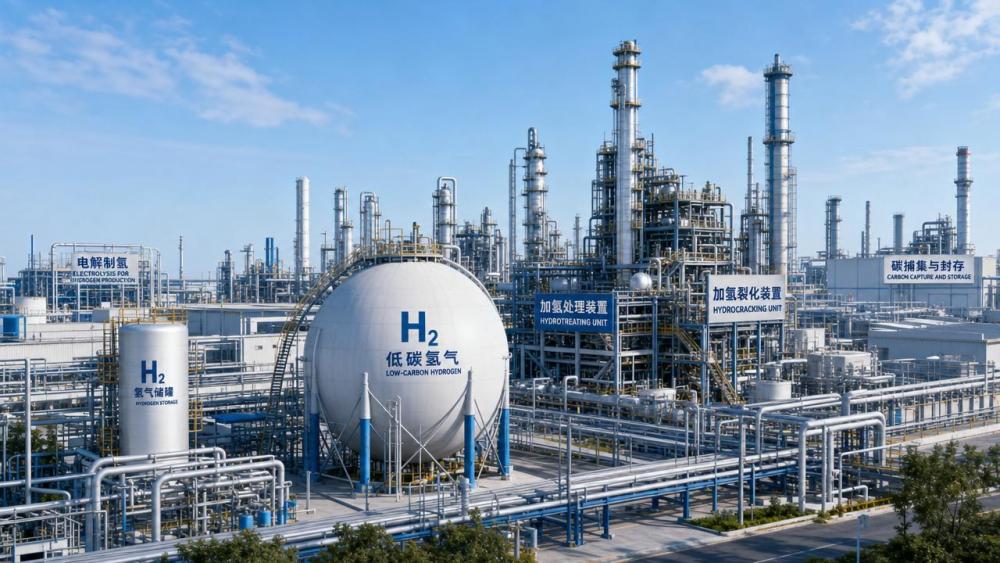
The best refinery decarbonization strategies usually start where hydrogen use is already mandatory, continuous, and material to product quality. This often delivers faster return on decarbonization capital than experimental end uses. A useful prioritization sequence is to focus on applications with high hydrogen intensity, low operational disruption, and strong reporting visibility.
In most cases, hydrotreating and hydrocracking are first-wave targets because they already depend on hydrogen for sulfur removal and molecular conversion. If low-carbon hydrogen substitutes conventional hydrogen here, the emissions benefit can be significant with limited product-market friction. The next step is usually hydrogen network optimization: reducing vent losses, improving purification, balancing pressure, and integrating storage buffers. Many refineries underestimate how much carbon reduction and cost control can come from better hydrogen management before major greenfield spending begins.
After these first steps, companies can evaluate whether hydrogen should also support process heating, power resilience, or adjacent low-carbon fuel production. Those later applications can be valuable, but they often require stronger infrastructure maturity and a clearer business case. For enterprise leaders, sequencing is critical. Hydrogen should first replace the dirtiest existing hydrogen and strengthen the refinery’s operational backbone before it is stretched into less proven uses.
Quick judgment table: where should leaders start?
How should enterprise leaders compare electrolysis, CCUS-based hydrogen, and hybrid pathways?
This is one of the most important questions in refinery decarbonization strategies because the wrong pathway can lock in avoidable cost or delay. Electrolysis is attractive where low-carbon electricity is abundant, power market structure supports industrial procurement, and energy security goals favor domestic hydrogen production. It can be especially powerful when paired with modern storage, advanced compression, and strict standards for material integrity and safety.
CCUS-based hydrogen may be the better near-term choice where existing reforming assets are large, carbon transport and storage are available, and speed matters more than full redesign. For some refinery operators, this route provides a pragmatic bridge because it leverages installed equipment while reducing lifecycle emissions. However, the capture rate, methane intensity, and permanence of CO2 storage must be examined closely. A low headline cost is not the same as durable strategic value.
Hybrid models are often strongest. A refinery may decarbonize current hydrogen through CCUS in the near term while building electrolysis capacity for future growth, resilience, and sovereign supply diversification. This layered strategy reduces transition risk. It also aligns with how major industrial systems actually evolve: through phased integration, not absolute replacement in a single investment cycle.
For senior decision-makers, the comparison should not be framed only as levelized hydrogen cost. It should include grid reliability, water strategy, export potential, permitting complexity, standards compliance, lifecycle emissions, and future flexibility. The best choice is the one that strengthens long-term operating optionality while meeting near-term decarbonization targets.
What are the most common mistakes companies make when building refinery decarbonization strategies?
A frequent mistake is treating refinery decarbonization as a generic ESG exercise instead of a process-specific transformation program. Refineries are highly integrated systems. Changes in hydrogen sourcing affect utilities, emissions accounting, reliability, maintenance schedules, and product economics. If teams work in silos—operations, sustainability, procurement, engineering, and finance each following separate assumptions—the result is often a weak roadmap.
Another mistake is starting with symbolic projects rather than high-impact ones. Pilots can be useful, but enterprise leaders should ask whether a project addresses a core emissions source, scales within existing assets, and improves strategic positioning. Installing a small showcase electrolyzer may create visibility, but replacing high-volume carbon-intensive hydrogen supply often creates more real value.
Underestimating infrastructure requirements is another major risk. Hydrogen projects are not only about production units. They require rigorous attention to pipelines, storage conditions, compression systems, metallurgy, leak detection, refueling interfaces where relevant, and codes such as ASME B31.12 or ISO 19880 in connected systems. Inadequate preparation here can undermine safety, uptime, and financing confidence.
Finally, many companies use short-term fuel price assumptions as the main investment filter. That may distort decision quality. Refinery decarbonization strategies should be assessed through a wider lens: carbon exposure, asset life, market access, geopolitical resilience, and the ability to integrate into a broader hydrogen economy. Boards that think only in annual commodity cycles may miss the strategic value of transition infrastructure.
What should decision-makers evaluate before approving a hydrogen-first roadmap?
Before committing capital, leadership teams should validate whether the refinery has a credible hydrogen baseline. That includes current production routes, purchased volumes, purity requirements, pressure levels, storage constraints, losses, and use by unit. Without this map, it is impossible to rank opportunities correctly. Good refinery decarbonization strategies are built on operational data, not assumptions.
The next checkpoint is infrastructure readiness. Can the site absorb electrolyzer output profiles? Is there access to renewable or low-carbon power? Are there water treatment implications? Can existing pipelines, vessels, and compressors support higher hydrogen throughput? Does the site have a practical route for captured CO2 if a blue hydrogen pathway is considered? These are not secondary engineering questions; they shape the commercial viability of the program.
Leaders should also evaluate standards and bankability. Large industrial hydrogen investments need confidence in safety frameworks, material compatibility, procurement specifications, and lifecycle performance benchmarking. This is where technical repositories and benchmarking institutions matter. They help buyers compare electrolyzer technologies, storage systems, cryogenic logistics options, turbine integration potential, and compliance expectations across the zero-carbon value chain.
A final screening lens is organizational readiness. Does the company have a decision structure that links process engineering, decarbonization strategy, treasury, risk, and government affairs? If not, even a technically sound hydrogen-first pathway may stall. Refinery transformation requires coordinated governance, not isolated project sponsorship.
How can a refinery turn hydrogen-first planning into a practical phased program?
A realistic rollout usually follows three phases. Phase one is diagnostic and optimization: build the hydrogen balance, identify avoidable losses, benchmark emissions intensity, and review asset integrity. Phase two is substitution and integration: replace carbon-intensive hydrogen, add storage and compression upgrades, and connect hydrogen strategy with power and CCUS decisions. Phase three is strategic expansion: use the refinery as a platform for low-carbon fuels, regional hydrogen logistics, and industrial cluster participation.
This phased model is effective because it balances urgency with discipline. It delivers visible progress early while preserving optionality for later technology choices. It also allows enterprises to align capital spending with policy support, infrastructure development, and off-take evolution. In many cases, the most durable refinery decarbonization strategies are not the most aggressive on day one—they are the most coherent over ten years.
For executives, the central takeaway is simple: hydrogen should be deployed first where the refinery already depends on it, where carbon intensity is highest, and where infrastructure improvements compound future value. That is how decarbonization becomes an operating advantage rather than a compliance burden.
What questions should you raise next if you want to assess a specific solution or partner?
If you are moving from strategy to execution, begin with focused questions. Ask how the proposed solution changes your refinery’s hydrogen carbon intensity, what standards govern materials and safety, how supply reliability is maintained during transition, and what infrastructure upgrades are mandatory versus optional. Confirm whether the provider can benchmark electrolyzer systems, storage, CCUS interfaces, and hydrogen-ready power integration against recognized frameworks.
You should also ask about implementation timing, permitting dependencies, expected efficiency under real refinery operating conditions, and how the roadmap scales from pilot to enterprise level. For boards and investment committees, the most useful conversations are not about technology claims alone. They are about transition sequence, asset security, lifecycle economics, and how refinery decarbonization strategies connect to long-term energy sovereignty. If you need to confirm the right direction, parameters, timeline, cooperation model, or evaluation framework, those are the first issues to put on the table.
Related News
- Are Clean Energy Solutions Cost-Effective in Manufacturing?Jun 17, 2026Clean energy solutions for manufacturing cost-effective? Explore how hydrogen, electrolysis, and CCUS compare by uptime, fuel risk, and compliance to find the smartest path.
- How to Choose Industrial Fans for High-Temperature Production AreasJun 07, 2026Industrial fans for high-temperature production areas: learn how to match fan type, materials, safety, and efficiency to reduce downtime and improve reliable thermal control.
- Refinery Decarbonization: Where Hydrogen Cuts Emissions FirstMay 23, 2026Refinery decarbonization strategies start where hydrogen cuts emissions fastest—hydrotreaters, hydrogen plants, heaters, and boilers. See the practical checklist for lower carbon with less disruption.
- Industrial Hydrogen for Green Steel: Burner Retrofit Risks and Performance TradeoffsMay 22, 2026Industrial hydrogen for green steel: learn the real burner retrofit risks, NOx, refractory, safety, and throughput tradeoffs before committing capex.
Related News
- 00
0000-00
Hydrogen Energy Storage for Data Centers Gets Costly Fast - 00
0000-00
When 99.999% Hydrogen Purity Still Is Not Good Enough - 00
0000-00
When Does a Hydrogen-Ready Gas Turbine Pay Off? - 00
0000-00
Electricity Price Volatility Is Rewriting Hydrogen Cost Models - 00
0000-00
PSA Recovery Rate Drops for Reasons Operators Miss
Dr. Hideo Torque
Weekly Insights
Stay ahead with our curated technology reports delivered every Monday.